



Garden: in autumn, whitewash trunks to protect trees and prevent disease
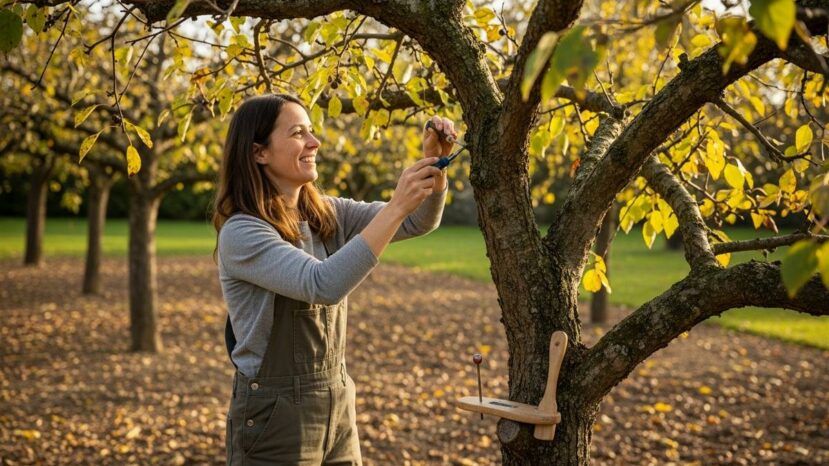
In autumn, a simple gesture can prevent many diseases in the heart of your garden. Temperature variations,
The key autumn gesture for healthy trees in the garden
The principle is straightforward: clean the bark and then apply an arboricultural whitewash, often called limewash. This whitewash sanitizes the surface of the trunk and inhibits the survival of larvae, eggs and spores. It also regulates thermal shock between winter sun and night frost. As a result, bark wounds are reduced and spring recovery in the garden is improved.
This treatment is aimed primarily at fruit trees and young, still-sensitive plants. Apple, pear, plum and cherry trees, as well as many ornamental hardwoods, are targeted. On the other hand, conifers and very thin
Why this treatment changes everything for your garden as soon as the first frosts arrive
Autumn offers an ideal window of opportunity: sap slows down and the bark lends itself to brushing. Then, the whitewash limits the hibernation of aphids, mealybugs and mites on the trunks. What’s more, the clear coating reflects the sun and limits frost cracks. As a result, many infections are avoided when spring returns.
“
Lime whitewash in autumn blocks parasites and spores before winter.
Tree whitewash is available ready-to-use, but you can also mix it yourself. You can combine slaked lime, clay and water to obtain a fluid, non-slumping texture. However, over-aggressive dosages should be avoided to prevent burning the bark. Many gardeners are now opting for clay-enriched versions for a gentler action.
Step-by-step instructions: preparing, brushing, brushing in the garden
First of all, protect your hands and eyes, then clear the base of the tree. A soft brush is then used to remove any debris, without damaging the cambium. In short, this is a superficial, precise and patient cleaning. Finally, if the trunk is damp, let it dry.
- Choose a rain-free, frost-free day
- Brush from bottom to top without scratching the bark
- Preparing a cream-textured whitewash
- Apply to trunks and lower timbers
- Check after rain and touch up if necessary
Brushing reveals old, scaly areas where eggs and fungi nest. This allows the next layer to adhere better and last longer. What’s more, we take the opportunity to remove mummified fruit and dead twigs. As a result, the focus of infection around the tree is reduced.
Next, limewash is applied with a broad brush, in even, criss-cross strokes. The trunk is covered from the collar to the first buds. The aim is to achieve a thin but covering layer, without dripping. If it rains quickly, apply another light coat as soon as it’s dry.
Practical questions: when, with what and on which trees in the garden
Fertigilene – Insecticide polyvalent (Elimination of aphids, mealybugs, mites; €9.90)[3] can complement this preventive care in the garden.
Use it in accordance with the instructions, then give preference to whitewash to limit pressure in winter.
The period runs from November to February, excluding frost and persistent rain. It’s best to intervene after leaf fall and before the coldest weather. On young trees, protect without weighing down, and renew if necessary the following year. On older trees, however, a repeat treatment every two or three years is often sufficient.
Sustainable protection: prevention, useful wildlife and safety
This gesture does not replace orchard hygiene. Pick up diseased leaves (scab, rust) and remove mummified fruit. What’s more, we avoid composting this waste when infection is high. As a result, we reduce the amount of inoculum that returns in the spring.
Glue strips can be applied to the trunks to prevent crawling insects. Light mulching stabilizes humidity and protects roots from the cold. Also, watering before frost helps young plantations. This simple routine improves the garden’s resilience over winter.
Encouraging biodiversity completes the strategy. Chickadees, ladybugs and lacewings naturally regulate many pests. What’s more, we choose a bark-friendly whitewash and wear gloves and goggles. In short, reasoned, discreet care, repeated at the right time, builds stronger trees for the following season.



No comments
Post a comment
Always participate in accordance with the law and with respect for others.