



Paris weather: when was the last snowy Christmas in the Paris region?
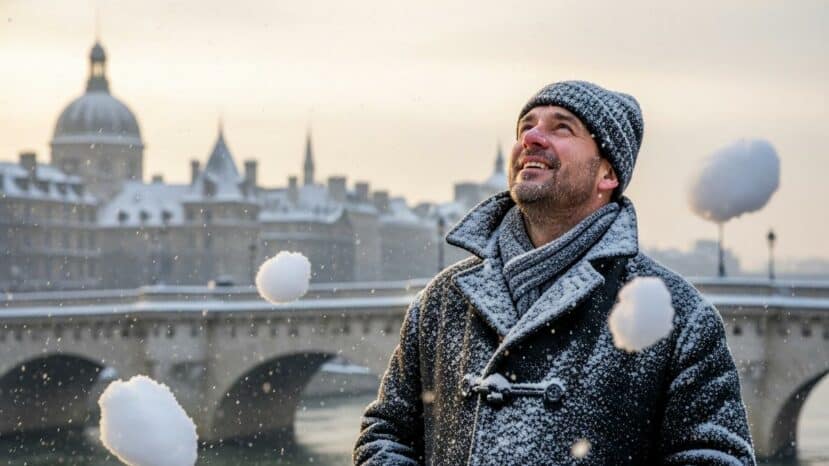
In Paris, the question comes up every winter: will we have a white Christmas? The weather gives us hope, but the archives tell a different story. Here’s what we know, and how to prepare without stress.
White Christmas in Paris: what recent archives have to say
Public records and local chronicles point to rare white Christmases in the capital. According to data consulted by the editorial team, the last occurrence of snow on December 25 in the metropolitan area dates back to 2010. In Paris intra-muros, the tracks were weak and uneven, and the layer didn’t hold everywhere. This fact, confirmed by the weather at the time, is a reminder of the considerable variability from one district to another.
For a truly snowy Christmas in the heart of the city, we have to go back further. Several archives cite the winters of the
December 2010 left its mark with several notable pre-holiday falls. However, on the 25th, milder air circulation limited the amount of snow on the ground in many arrondissements. In the inner suburbs, a few
“In Paris, a truly white Christmas is more the exception than the rule.
Why snow is so rare on December 25
The contrast comes from geography and the city itself. The urban heat island raises temperatures by one to 2°C at night, so snow melts quickly. What’s more, the oceanic influence often brings mild spells between two cold spells. The weather then shifts to rain at the slightest degree gained.
For snow to last at Christmas, three ingredients have to coincide. You need cold air at altitude, sufficient humidity, and a temperature close to 0°C on the ground. A light wind also helps the layer to form. Without this trio, Parisian weather reverts to rain.
- Cold soil increases the resistance of the first few centimetres.
- A light wind limits erosion of the ground layer.
- Sufficient humidity guarantees dense flakes.
- A brief thaw may cause the weather to change to rain-snow.
- Micro-reliefs sometimes create differences of 1 to 2°C.
What can we expect this year, on the right scale?
Snow forecasting is a tricky business when you’re looking several days ahead. Models still change a lot between D-5 and D-2, so reliability climbs late. A cold signal may appear and then fade as the runs progress. It’s best to follow the local weather forecast during Christmas week.
In the field, two thresholds guide the reading. When the air at 850 hPa falls towards -5°C, the probability of flakes increases in lowland areas. On the other hand, mild ground after a period of mild weather means that the first shower will melt away. The morning weather forecast may change in the afternoon.
Local residents know all about it. The same disturbance sometimes brings rain in the west and flakes in the east. Also, the light altitude of the hills to the east of Paris is conducive to stealthy local weather. Keep an eye on hourly temperatures and wind.
Practical tips for happy holidays, with or without snowflakes
Anticipate your travel plans, especially in the evening. If there’s a risk of snow, leave earlier and check the traffic forecast. In addition, opt for shoes with notched soles. An umbrella is also useful, as heavy snow quickly gets wet.
At home, think of the sidewalks. Salt or sand limits slipping in front of the driveway, so passageways remain safe. On the other hand, avoid using hot water on frost, as it will refreeze. A headlamp also helps when you’re coming home late.
History and climate in Paris
Winter 2010 disrupted airports and buses well before Christmas. In Paris, traffic was complicated around December 8-10, then again around the 15th. After that, the thaw limited the extent of the ice patches. This sequence illustrates how the weather can change over the course of a few days.
In the second half of the 20th century, a number of cold snaps left their mark on people’s minds. The winters of 1962-1963 and 1985-1987 come to mind, but December 25 has not always coincided with a snowy episode. The collective memory retains the bright decor and the photos. The weather reports of the time were less accurate.
In Paris, there’s a clear thermal gradient between the center and the suburbs. For example, a 1 to 3 cm layer of snow may hold in Montreuil or Saint-Denis, but quickly disappear in the heart of the boulevards. On the other hand, a clear night can bring frost to the heart of Paris. The timing of the disturbed passage counts as much as the intensity.
What signals to watch out for in the days leading up to Christmas
Watch the temperature trend at daybreak. If the 0°C threshold is reached several mornings, it becomes plausible that it will hold, and the risk of icy conditions increases. So adapt your travel schedules if an episode is forecast. Be especially vigilant on bridges and shaded sidewalks.
Follow the precipitation maps hour by hour. A 50 km misaligned active band is enough to change the outcome, so a time lag can make all the difference. On the other hand, don’t panic if the first scenario is rainy. So let’s keep a regular weather watch, without jumping to conclusions.
Everyday issues and useful little gestures in town
For families, the organization of meals is just as important as the atmosphere. That’s why having a plan B for transportation reduces stress for guests. What’s more, a simple entrance mat prevents water and salt from spoiling the floor. The weather doesn’t get in the way of a party when the logistics follow.
Neighborhood merchants scan the sidewalk in the wee hours of the morning. An unobstructed ramp and a bucket of sand make all the difference, but cleaning too late reduces footfall. A notice in the window informs vulnerable customers. An eye on the weather application helps to schedule deliveries.
For sports enthusiasts and walkers, common sense remains the rule. Gloves, hats and warm socks keep the heat in, so outings remain pleasant. That’s why you should opt for open parks and salty paths. And if a front passes, the weather can change in less than an hour.




No comments
Post a comment
Always participate in accordance with the law and with respect for others.