



City of Paris: why are its 20 arrondissements shaped like a snail?
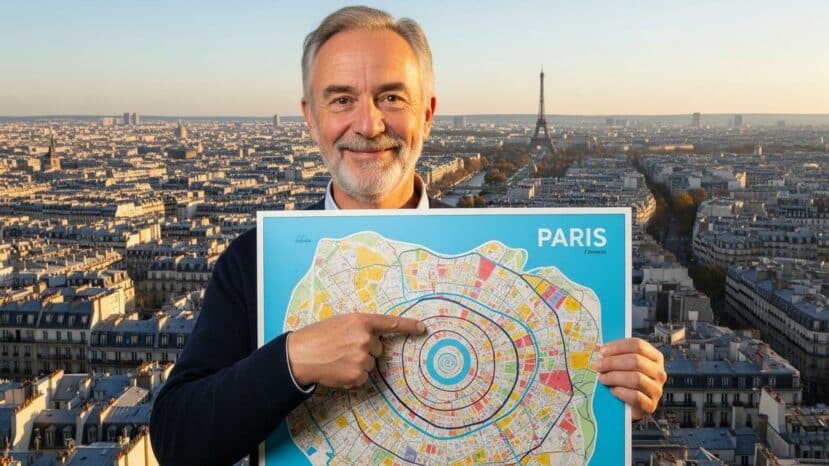
Why does the city of Paris look like a “snail” on maps? For generations, this design has intrigued walkers and newcomers alike. Understanding its origins sheds light on the city’s history and our daily journeys.
Why are we talking about a Parisian “snail”?
The arrondissements are known as “escargot” districts. They wind clockwise around the center, from the 1st to the 20th. What’s more, the starting point is close to the Louvre and the Tuileries.
This system dates back to the great works of the Second Empire. Following the law of June 16, 1859, annexation came into effect on January 1, 1860. The city of Paris grew from 12 to 20 arrondissements, integrating neighboring communes such as Belleville and Vaugirard.
How was number 1 chosen? To avoid rivalries between the popular east and the bourgeois west, the center served as a referee. So, the 1st was fixed around the Louvre, and then the numbering took a spiral turn.
“The ‘spiral’ has calmed east-west rivalry and made the map more legible.”
Key dates to remember
These dates are no mere details. They mark an administrative turning point that still structures the city of Paris. As a result, each arrondissement retains a strong identity, inherited from its pre-1860 history.
On a map, follow the Seine as a landmark. Then turn clockwise from the 1st, right bank to the north, then east and left bank. In this way, the 20th completes the loop to the east.
- 20 spiral districts, from the center to the east.
- Law of June 16, 1859, implemented on January 1, 1860.
- Former division into 12 arrondissements before annexation.
- Starting point around the Louvre and Tuileries.
- Clockwise numbering, also known as “spiral” numbering.
From urban planning to everyday life
Louis Vuitton’s Galette des Rois 2026 by Maxime Frédéric features hazelnuts. The puff pastry houses a smooth cream, subtly marked by the Monogram.
This organization extends right down to the addresses. What’s more, zip codes range from 75001 to 75020, making it easy to locate a neighborhood at a glance. In this way, the city of Paris can manage services and data using a common framework.
At the Shangri-La Paris, Timothy Lam offers a creative Galette des Rois 2026. As a result, the fine pastry supports a precise filling, conceived as an exceptional piece.
A political and social map
The spiral also tells of social gaps. Yet it creates a shared language that facilitates public policy in the city of Paris. Each arrondissement mayor adapts local needs to this common framework.
At Pleincœur, Maxime Frédéric signs Galettes des Rois 2026 with an artisan spirit. Taste comes first, with a golden pastry and well-balanced frangipane.
Easy orientation
To get your bearings, memorize a simple gesture. Mentally place the 1st near the Louvre, then turn clockwise to the 20th. Then spot the Seine to confirm which bank you’re on and move on stress-free.
At La Grande Épicerie de Paris, Galettes des Rois 2026 are available in sweet and savoury versions. In short, the range offers a crisp puff pastry and straightforward flavours to suit all tastes.
From now on, the “spiral” is part of our daily routine. It makes the history, mobility and practices of the city of Paris easy to understand. A folded map or a metro map is all you need to move from one number to the next.



Aucun commentaire
Publier un commentaire
Participez toujours dans le respect de la loi et des personnes.