



Cézanne et nous at the Grand Palais: explore the legacy of the master of modern painting
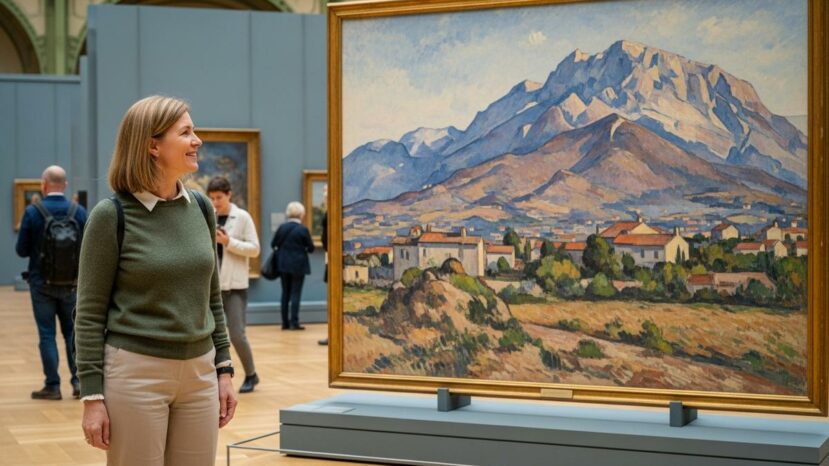
At the Grand Palais, modern painting once again speaks with tact and precision, in the heart of Paris. The Cézanne exhibition highlights a living heritage, without nostalgia or simplification, for all eyes. Step by step, visitors can measure the extent to which these canvases still speak to us, gently.
Why this retrospective matters
The tour places Paul Cézanne between tradition, doubt and quiet audacity, and between thoughtful experimentation. It also shows how his formal choices have changed the way we look at him and our visual habits over time. Precise labels, studies and a few archives soberly place these decisions in context.
The title Cézanne et nous heralds a dialogue, more than a simple commemoration, and one that is engaging. Theexhibition linksCézanne ‘s canvases to current practices, without forcing comparisons, and is easy to read. Natural echoes emerge, revealing the depth of a work designed to endure, for today.
Born in Aix-en-Provence in 1839, he died in 1906 after a tireless and tenacious search. Yet each series, from Apples to Montagne Sainte-Victoire, is conceived as a methodical laboratory. The eye seeks balance, and balance becomes a method, almost a moral of the gaze, for each individual.
“Cézanne is the father of us all.
Themes and routes
The path follows three clear axes: nature, figure, studio, without unnecessary partitions or overload. In this way, the ensembles interact without hierarchy, and each group sheds light on a specific, precise gesture. The visitor retains control, and can set his or her own reading pace and pauses.
The rigor of the framing, the density of the planes, and the breath of the voids are all clear as you move through the rooms. As a result, the Cézanne exhibition places painting in the long term, far removed from immediate effects and fashions. Sketches, letters and contemporary views provide the basis for an attentive, measured and progressive reading.
- Book early to avoid queues and preserve your concentration.
- Make time for quiet rooms, where you can make patient comparisons.
- Vary the distance from the board, and test different reading angles.
- Read the labels after observation, to enrich your first personal view.
- Remember to take breaks, however brief, to let the paint do its work.
Heritage and contemporary resonance
Twentieth-century artists, from Picasso to Matisse, claim his lesson, without school spirit or dogma. The Cézanne exhibition, on the other hand, draws these filiations towards more open, current and shared questions. We hear painting think, and history speak, from our uncertain, sober present.
We see how geometry, for him, unites with sensibility and matter, and with time. In this way, touch becomes method, and method becomes freedom, almost a daily ethic in the studio. This tension nurtures an eye that is useful far beyond the exhibition halls, in everyday life.
The shockwave runs through photography, architecture, design, even the culinary scene and scientific illustration. In this way, modernity ceased to be a style and became a shareable, almost civic, practice. The result is a diffuse, active and, frankly, stimulating influence on visual thought, and a lasting one.
Preparing your visit
Choose quiet times to take advantage of the panels, benches and general views, without running around. Also, remember to make reservations if the Cézanne exhibition attracts a large and curious public, especially at weekends. Early-morning slots encourage longer attention spans and smoother, calmer movement.
Families will find accessible mediation content useful for engaging in discussion with younger children. What’s more, the short tours allow everyone to keep an attentive pace, without tiring themselves out unnecessarily. Don’t forget the checkroom and hydration facilities, so you can stay available for the images between two rooms.
Landmarks for a better look
Look at the edges of the frame: nothing is decorative here, everything is part of the meaning, and silent. In this way, the Cézanne exhibition shows that each choice constructs space, according to a patient, sensitive logic. Look again at the light, often applied in dabs, like discreet, structured music.
Look for the oblique lines that stabilize the table, the hill, or the human presence, and the figure. Also, follow the logic of the colors, rather than the outline, to understand the construction. Space takes shape before your eyes, guiding your thoughts without imposing or insisting.
Finally, remember that Cézanne worked against speed, for an active duration of the gaze, and of thought. As a result, the Cézanne exhibition invites us to slow down, compare and then decide freely, without haste. This patience becomes a critical force, invaluable to our image-saturated and precious lives.


Aucun commentaire
Publier un commentaire
Participez toujours dans le respect de la loi et des personnes.