



Notre-Dame de Rouen Cathedral: a once-in-a-lifetime Gothic masterpiece 1h30 from Paris
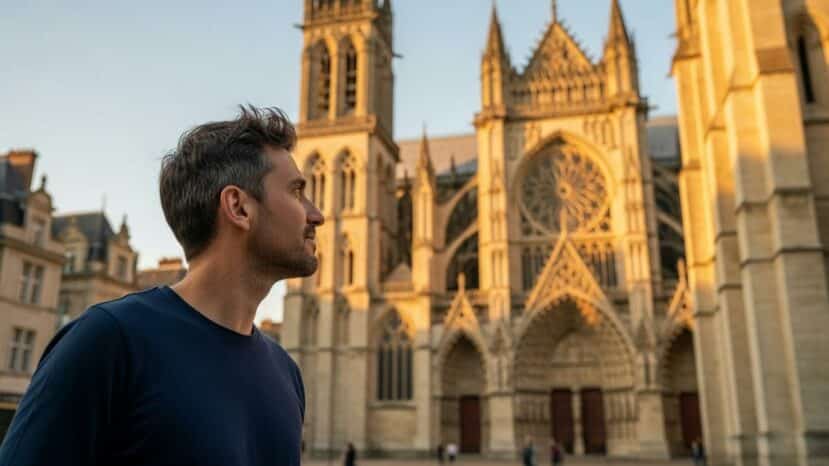
Rouen’s Gothic cathedral captures the eye and the memory. Its vibrant facade, towers and spire tell the story of eight centuries of audacity. We return to feel the link between stone, light and history.
A monument with many faces
Begun in the 12th century and completed in the 16th, the Gothic cathedral blends primitive élan with flamboyant lacework. The west facade features sculpted decoration of rare finesse. The Saint-Romain and Beurre towers mark two ages and two visions.
In the center, the cast-iron spire rises to 151 m, a landmark visible from afar. It was also the world’s tallest building around 1876-1880. As a result, Rouen is now part of the great European chronology.
Carved details, towers and spire
To the north, the Portail des Libraires (Booksellers’ Portal) is a reminder of the old neighborhood of shops. In this Gothic cathedral, the Portail de la Calende depicts biblical scenes. Each entrance offers a different reading path.
“Between stone and light, Rouen creates a dialogue between memory and the present.
Inside, the nave rises in a cluster of slender pillars. Yet the light remains soft, thanks to the 13th-20th-century stained glass windows. Stop by the recumbent heart of Richard the Lionheart and the tomb of Rollon.
Summer lights and the memory of centuries
Every summer, a night-time show dresses the Gothic cathedral in narrative colors. Viking” and “Impressionist” paintings enliven the west facade. The free show brings families, neighbors and travelers together at dusk.
- Spire at 151 m, the highest in France
- Monet series: over 30 paintings
- Twin towers: Saint-Romain and de Beurre
- Free summer show, “Vikings” and “Impressionism” themes
- Relics: heart of Richard the Lionheart and tomb of Rollon
Rouen has lived through fires, storms and wars. In addition, the bombings of 1944 wounded stones and stained-glass windows. Restoration work is now underway to make history legible, without erasing its scars.
Facing the façade, Claude Monet painted over 30 canvases. He also changed his angle depending on the time of day, to capture the living motif. As a result, the series turned Rouen into a laboratory of light.
All around, medieval streets lead to the Gros Horloge and timber-framed houses. On the other hand, the square remains airy, allowing the Gothic cathedral to breathe. Sit back, listen to the bells, watch the shadows.
Monet, colors and modernity
The projections interact with Monet’s palette. Cool blues follow crepuscular golds. Now, the digital image revives a centuries-old motif.
To photograph, arrive a little early and stabilize the camera. Also, a side angle reveals the relief of the statues. In short, respect your neighbors and the church services: beauty grows with discretion.
Preparing your visit to Rouen
From Paris, the train takes around 1 h 20 to Rouen. The station is just a 15-minute walk from the Gothic cathedral. In the evening, you’ll need a warm layer, depending on the wind from the Seine.
For lighting, aim for the golden hour before the show. What’s more, some chapels may be temporarily unavailable due to mass or construction work. Please ask reception for opening times.
The access features steps and old cobblestones. On the other hand, flatter areas line the square for strollers. You’ll need headphones for sound-sensitive children.
Extend your visit with onion soup or farmhouse camembert, as you wish. In this way, taste prolongs the visit and fixes the memories. The Gothic cathedral then accompanies the evening, like a discreet lighthouse.



No comments
Post a comment
Always participate in accordance with the law and with respect for others.