



Beaubourg 1971 competition unveils architectural designs for the Centre Pompidou: free exhibition in Paris
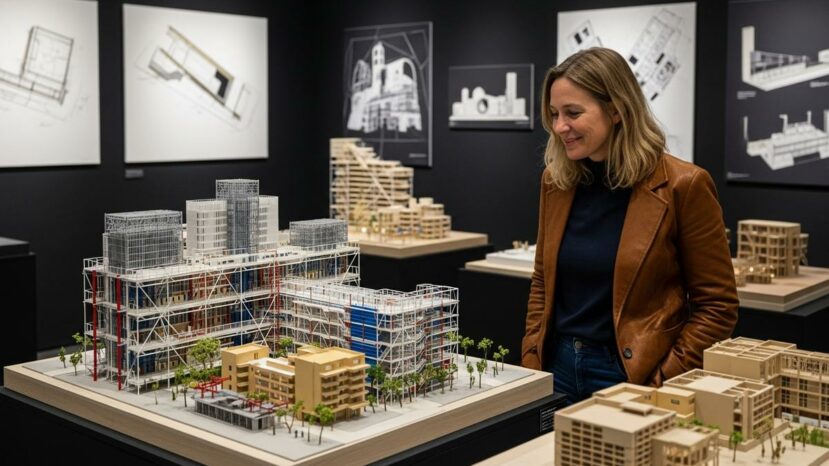
In the heart of Paris, a free exhibition sheds light on the competition that shaped Beaubourg. You can follow, step by step, the birth of a now-familiar architectural gesture. In this way, the history of a cultural symbol is made accessible to all, regardless of price.
Why this free exhibition is important for Paris and its visitors
In 1971, an international competition reinvented the public square and culture in Paris. In addition, the future Pompidou Centre brought together art, reading, research and the city in a single project. From then on, the exhibition places this founding moment at the center of an accessible and lively narrative.
It shows how a call for tenders becomes a political and social choice. The tour also explains the criteria, debates and biases that guided the decision. As a result, everyone can appreciate the role of citizens and teams in a major urban project.
Beaubourg projects: archives, models and key images
You’ll see competition boards, models and carefully reproduced period photos. In short, the scenography brings documents and visitors closer together, to encourage active curiosity. This free exhibition reveals forgotten paths, daring ideas, and very contemporary echoes.
“Seeing architecture search for itself, then become clearer, changes the way you walk through the city.”
Famous and lesser-known names return, with their visions and limitations. The Renzo Piano and Richard Rogers tandem, for example, stands out for its open, legible and evolving proposal. Other projects, on the other hand, are strong landmarks, sometimes majestic, but less permeable to neighborhood life.
What you’ll see and how to prepare your visit
The narrative progresses in clear stages, from the call to the final choices. Short, jargon-free labels provide reassurance for families, students and the curious. Historical landmarks place Beaubourg in the context of Paris in the 1970s, before it opened in 1977.
- Models and reproductions of the finalist projects, with summary highlights.
- Focus on the concept of the piazza, a free, urban space.
- Documents on the jury’s decision and its announced criteria.
- Technical tips on the “legible” facade and its color codes.
- Chronology of the project from start to finish.
Allow yourself some quiet time, as the eye gains from comparing solutions. This way, you’ll better understand why certain options have gone the distance in this free exhibition. As a result, a relaxed visit allows you to align your gaze, then refine your own opinion.
The materials are designed for a variety of audiences, with clear texts and sharp images. What’s more, the trails can be read effortlessly, even standing up at children’s height. Legends in French and, depending on the section, in English, facilitate shared reading.
Accessibility, budget and practical tips
Access is granted within the site’s usual reception area, subject to security control. This means you can enter the dedicated areas freely, with no need for special tickets or complex procedures. In short, free admission removes a barrier, especially for spontaneous visits in uncertain weather.
Students, teachers and creative teams find here a precise and stimulating case study. What’s more, the material can be used as the basis for dissertations, workshops and seminars, with no entry fees or logistical barriers. As a result, the example feeds the analysis, as the free exhibition concentrates archives, benchmarks and pedagogy.
Urban memory and the future: what can we learn from the 1971 competition?
We can see how public commissioning has responded to changing uses. In this way, the large open square, open circulation and shared culture become civic levers. As a result, the project continues to fuel debates on the permeable, lively and hospitable city.
The lessons we’ve learned can be summed up in a few simple, lasting ideas. The flexibility of the floors, the legibility of the paths and the technical modularity remain reliable benchmarks. Consequently, the color codes and apparent structure speak of orientation, maintenance and sobriety of use.
To look at these documents is to adjust one’s view of contemporary architecture. In short, you get a better idea of what’s in dialogue with the street, and then with time. In this way, everyone emerges equipped to read Paris, and to accept the invitation of this free exhibition.


Aucun commentaire
Publier un commentaire
Participez toujours dans le respect de la loi et des personnes.