



Île du Nohic: this secret islet in Morbihan is home to a blue-shuttered house steeped in 130 years of maritime history.
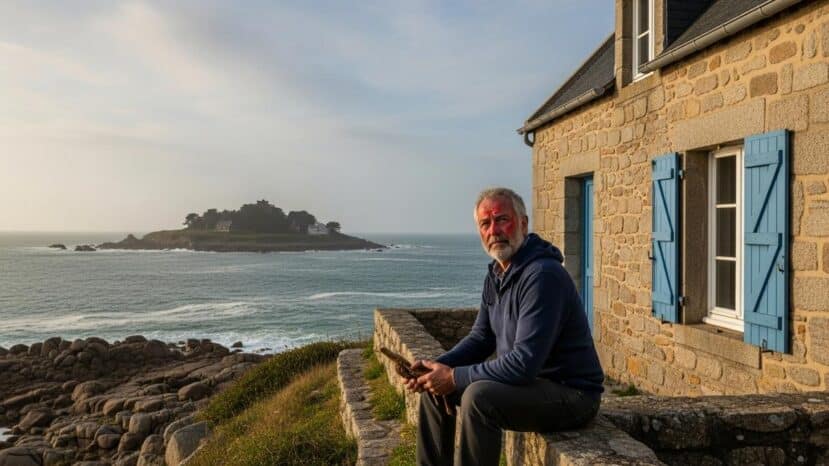
In the heart of the ria d’Étel, in Morbihan, a Breton islet of just 380 m² shelters a house with blue shutters that intrigues walkers. This unspoiled spot, known as Nohic Island, tells the story of over 130 years of maritime life. Yet few travelers are aware of its existence and unique history.
A tiny rock in the middle of the Morbihan waters
The Breton islet of Nohic lies off the coast of Plouhinec, on the south coast of Brittany. Its surface area is no more than 380 m² of tide-beaten rock. Oyster beds once stretched as far as the eye could see.
An oyster farmer named Stéphan obtained his concession in 1892. The following year, in 1893, he had a house built to house the janitor in charge of guarding the beds day and night. At the time, this Breton islet served primarily as a workstation, well before attracting the curious.
The building measures just 42 m² and consists of a single room. A fireplace, a few pieces of furniture and the bare essentials enable the janitor to live on site. His family sometimes joins him, adjusting their boat trips to the rhythm of the tides.
“Witness to the history of oyster farming
A harsh life punctuated by oysters and the seasons
Life on this Breton islet remains difficult, especially during the winter months. The janitor watches over the oyster beds tirelessly, whatever the weather. This simple existence sustained several generations of oyster farmers until 1955.
From these decades spent on the rock, stories of austere daily life remain. The care of the oysters and the protection of the oyster beds occupy every day. In this way, the little house with its blue shutters becomes the silent witness to a know-how handed down from father to son.
- Island surface: 380 m² of rocks
- House size: 42 m² in one room
- Concession obtained by Stéphan in 1892
- The house was built in 1893
- Last inhabitants to leave in 1955
The abandonment and rebirth of a maritime heritage
After the last inhabitants left in 1955, the house on this Breton islet remained empty for decades. Wind, salt and storms gradually damaged the walls. The roof collapsed and the blue shutters disappeared under the onslaught of time.
In 2013, a group of Plouhinec residents decided to save this heritage site. They created the Île du Nohic association with a clear objective: to restore the building to its original state. The Conservatoire du littoral and the Fondation du Patrimoine support the project.
Over 300 volunteers, craftsmen and patrons took part in the work. Granite masonry, oak framing and the laying of slates are bringing the little house back to life. Every detail respects the original architecture to preserve the authenticity of the site.
Inauguration and enhanced protection
The work was completed in 2017 after several years of collective effort. The restored house on this Breton islet was inaugurated on May 21 of the same year. It then came under the protection of the Conservatoire du Littoral to guarantee its preservation.
The building is not open to the public, to protect the fragile balance of the rock. Access is forbidden, but it can be admired from the banks of the Ria d’Étel. You can also take a boat trip to get closer to this place steeped in history.
A symbol of Breton memory facing the waves
This Breton islet embodies the oyster-farming memory of an entire region. The little house with its blue shutters is a reminder of the work of past generations. It bears witness to a time when the janitors lived as close as possible to the sea and the oyster beds.
Maritime history buffs regularly come to admire this vestige from the shore. The landscape of the ria d’Étel offers an unspoilt setting, far from the tourist crowds. This corner of Morbihan appeals to those seeking authenticity and calm.
The restoration of the house demonstrates the attachment of the inhabitants to their local heritage. Thanks to the commitment of 300 volunteers, this Breton islet continues to tell its story. It remains a discreet but precious landmark in the Breton coastal landscape.




Aucun commentaire
Publier un commentaire
Participez toujours dans le respect de la loi et des personnes.