Flavors of Timeless Tokyo: explore Tokyo and cook its flavors at an exhibition and workshops in Paris


In Paris, a sensory showcase brings together Japanese traditions and creations. Flavors of Timeless Tokyo offers a lively journey through images of Tokyo, refined tastes and savoir-faire.
Flavors of Timeless Tokyo: images, tastes and gestures
The tour brings together artistic pieces and culinary know-how rooted in Tokyo. Photos, drawings and everyday objects are displayed alongside gourmet demonstrations. Visitors move from one stand to the next, then compose their own roadmap. Visit Japan is told through simple, concrete and precise gestures.
The organizers are highlighting the links between craftsmanship, the table and hospitality. What’s more, the scenography encourages a fluid flow between tastings and educational exchanges. Textures, seasons and fermentations are discussed in order to shed light on codified practices. Culinary Japan is alive and accessible.
Regards sur Tokyo, instants de table
Workshops encourage learning by doing, without intimidation. Also, the short formats enable participants to understand a product, then leave with a clear method. Families and the curious alike come together, as everyone can progress at their own pace. Visit Japan becomes a sensitive experience, punctuated by everyday gestures.
“Between a neat bowl of rice and a clean cup of sake, we read about a city, a season, a memory.”
Mateusz Urbanowicz – Original works and signed prints. Luminous watercolors and limited edition prints compose a poetic look at Tokyo’s streets, storefronts and quiet scenes. Each piece encourages us to slow down and observe the city, detail by detail.
Taste, learn, pass on
The tastings serve as a red thread, then open onto historical landmarks. The result is an understanding of how a particular neighborhood, climate or artisan influences the mouth. Mediators answer practical questions, from cooking rice to cutting fish. Japan can then be read as a coherent system of balances and seasons.
- Key themes: rice, condiments, wagashi, tea, sake.
- Length of short formats suitable for beginners.
- Technical advice and useful shopping tips in Paris.
- Immediate practical application for greater autonomy.
- A caring, intergenerational and inquisitive atmosphere.
The meetings showcase the producers and behind-the-scenes trades. From rice polishing to tea roasting. But nothing is set in stone: recipes evolve, as do the city’s tastes. Here, contemporary Japan dialogues with its gourmet archives.
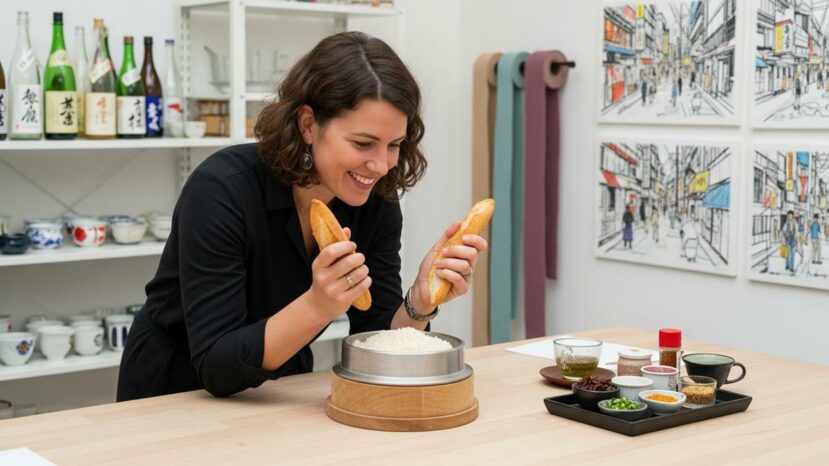
HIS Paris – Japanese cuisine workshops. Onigiri, sake, wagashi and tea are offered in educational formats, with ticket prices ranging from 34€ to 60€. The sessions also provide a clear basis for home reproduction, without the need for expensive equipment.
Practicality, budget and field tips
To register, it’s best to anticipate the most popular times. For example, sessions at the end of the day often attract working people. Remember to check the language of animation, then adapt your questions to your level. Culinary Japan is still very specific, but a reminder sheet simplifies the essentials.
In terms of equipment, a good knife and a rice cooker make life easier. However, a well-managed saucepan is all you need to get started. What’s more, our contributors share reliable addresses for basic ingredients. Domestic Japan often starts with good rice, weighed with regularity.
Objects, gestures and memory
Handcrafted products (glassware, textiles, incense, sake) – Japanese selection. The presentation contrasts everyday use with the care given to materials, from blown glass to dyed cotton. In this way, buying becomes a thoughtful act, oriented towards durability and repair.
The objects on display are not there for decoration, but to serve. A well-chosen sake glass changes the perception of an aroma. Textiles interact with the table, then tell the story of a workshop. Japan is expressed in detail, just as a mouthful is expressed in texture.
Last but not least, the tour links the three main themes: image, taste and use. As a result, a watercolor can inspire a recipe, then guide the choice of an object. This back-and-forth approach fuels curiosity, step by step. In this way, Japan is approached through several doors, without a rigid hierarchy.
At the end of the tour, everyone leaves with precise, practical knowledge. What’s more, the information on rice, tea and sake helps to avoid buying mistakes. Simple, workshop-tested gestures are easy to repeat. Japan remains close at hand, with the right table and well-thought-out objects.