
Green parakeets in Paris: origins and development in the Île-de-France region since the 1970s
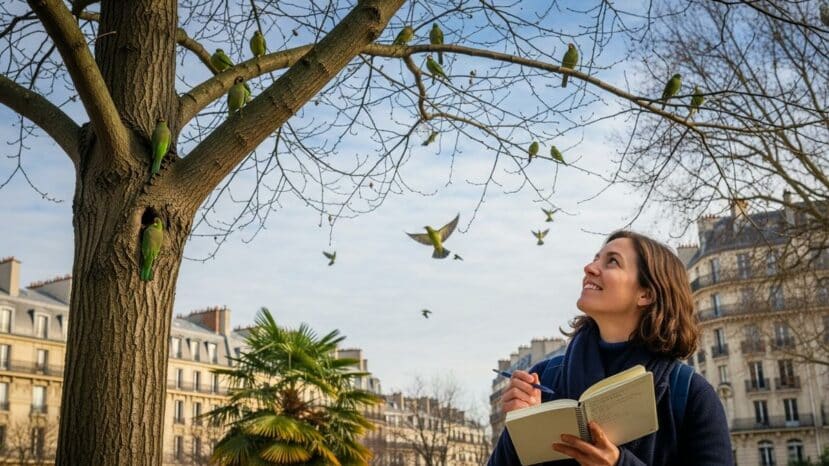


Their lively flight stands out against the stone and plane trees. In Paris and the Ile-de-France region, green parakeets intrigue, amuse and sometimes disturb. So, where do they come from and how do they live so close to humans?
Origins and arrival in Île-de-France
There are several accounts of their arrival. Some mention birds that escaped from a hold at Orly in the 1970s. Others report leaks near Roissy in the 1990s, followed by slow expansion.
Thepet bird trade played a role, according to naturalists. Released birds were able to join other birds in the vicinity. What’s more, the city offered room and board, which facilitated settlement.
Dormitories have formed around large parks and the Seine. Their presence can now be observed from the inner suburbs to the edges of the Paris ring road. As a result, the population has structured itself into clearly recognizable groups.
“The capital wasn’t ‘invaded’ in a day: settlement came in local waves.”
An express adaptation to the city
These birds are hardy, gregarious ring-necked parakeets. Green parakeets are surprisingly resilient to urban winters. However, the microclimate of boulevards and gardens benefits them.
Their diet is varied: buds, fruits, seeds and home feeders. They also exploit cavities in plane trees and tree lines. Palms and certain conifers also provide welcome shelter.
- 1970s and 1990s: key introductory stories
- Île-de-France: expansion by urban nuclei
- Varied diet: fruits, buds, seeds
- Collective dormitories at dusk
- Tree cavities: a strategic resource
Living in groups helps them find food and shelter. On the other hand, this sociability translates into noisy gatherings near parks. This makes for easy observation, especially at dusk.
Impacts and cohabitation
Their impact is the subject of debate, ranging from amazement to annoyance. Local studies point to varying effects in different neighborhoods. What’s more, the abundance of urban resources changes the situation every season.
Competition for cavities worries some observers. On the other hand, large cities already lack old trees for woodpeckers and sparrows. Consequently, tree management is becoming a central lever.
The noise can be surprising at first, especially under the dormitories. Dirt can also accumulate under specific trees at dusk. Targeted cleaning can limit the disturbance.
The legal framework is based on prevention rather than eradication. Many municipal services now focus on information and monitoring. For example, feeding wildlife is not recommended, to avoid mass gatherings.
What to do, who to contact
Naturalist associations offer participatory counts. Green parakeets are reported to monitor trends and distribution. In short, this data guides measured, transparent action.
For condominiums, it’s best to protect attics and openings. In addition, netting a fruit tree can act as a deterrent without causing injury. Also, report any worksite close to a suspected nest to the relevant authorities.
Urban gardeners can adjust their practices. For example, careful winter pruning limits the appeal of exposed cavities. As a result, refuges for small fauna need to be diversified.
Where and when to observe them
The best times are in the morning and evening. On the way back to the dormitory, the groups get louder. What’s more, the streamlined silhouette is easier to spot against the light.
Parks and riverbanks offer accessible vantage points. Montsouris, Sceaux, Vincennes, Issy and Bercy are often cited. In this way, green parakeets draw regular trajectories between trees and rooftops.
Photography benefits from being discreet and mobile. Also, keeping your distance reduces stress on shared dormitories. In short, winter makes it easier to see through bare branches.
For the curious, a field notebook helps to compare seasons. From now on, anyone can note down places, times and significant behaviors. As a result, the chronicle of green parakeets is written to the rhythm of the city.