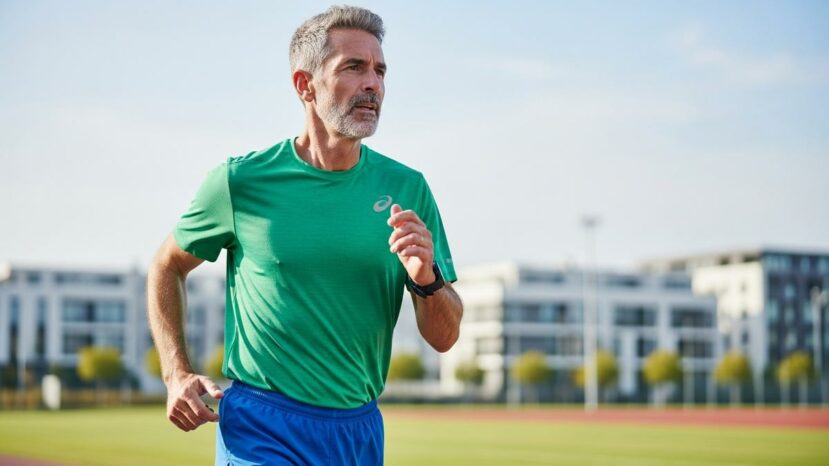
Running: in men, science confirms that there is no age limit, but pace declines from the age of 40 onwards


The debate often comes back to the track: at what age should you put away your running shoes? The scientific answer is not so much a deadline as an adaptation strategy. Above all, age is an invitation to run differently, without giving up pleasure or goals.
Until what age is running still beneficial?
The body changes, but continues to progress if training is adjusted. What’s more, the cardiovascular, metabolic and mental benefits continue well into your forties. On the other hand, listening to signals and planning become central allies.
Performance often peaks around the age of thirty, then slowly declines. The decline in aerobic capacity is estimated at 5-10% per decade after the age of 30, depending on training. Intelligent training therefore more than compensates for this natural slope.
The “masters” categories show impressive records at advanced ages. For many, running remains a social engine and stress regulator over the decades. What’s more, athletes over 70 are still completing marathons, proof of real sporting longevity.
“Age is not a barrier, it’s a training parameter.”
What studies say about age and performance
The major marathons results databases describe a speed peak in the 30-35 age group. However, individual variability is high, depending on injury history and volume of running. This means that two runners of the same age can have very different profiles.
In ultra-distance races, podium finishes often include people in their forties and even fifties. This is because race economy, mental endurance and effort management improve with experience. Tolerance to high intensities also diminishes, but strategy compensates for some of the physiological deficit.
- Adjust weekly load with scheduled recovery cycles.
- Maintain intensity, but reduce the duration of fast fractions.
- Strengthen posterior chains and calves twice a week.
- Pay particular attention to sleep and protein intake after key sessions.
- Monitor simple markers: morning fatigue, motivation, heart rate.
Adapting training after the age of 40, 50, 60
The golden rule is: less, better, regular. Thus, an 80/20 model (majority endurance, peak intensity) remains relevant for running. In addition, short, controlled intervals maintain VMA without overloading.
Strengthening protects tendons and stabilizes joints. Aim for 2 sessions per week, targeting hips, trunk, calves and feet. On the other hand, focus on technical, progressive movements with careful amplitude.
Recovery becomes a training variable in its own right. Sleeping 7 to 9 hours supports adaptation and limits the risk of injury. Regular hydration and protein intake spread throughout the day also facilitate tissue repair.
Simple medical monitoring provides reassurance and clarifies intensity choices. In addition, a blood pressure check and, if necessary, a resting ECG, provide useful benchmarks. In short, report any unusual shortness of breath, chest pain or discomfort on exertion to your doctor.
Prevent injuries without sacrificing speed
A thorough warm-up makes all the difference after the age of 40. This means jogging for 10 to 15 minutes, adding some educational exercises and a few progressive straights before the running session. As a result, muscles and tendons are better able to withstand rapid stress.
Progressivity offers better protection than any miracle shoe. In addition, increase volume or intensity by a maximum of 5-10% per week. Alternate surfaces and pairs of shoes to vary mechanical stress.
Practical plan: a typical week and signals to follow
A simple framework is all you need, then adjust it to your personal context. For example, combine an easy outing, a short split session, a longer outing and two short refits. In addition, set aside a very light day before each key running session.
Internal signals guide daily decisions. So, if morning fatigue persists or your mood takes a turn for the worse, lighten up without feeling guilty. In short, a skipped session is better than an injury that lasts for weeks.
Motivation changes with age, but curiosity remains a reliable driving force. So vary your distances, try out new routes, or set a realistic seasonal goal. What’s more, the collective helps: a partner, a club, or an ongoing plan can give you a boost when your energy wanes.