
Medieval waterside village in Alsace, less than 2 hours from Strasbourg: a picture-postcard setting for a weekend away.
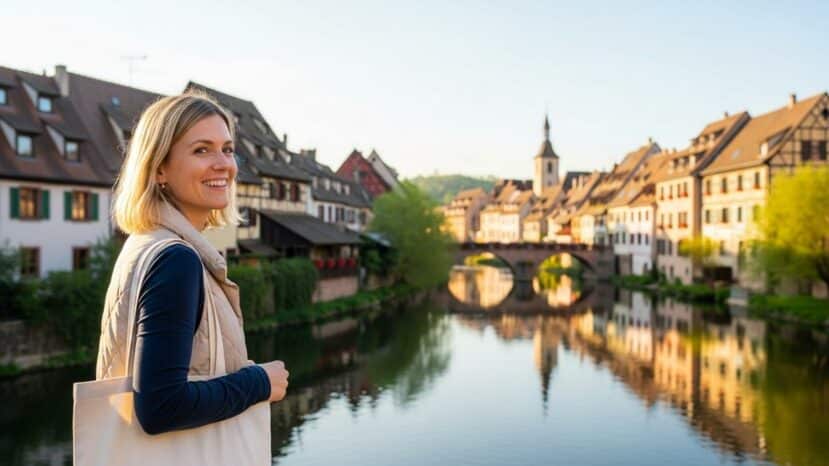


Less than two hours from Strasbourg, a corner ofAlsace lives to the rhythm of a clear river. Here, the charm of a medieval village can be seen in every stone and flower-bedecked bridge. It’s a perfect getaway for the curious and families in search of authenticity.
An Alsatian setting less than two hours away
In the hollow of the Weiss valley, timber-framed facades line up with modesty. The reflections of the water highlight the colors of the geraniums and old shutters. This medieval village invites you to take a slow walk, then let the postcard take care of itself.
The cobbled lanes wind between small squares, discreet but lively. Also, you can hear the lapping of the stream under the footbridges, right next to the cafés. Travelers pause as the morning light reveals brown tiles and delicate half-timbering.
Getting there from Strasbourg is easy, either by road or by combining TER and bus services. Moreover, the signposted access is reassuring for day trips or short stays. In short, there’s one photo stop after another, between bridges, ramparts and flower-decked houses.
“An hour and a half from Strasbourg, Alsace tells its own story along the water and timber-framed houses.
Living history and heritage
Beyond the decor, the medieval past can be read on the corner stones and arches. A few relics tell the story of the town’s defense and trade. Yet the atmosphere remains peaceful, as if the centuries had adopted the slowness of the place.
Workshops, cellars and small stalls continue the story of daily life. What’s more, some houses proudly display an ancient date, engraved under the awning. In this setting, the medieval village converses with the present without forcing the issue.
Seasonal markets punctuate the year, with local produce and locally crafted objects. Winter also attracts visitors with its lights and spicy scents, although the streets remain narrow. As a result, it’s a good idea to organize your visit to take advantage of the quieter times.
- Less than 2 hours from Strasbourg, easy road access
- In the heart of the Weiss valley and a timber-framed village
- Cobbled streets, flower-bedecked bridges, postcard atmosphere
- TER + bus option via a nearby rail hub
- Mild periods in spring and autumn
Getting there and planning your visit
From Strasbourg, a direct car journey is all you need for a flexible getaway. Then, if you prefer the train, you can get off in a nearby town, then take a regional bus. Checking the timetable the day before avoids waiting at the terminus.
The village can be explored on foot, with the paths sometimes gently sloping. Comfortable shoes and a water bottle make the day easier. So be sure to take water breaks to take a breather and adjust your itinerary.
The high season attracts many visitors between the warm summer days and the December festivities. However, the mild spring reveals the facades without queues. In this context, the medieval village gains in tranquillity at sunrise.
A day is enough to capture the essence, but a weekend unfolds other nuances. What’s more, charming accommodations sell out quickly during peak tourist periods. Booking early means staying in the heart of the old streets.
Gastronomy and local encounters
The tables mix Alsatian specialties and seasonal inspirations, with convivial portions. Share a crisp tarte flambée, followed by an almond or honey dessert. The cellars also offer Alsatian wines, to be enjoyed in moderation.
Craftsmen and producers share their know-how in a few simple gestures. What’s more, the welcome often takes place right on the doorstep, simply and without fuss. In this atmosphere, human contact becomes the real surprise of the day.
The children quickly find a motif of wonder near the water. Then, each one collects details in wood, stone and wrought metal. As a result, the walk becomes a treasure hunt, even in an unassuming medieval village.
Vineyard and water walks
The river naturally guides our steps towards bridges and footbridges. Backlighting along the water’s edge creates soft, precise shots. What’s more, certain viewpoints are revealed at the turn of a low wall covered in moss.
The nearby vineyard paths invite you to take an easy loop through groves and rows of vines. Local signposting also helps you locate nearby ridges and hamlets. It’s a good idea to keep an eye on the day’s weather, especially near the hillsides.
Respect for the environment and crops, simple gestures, bags for your garbage. Afterwards, we stay on the marked paths to preserve flora and fauna. In the golden light, the link between vineyards, water and village is easily understood.
Families prefer short routes, which can be adapted to suit the age of their children. What’s more, an offline map is a welcome relief when the network is weakening below. Finally, the idea of a snack break by a flower-bedecked bench brings everyone together around a soothing medieval village.
Practical advice and travel ethics
Travelling light simplifies the experience and reduces the footprint on site. A small first-aid kit, rain jacket and reusable bag are all you need. Also, tap water is often of good quality, which makes shopping easier.
Arriving early makes the visit smoother and leaves space for local residents. What’s more, a good sense of walking helps to avoid narrow areas. In short, everyone contributes to the calm of the village by managing their stops.
The photos respect privacy, especially near flower-filled windows. After that, a hello and a thank you sometimes open the door. As a result, exchange takes precedence over performance, even in a highly photographed setting.
Why this getaway makes a lasting impression
Here, the coherence between architecture, nature and everyday gestures imposes itself without force. Water, half-timbered houses and narrow streets create an ever-changing scene. And the short distance to Strasbourg makes it easy to return season after season.
The eye remembers colors and textures more than lists. What’s more, the details tell the same story, from the carved balcony to the polished paving stone. Within this framework, the medieval village becomes a promise of assumed slowness.
It’s as much a first-time experience as a repeat visit. After all, the weather, the light and the people you meet all change from one day to the next. So leaving with a notebook of short itineraries helps to feed the desire.
What remains is the simplicity of a bench, a bridge or a discreet little square. A warm loaf of bread, a cup of coffee and a smile all add up to a lasting memory. Finally, the postcard comes alive with every step, carried by a medieval village on a human scale.