Annette Messager exhibits the animal and the human at the Musée de la Chasse et de la Nature in Paris
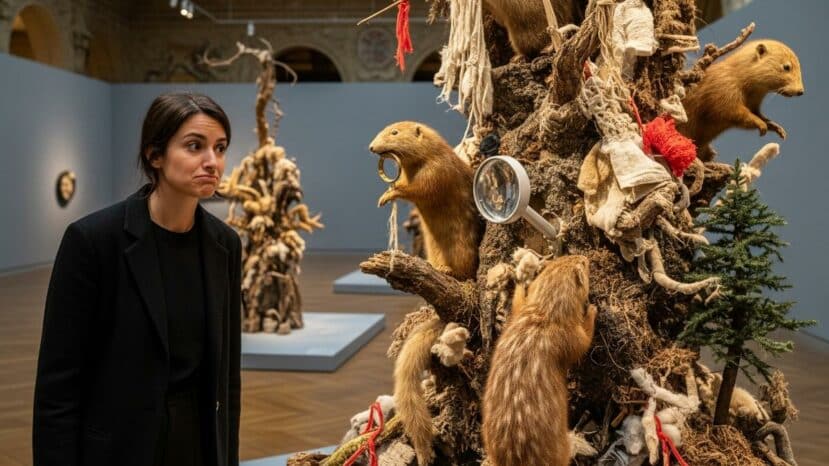


In Paris, an exhibition by Annette Messager transforms a visit to the Musée de la Chasse et de la Nature into an intimate, sensory experience. Using images, materials and gestures, the artist weaves a tale that is both tender and disturbing. In this way, each of us measures our share of the animal and the sensitive.
Annette Messager, the art of ambivalence
Known for her assemblages, the artist combines taxidermy, stuffed animals and hijacked objects. She also plays with oppositions: softness and bite, playfulness and gravity, memory and oblivion. As a result, her work invites us to take a fresh look at our fears and attachments.
His installations provide both pause and momentum. Drawings, photographs and texts form narrative fragments. In short, each room offers a point of view, never a moral.
A sensitive face-to-face encounter with the human-animal
Here, humans are not separated from the living. Instead, they cohabit, adapt and sometimes falter, to the rhythm of playful and disquieting assemblages. The tour of the Musée de la Chasse et de la Nature underscores this physical and mental proximity.
“You think you’re looking at an animal; suddenly, it’s looking back at you.
The materials evoke memories of childhood and the workshop. A stuffed toy becomes a relic, while a fragment of feather becomes an intimate trophy. As a result, the scale of emotions shifts, from smiles to amazement.
Nothing is left to chance, yet nothing seems set in stone. The gestures of sewing and collecting connect worlds that were once thought to be separate. In short, the exhibition is as much to be experienced as it is to be understood.
- Theme: relationships between humans, animals and the imaginary
- Materials: taxidermy, stuffed animals, reassembled objects
- Format: installations, drawings, photographs, texts
- Location: heart of the Marais, Paris 3rd arrondissement
- Public: curious, informed families, art lovers
What you’ll see in theatres
Expect a montage that blurs the front. In this way, a stitched detail can take precedence over an entire figure. What’s more, the eye is guided by sharp contrasts: rough materials, soft surfaces, fine shadows.
We come across series where the assembly becomes a narrative. On the other hand, the narrative remains open-ended, like a never-ending tale. The Musée de la Chasse et de la Nature becomes a critical and sensitive playground.
Works of art interact with the permanent collections. Showcases, trophies and antique silhouettes respond to contemporary forms. As a result, the history of hunting opens up to current ecological and ethical issues.
The editing favors movement and attention. Each step offers a new, almost cinematic focus. In short, the transitions between rooms provide useful breathing space for younger visitors.
Why this exhibition resonates today
The “animal-human” question goes beyond the aesthetic debate. What’s more, it affects the way we live with what surrounds us, from the domestic to the wild. As a result, art becomes a compass for feeling, thinking and acting.
This approach rejects peremptory discourse. Irony, tenderness and strangeness coexist without canceling each other out. At the Musée de la Chasse et de la Nature, nuance once again becomes a concrete gesture.
Practical information and visiting tips
The institution is located in the quiet, narrow streets of the Marais district. It’s also easy to get to by metro or bike, depending on your habits. In short, don’t forget to check the timetable before you go.
Weekend slots are often in demand. So planning ahead makes it easier to get in with children. As a result, a morning visit ensures a more relaxed experience.
The displays remain accessible to the widest possible audience. What’s more, the signage helps visitors to read the works without flying over them. On the other hand, some rooms play with darkness: a smartphone can be used as a discreet reference point.
For families, a slow pace works best. Alternating observation and pause encourages spontaneous discussion. At the Musée de la Chasse et de la Nature, this breathing makes for a memorable tour.
Points of reference for further reflection
Art schools and mediators see this as fertile ground. In addition, workshops and visitors’ notebooks can be used to encourage the youngest visitors to express themselves. As a result, everyone leaves with images and words.
For groups, deciding on a common thread helps: material, gesture, look, or memory. In this way, the notebook becomes a simple, agile tool. In this context, the Musée de la Chasse et de la Nature serves as a shared laboratory.
What this exhibition changes in the way we look at things
Annette Messager shifts the center of gravity of the museum experience. What’s more, she rehabilitates attention to detail as a way of thinking. As a result, curiosity takes precedence over habit.
The bestiary is neither fable nor cold showcase. In this way, it becomes a close friend, awakening memory and care. In short, the viewer tries his hand at a tactile and visual ethic.
Here, hunting is not a heroic motif. Instead, it serves as a historical and critical prism. At the Musée de la Chasse et de la Nature, history dialogues with the present without forcing agreement.
We come away moved, sometimes bewildered, but never indifferent. A taste for nuance is rooted in the simplest gestures. As a result, this tour of the Musée de la Chasse et de la Nature is an experience to be lived and thought about.