Place du Louvre: a giant artistic portal sets up, free to view
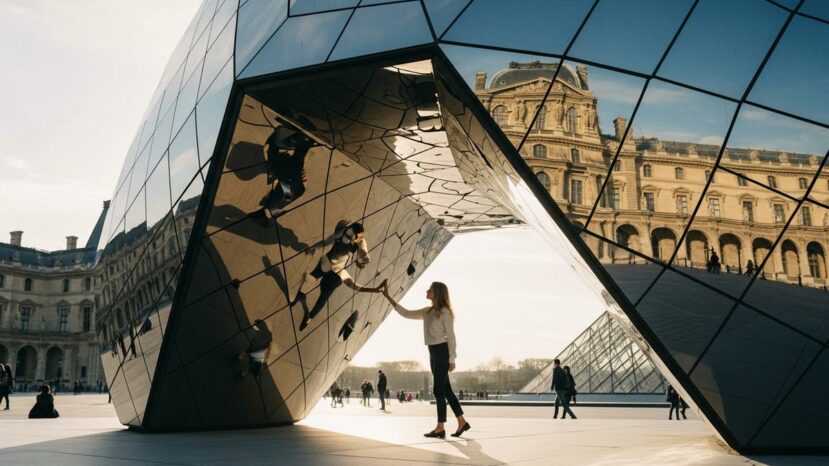


A monumental gateway intrigues passers-by and residents alike in the Place du Louvre. This geometric structure, half-architectural and half-sculptural, catches the eye at dawn. It invites us to slow down and wonder what we’re really seeing.
Where does this artistic appearance come from?
According to the signage at the foot of the work, the sculpture is entitled “Mirror Gate II” and bears the signature of Pilar Zeta. The installation, which can be seen from the Perrault colonnade, is part of a recent public art program installed in the Place du Louvre. What’s more, access is free, with no barriers or ticket booths.
This door with its changing reflections is the continuation of a research project on the threshold and optical illusion. A first version was shown at the Pyramids of Giza, in a dialogue between ancient and contemporary. Here, the Parisian setting changes the reading, yet the idea of passage remains.
What we see, what we feel
The play of mirrors cuts through the landscape and frames the museum’s perspective. Visitors see themselves both inside and outside, as if on the edge of a dream. As a result, they can compose their own image as they move about.
“An eye-opening, mind-opening portal.”
The structure appears to be made of metal and reflective surfaces, patiently assembled. No official dimensions can be found on site, yet its scale remains imposing. What’s more, discreet markings encourage us to keep our distance and not climb it.
The framing varies according to the light, transforming perception with each passing hour. Morning offers soft reflections, while evening sculpts sharper contours. In the Place du Louvre, the work dialogues with the stone, the sky and the crowd.
- Where: Place du Louvre, 75001 Paris.
- Access: Palais Royal – Musée du Louvre metro station, lines 1 and 7.
- Opening hours: public space, accessible at all times.
- Price: free, no reservation required.
- Safety: do not climb, respect signs and perimeter.
Practical information and regulatory framework
This type of installation requires the approval of the relevant authorities. As a general rule, the municipal services and the site concerned validate the plans, insurance and safety. In this way, the public can enjoy a work of art under controlled conditions.
Pilar Zeta – Mirror Gate II is a monumental sculpture designed for open space. The first version took shape at the Pyramids of Giza, which explains the motif of threshold and time.
For image lovers, low-angled light reveals fine textures and shadows. A visit at sunrise or dusk, for example, produces more nuanced photos. Around the Place du Louvre, there are several angles from which to avoid the immediate crowds.
Photography, social networks and image rights
Taking photos for personal use remains permitted in public spaces. However, commercial distribution may require specific authorization. It’s best, therefore, to check the purpose of any organized shooting beforehand.
Media and productions often need to coordinate logistics and rights. An advance request makes it easier to respect rules and schedules. A clear framework avoids tensions and last-minute postponements.
Reactions, local impact and the meaning of the work
On the spot, reactions range from astonishment to amused curiosity. Some children try to understand why the set splits into two. In this way, the play becomes a pretext for dialogue, even between strangers.
The portal motif evokes the passage between eras and narratives. One can move from a thousand-year-old museum to a contemporary creation in a single step. In the Place du Louvre, this face-to-face encounter makes the continuity of forms visible.
Many walkers read sculpture as a mirror of intentions. Some see it as a gateway to the imaginary, others as a setting for the city. What’s more, the site absorbs reflections and reflects urban life.
Staging the everyday
The work captures flows and gestures, then reinscribes them in its geometry. In this way, we look at ourselves differently, because the scenery is also looking at us. This slight shift changes the walk and, sometimes, the day.
Its presence remains ephemeral, as the format is temporary by nature. Yet we become attached to this window that won’t open. Consequently, removal will leave a tangible void on the Place du Louvre.
Responsible visiting tips
Come early to avoid the crowds and enjoy the soft light. However, mid-day is still a good time for clearer reflections. In this way, each hour of the day offers a different reading of the installation.
Respect the perimeter to preserve surfaces and anchors. The slightest scratch distorts the optical effect and weakens the whole. What’s more, careful behavior protects the public around you.
Remember to look up: the colonnade and sky complete the scene. Then turn towards the Seine to frame the perspective differently. As a result, you’ll multiply the points of view without repeating yourself.