
Running: 5 exercises to strengthen your legs and improve your performance
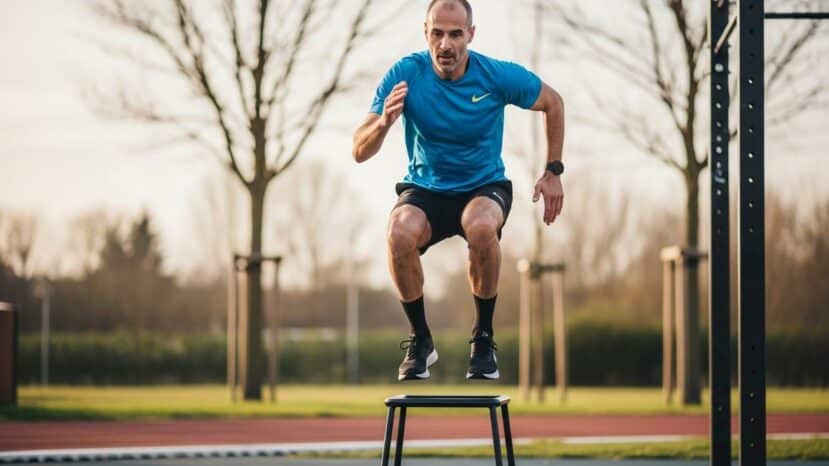


You’re already a runner, but you’re still hesitant about building up your legs to take it to the next level. This guide is inspired by a training program highlighted by GQ, and links strength, explosiveness and mobility, without losing sight of health.
The principle is simple, but precise. The lower body is strengthened to better absorb impact, improve running economy and avoid glitches.
Leg training to improve your stride
According to the article, the central axis is clear: strength, plyometrics and unilateral stability. To build leg muscles without weighing down your stride, aim for full body movements, followed by short, controlled jumps.
The trunk serves as a belt, the foot as a sensor. What’s more, the quadriceps, ischios and glutes become the “engine”, while the calves handle the rebound.
“Leg strength serves as an engine: more stable, faster.”
A dynamic warm-up is the first priority before loading. This enables ankle and hip mobility to be better prepared and reduces stiffness at impact.
A typical session, from rack to track
The session opens with a basic movement (squat, lunge or Romanian deadlift). This is followed by a one-sided workout, then short jumps, finishing with calf raises and a gainage workout. In practice, 2 to 3 times a week for 20 to 30 minutes is all you need to build up your legs without overloading them.
- Active warm-up: mobility of ankles, hips and trunk (5 minutes)
- Strength movement: 3-4 sets of 8 to 12 repetitions
- Unilateral: walking lunges or controlled step-ups
- Pliometry: low box jumps, green jumps, jumps on the spot
- Finish: standing calves and anti-rotation board
Tempo makes all the difference: slow descent, steep ascent. Consequently, technique takes precedence over load, with 1- to 2-minute breaks between sets.
Technique, recovery and injury prevention
On squats and lunges, knee and foot interact: knee following the toes, “tripod” foot well anchored. On the other hand, the back remains neutral, and the ribcage fixed by active sheathing.
Bleu de Paname offers a sturdy, sober jogging suit designed for before and after workouts.
In video, the cut remains fluid, so warming up is done without discomfort to the calf.
Recovery structures progress. In addition, leave 48 h between two heavy sessions, get enough sleep, and aim for 20-30 g of protein after exercise: building leg muscles appreciates this framework.
For prevention, single-leg exercises reduce asymmetries. From now on, think about eccentric calf work and midfoot strengthening to better tolerate running volume.
Progression and periodization for faster running
Gradually increase the volume: +1 set or +2 repetitions per week, no more. Also, organize cycles of 4 to 6 weeks with a lighter week to consolidate.
The track remains an ally. Alternate short climbs with strengthening in the gym: building up your legs means a more elastic stride and greater stability on the downhill.
Equipment, terrain and daily motivation
Stable shoes for the gym, and an even surface for jumps. As a result, give priority to secure supports, a low plyometric box and a clear space.
Jordan – early 90’s recalls a retro aesthetic, but above all good lateral support for light training.
In town, the style remains marked; so comfort protects your support during active travel.
No room? No problem. A weighted backpack replaces a barbell, a bench is used for step-ups, and stairs are all you need to build up your legs with regularity.
Measure your progress: time over 1 km, RPE at the end of a series, and pain noted when cold. In short, this follow-up motivates and frames the load, so that building up leg muscles is a lasting pleasure.