Paris/Roma at the Hôtel de Ville: the free photo exhibition is displayed in the open air on the railings
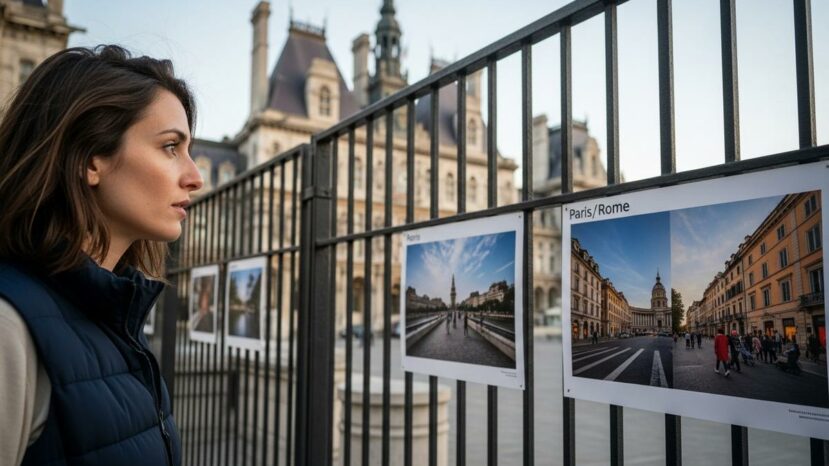


Paris hosts a free photo exhibition on the gates of the Hôtel de Ville. The open-air exhibition brings Paris and Rome face to face. Pass by, look around, and the city tells a story.
Paris and Rome mirrored on the gates of the Hôtel de Ville
On the high gates of the Hôtel de Ville, 2 cities talk to each other. In this way, views are exchanged between Paris and Rome. The images reveal gestures, streets and familiar monuments.
What’s more, the selection brings out unexpected echoes. We see urban changes, but also human constants. Photography becomes a bridge between yesterday and today.
The route can be read as an urban stroll. It’s part of everyday pedestrian life, with no tickets or queues. Passers-by stop, then set off again, to the rhythm of the 4th arrondissement.
“On the gates of the Hôtel de Ville, two capitals look at each other and at us.
A free photo exhibition for everyone
This free photo exhibition is suitable for families, students and the curious in a hurry. But it’s also a great way to spend time, picture by picture. Children quickly spot a detail, then ask questions.
However, the weather often guides the experience. On the other hand, soft light in the morning or at the end of the day helps the reading experience. On weekends, the crowds are denser, but the atmosphere remains fluid.
- Address: Grilles de l’Hôtel de Ville, Paris 4th arrondissement
- Access: metro 1 and 11 – Hôtel de Ville station
- Cost: free, no reservation required
- Tip: come on a clear day, off peak
- Duration: 20 to 45 minutes at your own pace
The sidewalk is wide and even, making it easy for strollers to pass. What’s more, the signs are at eye level, with no steps to cross. Nevertheless, keep a safe distance from the road.
Practical information for this free photo exhibition in Paris
The route is visible outdoors, on the public highway. This means that anyone can stop by on a walk through the city center. According to the schedule announced locally, the installation will run from the end of January to the end of February.
You’re right in the heart of the capital, between the Seine and Rue de Rivoli. What’s more, the Hôtel de Ville stations(metro stations 1 and 11) are within easy reach. The square and surrounding area are well served by bus.
The prints, protected for outdoor use, remain legible in different lighting conditions. However, some windows shine brightly at midday. Allow yourself to step back slightly, then refocus your gaze.
In short, the tour is flexible and unrestricted. You can also divide your visit into several sections. This way, the photos accompany your daily journey.
On-site photo and safety tips
To photograph the works of art, position yourself at a slight angle. This limits reflections and backlighting. And wait for the light to break to capture the fine details.
Store your bags well and keep an eye on traffic. Also, keep an eye on bicycles and scooters near crossroads. A sideways step is often enough to clear the frame.
It’s best to divide the groups along the grid. Then move forward in short sequences to avoid blocking access. Teachers can prepare two observation questions per image.
Why these images resonate today
The pictures are a dialogue with our hurried lives. They draw attention back to the city we live in, not just pass through. The result is a slow, conscious reading.
Comparisons between capital cities open up concrete possibilities. It also raises questions about the place of pedestrians, trades and urban landscapes. This free photo exhibition provides an ideal platform for these questions.
There are similarities in the gestures and materials of the streets. And yet, each capital retains its own unique rhythm and framing. The photograph shows, then leaves it up to the viewer to interpret.
As a result, the experience goes beyond mere contemplation. It also links memory, heritage and urban practices. This approach, accessible and public, is part of the life of the neighborhood.
The series function as a visual score. Variations can be read between bridges, squares and facades. The repetition of motifs highlights historical continuities.
Moreover, open-air access encourages chance encounters. Nonetheless, many return to see certain panels again at a different time. The different light reveals unsuspected details.
This cultural walk is both demanding and simple. You can put together your own tour according to the time you have available. You’ll leave with new insights into both cities.
With each step, the eye learns to frame and compare. What’s more, these images encourage a citizen’s view of the street. As we leave, we keep in mind the idea of a free photo exhibition that belongs to everyone.