Supermarket colorants: what’s really in the budget formulas
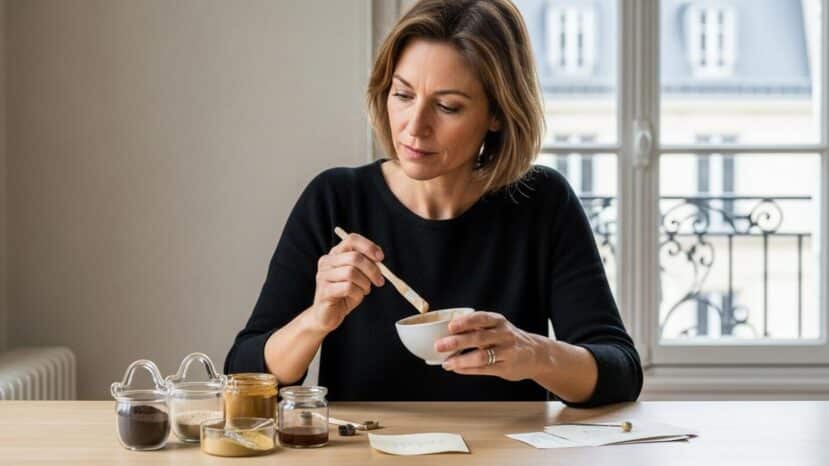


Convenient, economical and available everywhere, supermarket hair dyes appeal to millions of French women. However, behind the promise of dazzling highlights lie powerful chemical substances that raise legitimate questions about their harmlessness.
In France, nearly 64% of women use hair color. Across Europe, more than one in two women use hair color, and around 60% use it regularly, according to European Commission estimates. These oxidation products, the most common in supermarkets, are based on a chemical reaction that permanently alters hair color.
To work, these formulas require the use of powerful active molecules. So it’s precisely the nature of these compounds that raises questions and merits close examination.
What do supermarket colorants really contain?
Behind their promising packaging, hair colorants are based on a combination of clearly identified ingredients. Paraphenylenediamine (PPD ) is a particularly effective colorant, especially for darker shades. Resorcinol acts as a coupling agent to fix the color.
Ammonia or its derivatives open the hair scales, while hydrogen peroxide bleaches the natural pigment. These substances have been assessed by European health authorities and are subject to precise restrictions.
According to the European Commission’s Scientific Committee on Consumer Safety (SCCS), several of these compounds are authorized only in limited concentrations, following an assessment of their safety. Their presence is therefore restricted, but not prohibited.
“Hair colors are considered safe under standard conditions of use, based on a few applications per year, according to the Scientific Committee for Consumer Safety.”
Well-documented short-term skin risks
According to ANSM, PPD can cause sometimes severe skin reactions: itching, swelling and, in rare cases, even generalized reactions. An allergy test is recommended 48 hours before use, but this advice is often ignored.
Other short-term effects are regularly observed. Irritation of the scalp, burning sensations and hair weakening bear witness to the active, even aggressive nature of these products. Fortunately, these effects are generally reversible.
Coloration and cancer: what do the studies really say?
The WHO’s International Agency for Research on Cancer (IARC) classifies the occupational exposure of hairdressers as “probably carcinogenic” (Group 2A). This classification concerns professionals with repeated and prolonged exposure, often over many years.
For the general public, the picture is much less clear-cut. Health authorities agree on several points: the available studies give contradictory results, some suggesting a possible link while others find none.
- IARC considers that the data are insufficient to conclude that there is a risk in conventional users.
- ANSES stresses that studies are too heterogeneous to be conclusive
- It remains difficult to isolate the effect of coloring from other lifestyle factors
- Hairdressers are still the most exposed through daily handling
- People with allergies or sensitive skin have a higher risk of reaction.
As a precautionary measure, some authorities recommend limiting the use of chemical colorants in pregnant women. That said, no specific effects have been formally demonstrated.
Increasingly strict European regulations
In Europe, cosmetic products, including hair colorants, are subject to particularly stringent regulations. Regulation (EC) n°1223/2009 imposes a prior safety assessment for each ingredient, strict concentration limits and bans on certain substances deemed too dangerous.
Manufacturers are required to provide a full dossier proving the safety of the product before it is placed on the market. According to the European Commission, over 150 substances formerly used in hair colorants have been banned or restricted in recent years.
Are “natural” alternatives really safer?
Faced with these concerns, the cosmetics industry has developed alternatives: “ammonia-free”, “plant-based” or “natural” colorants. But beware of misleading shortcuts.
So-called “ammonia-free” formulas often use other alkaline agents, such as monoethanolamine, whose effects are not necessarily gentler. As for henna-based vegetable colorants, they can be an interesting alternative, but only if they are pure.
Indeed, some so-called “natural” products actually contain chemical additives. What’s more, certain usage habits deviate from standard conditions, with monthly or even more frequent touch-ups and sometimes longer application times.