“Each element has great scientific value”: under Notre-Dame square, excavations reveal Paris
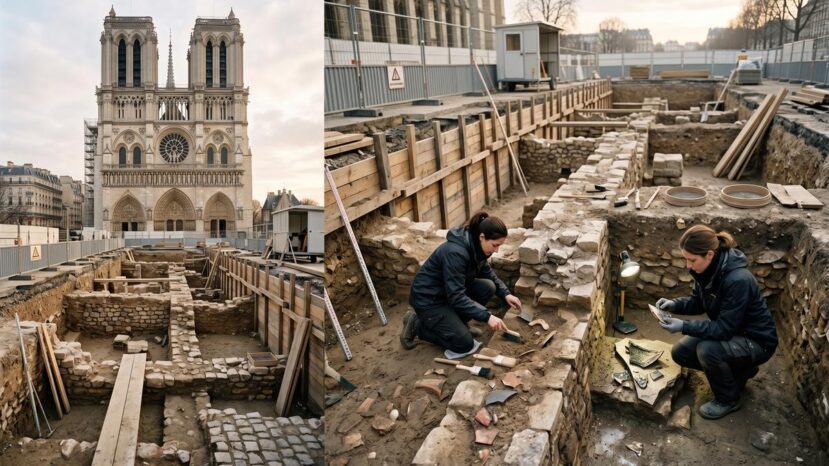


Under the cobblestones of Paris, history awaits. Since the beginning of 2026, the square in front of Notre-Dame Cathedral has been the site of a major archaeological dig. This discreet but promising project could well rewrite a few pages of Parisian history.
A forecourt steeped in history beneath Notre-Dame Cathedral
The renovation of Notre-Dame has captivated the world. Yet the work in this part of the Ile de la Cité is far from over. On the cathedral square itself, archaeologists are digging, analyzing and documenting what centuries of city life have buried.
These excavations are taking place ahead of a major transformation project. The square is to be greened by 2028, and the archaeologists have been commissioned to intervene before the start of this development.
What’s more, the Pôle archéologique de la Ville de Paris is in charge of the work, as prescribed by the Direction régionale des affaires culturelles d’Île-de-France. Work officially began in January 2026.
A large-scale dig led by Camille Colonna
The excavation zone is 30 metres long and descends to a depth of four metres. It is under the scientific direction of Camille Colonna.
Last January, when the concrete slab was removed, the first discoveries were made. Metal parts, ceramic fragments, sections of wall: one by one, objects are being brought to the surface.
“These are not treasures like gold ingots, but each item has great scientific value. This furniture makes it possible to reconstruct the daily life of the period and to characterize occupations: elite housing, simple houses, places of worship, commerce.” – Hugo Cador, archaeologist with the City of Paris
What excavations reveal about early Parisian life
Every object unearthed near Notre-Dame tells a story. A fragment of pottery may indicate a craft workshop. A section of wall may betray the location of an ancient dwelling or place of worship.
Archaeologists don’t look for spectacular finds. They reconstruct, layer by layer, the daily life of Parisians in days gone by. As a result, even a single shard can change our understanding of an entire neighborhood.
This research sheds light on the history of Paris and its inhabitants over more than 2,000 years. However, laboratory analysis takes time to deliver precise results.
- Excavation of Notre-Dame square to begin in January 2026
- Excavation area: 30 metres long and 4 metres deep
- Objects discovered: metal parts, ceramic fragments, wall sections
- Scientific director: Camille Colonna
- Objective: to plant the forecourt by 2028 once excavations are complete
Three sites excavated in parallel in the heart of Paris
The parvis de Notre-Dame is not the only active archaeological site in the area. Excavations are also taking place in the courtyards of the Hôtel-Dieu, as well as in the Cour du Mai of the Palais de Justice.
The first phase of excavations at the latter site took place between August and November 2025. Burials dating back to the Middle Ages were uncovered, as well as a burial area.
Laboratory analysis is now required to pinpoint the exact date of these discoveries. These three sites thus form a coherent whole that sheds light on the ancient history of the Île de la Cité.
A project that goes beyond Notre-Dame Cathedral
This excavation program is part of a broader approach. Paris, like other major European cities, regularly carries out this type of operation prior to urban redevelopment.
In the case of the parvis, the challenge is twofold. On the one hand, to preserve and document the buried heritage. On the other, to prepare the future green transformation of this emblematic space facing Notre-Dame.
Alongside the work visible on the surface, a whole invisible part of Parisian history is slowly coming to light. These excavations are a reminder that every square metre of old Paris still conceals traces of the past, however modest.
As a result, when the Notre-Dame forecourt is finally revegetated by 2028, it will rest on soil whose secrets will finally have been recorded and preserved for future generations.