“Black mascara, never brown”: the makeup artists’ rule that’s changing for women over 50
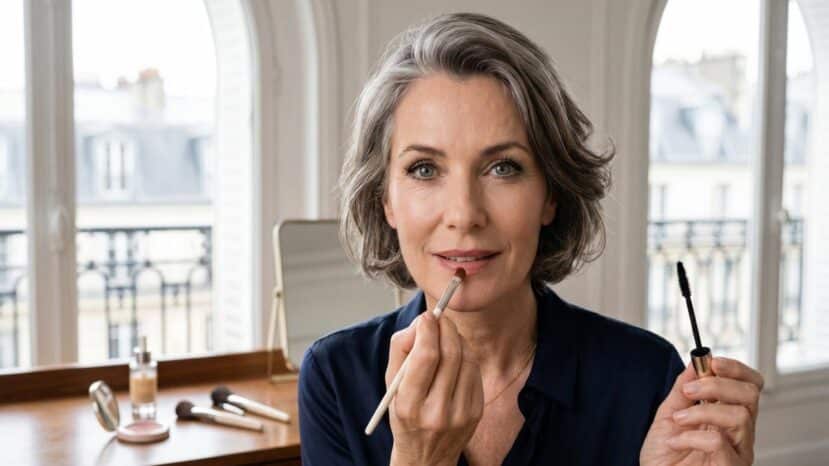


At age 50, your face changes, and it’s time to rethink your beauty routine. Makeup suited to mature skin relies on precise techniques, targeted textures, and careful preparation—much more so than on the amount of product applied.
Prepare mature skin before applying any makeup
After age 50, the skin can lose its radiance, become dry, and develop fine lines, dark spots, and more pronounced dark circles. These changes are normal. They simply require adjusting the products and skincare routine you use.
First and foremost, cleansing is essential. A mild soap suited to your skin type is the best starting point. Micellar water isn’t ideal: it can leave impurities behind and cause breakouts. According to experts, cold-processed organic soap is one of the most effective makeup removers.
Drinking at least 1.5 liters of water a day helps combat skin dehydration, even for those with oily skin. Rubbing an ice cube around your eyes every morning helps reduce puffiness and tighten the skin. Cold water first thing in the morning has the same toning effect.
“Correct, don’t hide.” — Rose-Marie Swift, expert makeup artist
Primer and serum: two must-have allies
A primer is not optional for mature skin. It smooths the skin’s texture, visually minimizes pores, and helps makeup last much longer. Apply it to areas with enlarged pores: the nose, forehead, and chin.
Charlotte Tilbury, a makeup artist, uses a technique called the “angel wing motion”: this involves lifting the contours of the face while applying moisturizers to create a natural lifting effect. This motion positively influences how the products are applied afterward.
A serum can complement your moisturizer. Ingredients such as hyaluronic acid deeply hydrate and smooth the skin’s surface. Apply it from the inside out, starting from the center of the face and moving toward the temples, using upward strokes.
Foundation, concealer, and blush: choosing the right makeup formulas
Lightweight, liquid formulas are far superior to heavy foundations on mature skin. High-coverage compact formulas settle into fine lines and make wrinkles appear deeper. In contrast, a lightweight tinted moisturizer or a foundation with buildable coverage provides a much more natural finish.
Laura Geller, in an interview with Vogue US, does, however, recommend certain full-coverage foundations specifically formulated for mature skin: they lock in moisture while applying like a powder, for a lightweight finish and a dewy look. Always choose a shade by comparing it to the color of your neck, never just the back of your hand.
For concealer, the ideal shade is slightly lighter than your foundation. It should be creamy or liquid—never dry or powdery. A thin layer is enough: applying too much will cause the pigment to settle into fine lines and make them more noticeable. A light dusting of loose powder on top helps it last, as long as you use it sparingly.
- Avoid glittery eyeshadows, which accentuate fine lines around the eyes
- Avoid bronzing powders, which give a sallow or orange-ish appearance
- Avoid matte and very dark lipsticks, which can dry out your lips and make you look older
- Do not use thick formulas that clog pores and settle into fine lines
- Use powder sparingly, as it settles into wrinkles and makes them more noticeable
When it comes to blush, cream or liquid formulas are the way to go. They provide a soft, diffused color and a natural look. Apricot, peach, and pink shades are recommended to restore radiance to the cheeks. Apply the blush to the center of the cheekbones, then blend upward toward the temples. Never apply it below the base of the nose—this can make the face appear longer.
Eyes and Lips: Precise Techniques for an Open Look
Eye shadows suitable for women over 50 enhance the natural color of the eyes. A light pink suits green eyes, warm browns enhance blue eyes, and copper or bronze shades make brown eyes stand out. Opt for a creamy texture: it won’t dry out the skin and blends easily with your finger.
When it comes to eyeliner, creamy pencils in shades of brown, bronze, or taupe are much more suitable than liquid formulas. Rose-Marie Swift is adamant about mascara: it must always be black, not brown. Brown shades accentuate the red or yellow tones in the whites of the eyes as we age. Curl the lashes before applying, and apply the mascara as close to the root as possible.
Applying a touch of light to the inner corner of the eye—in a champagne or iridescent beige shade—is all it takes to make your eyes look more open. For the outer corner, apply brown or gray eyeshadow with a blending brush to create a subtle V-shape. These two steps combined define your eyes without making them look heavy.
Lips and finishing touches for a rejuvenating result
Avoid very dark matte lipsticks: they dry out your lips and accentuate fine lines around the mouth. The experts interviewed by Vogue US swear by moisturizing lip stains for their staying power and lightweight feel. A shade that’s just one tone darker than your natural lip color creates an instant healthy glow.
A lip liner in the same color as the lipstick keeps the color in place and prevents it from settling into fine lines. Apply the lipstick with a brush in thin layers, starting at the center and dabbing outward. Blotting with a tissue, followed by a second coat, ensures maximum staying power.
Hard lines and sharp edges always make you look older. Blending out each product you apply is still the most rejuvenating step. All movements should be upward, never downward. Lisa Eldridge, whose clients include Kate Winslet, and Fabiola, who does the makeup for Hillary Swank and Padma Lakshmi, share this same principle: applying makeup near a window with good natural light helps avoid mistakes in product amount and shade.
Removing makeup deserves just as much attention as applying it. Washing your face twice in a row with a mild soap and lukewarm water ensures that all makeup is completely removed without irritating the skin. For the lips, applying a vegetable oil before using soap makes it easier to remove stubborn pigment.