Grand Jardin opens its glamping site on July 15: 6 cotton tents set amid 38 hectares in the Perche region
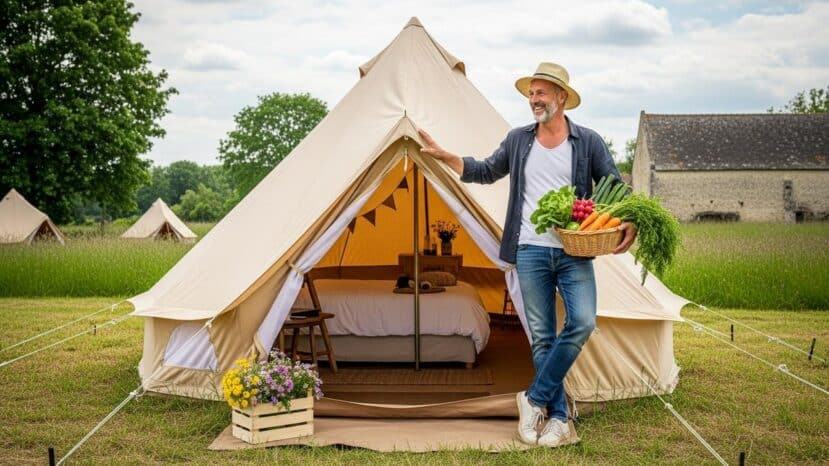


This summer, a farm still in its early stages of development is opening its doors even before construction is complete. Grand Jardin, located in Lamblore in the Eure-et-Loir department, in the heart of the Perche region, will offer its first glamping experience on its 38 hectares of meadows starting July 15, 2026. It’s a rare opportunity: to enjoy a stay in a place that’s still under construction, nestled between unspoiled nature and a farming landscape in the making.
Six cotton tents in the heart of the Perche meadows
The concept is simple, yet uncommon. Six spacious cotton tents are spaced a good distance apart across the estate. Each one offers unrestricted access to the working farm, without any pretense or artificiality.
The idea isn’t to imitate nature, but to truly be a part of it. Fewer screens, more time outdoors. This way, guests find themselves in direct contact with the rhythms of life: the seasons, the crops, and the animals that gradually make their appearance.
Glamping, a portmanteau of glamour and camping, combines the adventure of the outdoors with the comforts of home. You wake up to the rhythm of farm life, without sacrificing a good night’s sleep.
A farm on a human scale, the size of a real farm
The project was founded in 2021 by entrepreneur Romain Viennois. From the very beginning, the vision was clear: to create a space dedicated to practicing and exploring regenerative agriculture in renovated historic farmhouses.
In addition, the farm combines local organic produce with a warm welcome. This season, the farm is entering its second year of production, growing organic vegetables, and will soon be offering eggs and cut flowers as well.
“This summer, Grand Jardin is opening in a tent. Meadows stretching as far as the eye can see, a working farm, and the feeling of truly getting away from it all. This is the kind of summer we wanted to offer.” — Romain Viennois, founder.
An ecotourism project supported by the European Union
The estate lies at the intersection of agriculture and ecotourism. As a result, it receives financial support from the European Union through the European Regional Development Fund (ERDF). This support underscores the scope of the project, which extends far beyond simply providing lodging.
The belief expressed here is strong: tourism has a role to play in the ecological transition. However, this is not just theoretical talk. Every detail of the stay is designed to immerse guests in a concrete and vibrant agricultural reality.
- 6 cotton tents spread across 38 hectares of meadows, starting July 15, 2026
- Free access to the working farm throughout your stay
- On-site organic production: vegetables, eggs, and cut flowers
- Support from the ERDF, European Regional Development Fund
- Scheduled to open fully in September 2026, with 15 suites ranging from 50 to 150 m²
A full opening is scheduled for September 2026
The glamping phase is just the beginning. Starting in September 2026, the hotel complex will open in its full form, featuring 15 suites ranging from 50 to 150 m², capable of accommodating up to 100 guests. The estate aims to become the largest farm-based hotel in France.
This growth, however, is taking place at a measured pace. The spirit of the place remains intact: community-based tourism, local agriculture, and an environmentally friendly setting. In fact, each new step builds on that same initial vision.
Why this type of vacation is attracting more and more travelers
The need to reconnect with nature is now well documented. Many travelers seek to break away from their daily routines—not by fleeing far away, but by changing their pace. A farm stay fulfills this desire in a direct and authentic way.
Glamping, in particular, is appealing because it reconciles two often conflicting desires: a change of scenery and comfort. Sure, you sleep under a tent. But you don’t have to give up a bed, warmth, or peace and quiet.
For families, couples, or groups looking for a unique getaway, this type of place also offers an educational aspect. Observing a working farm, understanding where food comes from, and following the seasons: these are all experiences you won’t find at a traditional hotel.
As such, Grand Jardin stands out as a concrete response to the growing demand for a slower, more local, and more meaningful form of tourism. The Perche region, with its open landscapes and unobstructed horizons, offers an ideal setting for this type of project. The farm-inn fits right in here, supported by a region that has always successfully combined agriculture with a relaxed way of life.