
A podiatrist recommends this €29.99 Decathlon sneaker over New Balance


Every morning, we slip on our trainers without asking the right question: are they actually suited to our feet? While New Balance and other on-trend sneakers dominate the shelves, one podiatrist is pointing to a model sold for under €30 at Decathlon as the smartest choice for foot health.
What podiatrists really think about New Balance and thick-soled sneakers
Pierre Schlienger, podiatrist and content creator known as @allopodo, is unequivocal on the subject. For anyone without a specific foot condition, under 60, and without a long history of wearing high heels, a flat shoe remains the best option. That single criterion immediately rules out a large number of popular styles.
Because not all trainers are created equal. The specialist warns against thick, cushioned running soles, which are often perceived as comfortable. In reality, that type of sole is not recommended for everyday wear. New Balance, like other brands celebrated for their generous cushioning, falls into the category the podiatrist advises against for daily use.
What Schlienger recommends instead are flat sneakers with thin, firm soles. It may sound counterintuitive, but that construction better matches what the foot actually needs in day-to-day life.
The €29.99 Decathlon sneaker that ticks every box
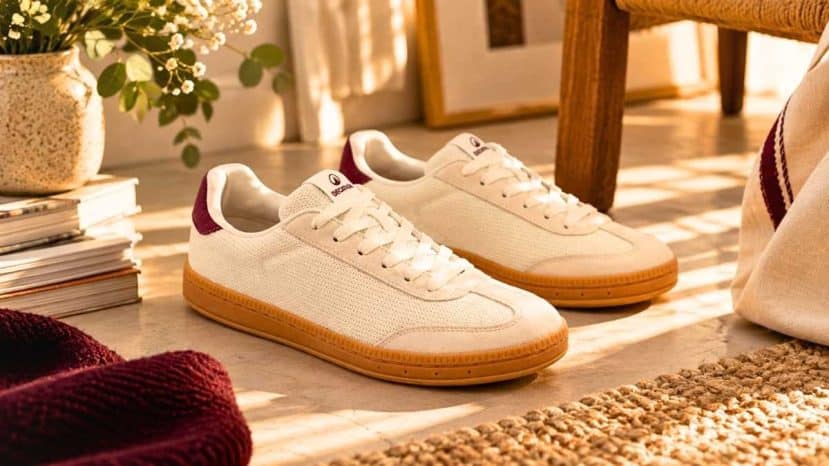
Among the accessible options, the podiatrist singles out the Decathlon PLAYER T MESH women’s sneaker, priced at €29.99. The model meets every criterion he champions: a rubber sole for durability, a breathable mesh upper for thermal comfort, and split-leather panels for structure. A very different profile from the high-volume New Balance sole.
This model is clearly positioned for relaxed everyday wear. It is not, strictly speaking, a sports shoe, but a sneaker designed to carry you through the day. That is precisely what the podiatrist is looking for in his recommendation.
Getting your size right, first and foremost
Before even comparing styles, there is a common pitfall to avoid. Schlienger points out that many women underestimate their shoe size, which leads to conditions caused by ill-fitting footwear. It is a detail that is frequently overlooked at the point of purchase.
What’s more, shoe size is not fixed throughout the day. Feet swell after several hours of walking, or when venous issues are present. Trying on shoes in the morning, therefore, is no guarantee they will still feel comfortable by evening. It is a small thing that makes a significant difference over time.
- Choose a thin, firm sole over a thick, cushioned one
- Opt for a flat shoe if no foot condition is present
- Account for foot swelling at the end of the day when choosing your size
- Walk for at least 5 minutes in the shop before buying
- Watch for any rubbing, redness, or tingling during the fitting
Five minutes of trying them on that can change everything
Once you have found a pair, the podiatrist advises against heading straight to the till. He recommends walking for at least 5 minutes in the shop to catch any signs of discomfort: rubbing, redness, tingling. This step matters even more for anyone with a history of foot problems.
In short, the right choice does not always come with the most recognisable name. Where New Balance wins people over with its style and cushioning, it is ultimately a sub-€30 trainer that earns a foot specialist’s seal of approval. A useful reminder: real comfort cannot always be measured by price or brand prestige.