Fashion show set designs that break the internet and sometimes save a collection
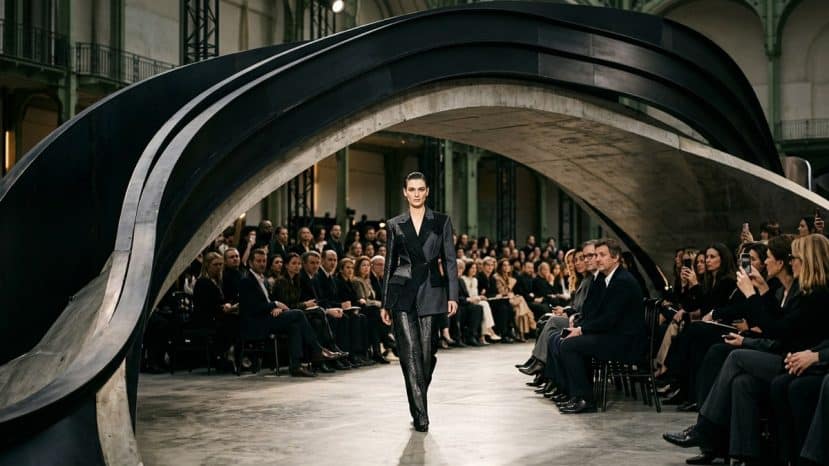


Fifteen minutes on the clock, millions of viewers watching live, and a set design that can make or break a collection: fashion show set designs have become far more than mere backdrops. Behind every show lies a discreet but decisive craft, that of the scenographer, whose visual choices reverberate across screens around the world for months on end.
When a show budget can reach six figures
Staging a runway show represents a considerable investment. For emerging brands, the minimum threshold hovers around €50,000, while the major houses mobilise budgets with six zeros, sometimes more. These sums fund the set design, lighting, music, hair, make-up and styling, all the tools that show producers orchestrate together to serve a designer’s vision.
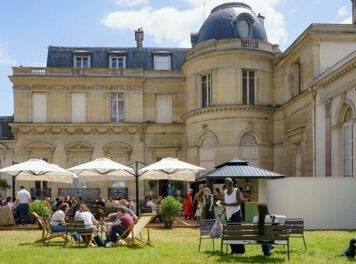
Three companies share the lion’s share of this global market: Villa Eugénie, founded in 1994 by Étienne Russo, La Mode en images, active since the early 1980s, and Bureau Betak. Each works with a distinct portfolio of houses and produces dozens, sometimes up to a hundred shows a year around the world. Competition is fierce, and every season demands reinvention.
Since 2025, global crises and growing consumer disenchantment with luxury have pushed many brands to cut spending. Show budgets, once considered untouchable, are shrinking in favour of overall brand image. For smaller operations, the exercise has become a precarious financial balancing act.
Fashion show set designs that tell a story season after season
The scenography of a show does not come together in a matter of days. After an initial briefing with the artistic director, ideas are exchanged through moodboards in a process that can stretch from six weeks to nearly a year, depending on the scale and location of the project. Étienne Russo distinguishes three types of collaboration: pure executive production, near-total carte blanche, and co-construction through continuous dialogue with the house.
These stagings can swing between two extremes. Some shows assert themselves through sheer scale, such as the Moncler show held in Shanghai across 20,000 m² for nine thousand spectators. Others deliberately choose restraint, as with Jonathan Anderson’s first Dior Homme show in June 2025, where two small paintings by Jean-Siméon Chardin were enough to dress the walls of an otherwise empty room. Emmanuel Heimann, managing director of La Mode en images, notes that the number of stakeholders has multiplied: marketing directors, image directors and communications directors all now take part in discussions, because brand consistency from season to season has become a central concern.
Scouting locations is a key step. Some houses have their habits: Dior has been presenting its haute couture at the Musée Rodin for around ten years, while Saint Laurent takes up residence at the Trocadéro at the moment the Eiffel Tower lights up. By contrast, so-called wild venues, such as Martin Margiela’s disused metro station in the 1990s or Vetements’ stretch of the Paris ring road in 2018, have become virtually unthinkable due to security and crowd-management constraints.
Media impact: the engine and the trap of fashion scenography
In 2025, the media impact of Women’s Fashion Week exceeded twice that of the Super Bowl, according to a study based on the Launchmetrics algorithm. This figure illustrates the radical transformation of the runway show, which has shifted from a confidential presentation for buyers and press to a global event followed by hundreds of millions of people online. The Louis Vuitton Men’s autumn-winter 2021-2022 show, staged in Seoul in partnership with K-pop group BTS, drew more than one hundred million viewers in a single event.
Yet this massive visibility has a flip side. Manon Renault, a doctor in information and communication sciences specialising in fashion, conducted a survey among observers aged 18 to 25. The finding: a powerful set design can compensate for an average collection in media terms, but it can also capture all the attention at the expense of the clothes themselves. The 2022 Coperni show, in which Bella Hadid had a white dress spray-painted directly onto her skin, is remembered as a viral moment, but those surveyed did not necessarily talk about the collection itself.
- The Chanel autumn-winter 2017-2018 show featured a 37-metre rocket beneath the glass roof of the Grand Palais.
- Matthieu Blazy’s first show for Chanel incorporated fifteen giant luminous planets orbiting beneath the nave of the Grand Palais.
- Balenciaga autumn-winter 2022-2023 sent its models down the runway into an artificial blizzard, echoing the climate crisis and the war in Ukraine.
- The Courrèges spring-summer 2023 show, conceived by artist Théo Mercier, placed models around a giant hourglass marking the passage of time.
- Ester Manas refocused her brand with a life-size inflatable elephant rented for €400 from a fairground operator for her spring-summer 2025 show.
Étienne Russo now factors virality into the conception of fashion show set designs from the very start. Every rehearsal is put through the mobile phone test, which he describes as his own eyes. Because the images from a show serve as the backbone of a house’s global communications for months, long after the few hundred guests in the room have gone home.
Creativity under constraint, or how an elephant can save a brand
Faced with financial pressure, some houses prove that a strong idea can sometimes be worth more than a colossal budget. Ester Manas experienced this in the most brutal way. In 2024, her house invested heavily in a collection with a show to match its ambitions. The collection failed commercially, and everything that had been poured into that season was lost. The question then arose: what is the point of a show whose life lasts only ten minutes?
The answer came with the following collection. The English expression for a problem that everyone sees but no one mentions, the elephant in the room, became the guiding thread of the spring-summer 2025 show. A life-size inflatable elephant, rented from a fairground operator for €400, served as the set. Not only did the collection put the brand back on track, it allowed the designer to hire new collaborators and develop her studio.
Meanwhile, Marie Adam-Leenaerdt, winner of the Grand Prix de l’Andam, chose for her autumn-winter 2026 show an empty room where each guest picked up a folding stool and sat wherever they liked. These minimalist approaches reflect a deeper trend: refocusing fashion show set designs on the garment itself, its details and its craftsmanship, rather than piling on spectacular effects. For Manon Renault, this shift marks a genuine turning point, one in which reducing the number of influencers invited allows houses to regain control over what circulates around their image in a world saturated with information.