
Just two hours from Paris, this Norman village inspired two film adaptations of Madame Bovary
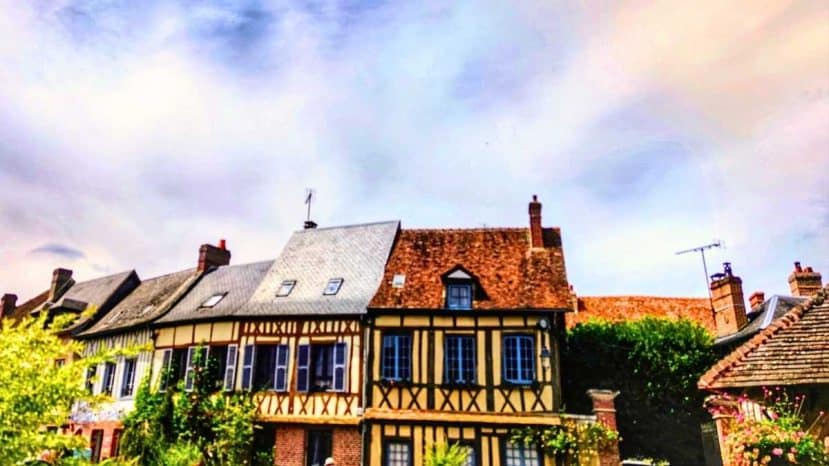


Imagine a town of fewer than 700 inhabitants where every façade looks as though it has stepped straight out of a 19th-century novel. That is precisely the feeling that greets visitors to Lyons-la-Forêt, a Norman village nestled in the Eure department, just two hours from Paris. This intimate little town, officially listed among the Plus Beaux Villages de France, has far more to offer than a pretty stroll.
An extraordinary artistic and cinematic legacy
Few Norman villages can claim to have inspired two film adaptations of the same literary masterpiece. Yet Lyons-la-Forêt served as the backdrop for two cinematic versions of Gustave Flaubert‘s novel Madame Bovary, one made in 1933 and the other in 1991. Both directors chose this town to bring to life the fictional village of Yonville-l’Abbaye, its timeless atmosphere fitting so naturally into Flaubert’s world.
But the artistic connection does not stop at cinema. Composer Maurice Ravel also stayed here, and his house still bears witness to that chapter of the village’s story. This dual literary and musical imprint gives the place a cultural depth that is rare for a town of its size. To walk across the central square is to move through several layers of artistic history at once.
That creative spirit permeates every corner of the village, reinforcing the sense, for anyone who visits, that this has always been fertile ground for imagination.
What the Norman architecture tells you here
One of the most striking qualities of this Norman village is how remarkably well its built heritage has been preserved. Houses dating from the 17th and 18th centuries line the streets with their exposed timber frames and thatched or slate roofs, creating a visual coherence that is genuinely arresting. No jarring stylistic intrusion breaks the harmony of the whole.
Several buildings are listed as Monuments Historiques, ensuring their long-term protection. Among them are the former Cordeliers convent, the Chapelle Saint-Jean-Baptiste de l’Essart-Mador, and the Hôtel de la Maréchaussée. Each one carries a fragment of local history that is legible even to the non-specialist visitor.
- The former Cordeliers convent, listed as a Monument Historique
- The Chapelle Saint-Jean-Baptiste de l’Essart-Mador, also under heritage protection
- The Hôtel de la Maréchaussée, a testament to the town’s administrative past
- Remarkably well-preserved half-timbered houses from the 17th and 18th centuries
This architectural heritage makes Lyons-la-Forêt a genuine open-air museum. Unlike many heritage sites, no ticket is required: simply wandering the cobbled lanes is enough to take it all in.
The Lyons state forest: a natural setting of sweeping scale
The village’s name is no coincidence. Lyons-la-Forêt is entirely encircled by the forêt domaniale de Lyons, recognised as the largest beech forest in France. Spanning more than 10,000 hectares, this natural expanse offers an impressive network of hiking trails winding through clearings and past centuries-old trees.
Numerous marked paths allow visitors to explore at their own pace. The forest becomes a natural extension of the village itself, offering a quiet, unspoilt immersion in the surrounding landscape. For nature lovers, it is every bit as compelling as the architectural heritage.
The combination of exceptional built heritage and a forest of this scale is rare. It makes this Norman village a destination in its own right, whether for a day trip or a longer stay, easily reachable by train or car from the capital.
Why this Norman village deserves a visit in 2026
At a time when travellers are seeking authentic destinations well away from the crowds, Lyons-la-Forêt ticks every box. Its modest size, fewer than 700 inhabitants, preserves an intimacy that major tourist sites can no longer offer. And yet the richness of this Norman town holds its own against far better-known destinations.
Between its listed architecture, its artistic legacy tied to Flaubert and Ravel, and the vastness of the surrounding forest, this Norman village delivers a complete experience. Every element connects with the others to create a stay that is both restorative and culturally rich. Its proximity to Paris, just two hours away, makes it an effortlessly accessible escape that requires no complex planning.