
The worst mistake is trying to hide grey hair this way” after 50
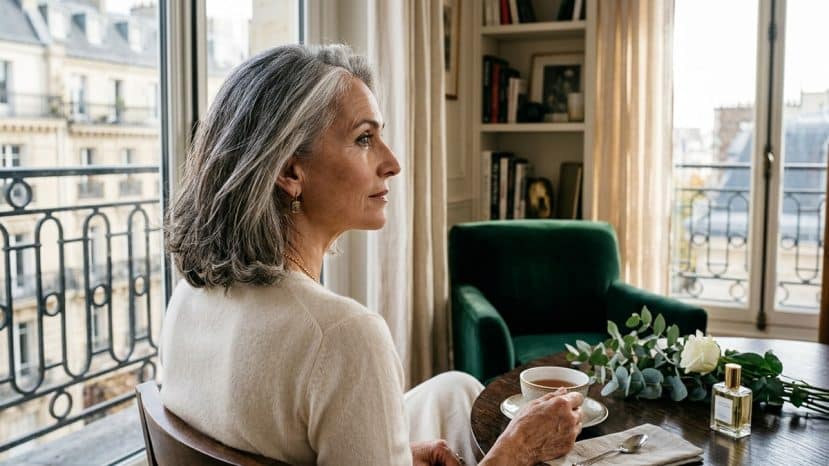


Every morning in front of the mirror, the same question surfaces: how to hide grey hair without weighing down your face or chaining yourself to endless touch-ups? It’s a reflex shared by millions of women over 50, and yet it conceals a trap that very few suspect. Because the most common method is also the one that ages you most reliably.
Why trying to cover grey hair with your original colour is a mistake
Celebrity hairdresser Fabien Giambona is unequivocal: the worst mistake is trying to recapture the dark shade of your youth. Over the years, hair’s natural colour softens and gradually loses its pigmentation. Reapplying a dark, uniform tint then creates a harsh contrast with the skin, which has also changed with time.
The result is often counterproductive. A heavy mass of very dark hair can harden facial features or make regrowth even more visible. By trying to hide grey hair this way, you end up with a rigid, frozen effect that accentuates wrinkles and dulls the complexion rather than reviving it.
There’s a practical problem on top of that: this type of colouring requires root touch-ups roughly every three weeks. And by regularly applying colour at home, you risk layering pigments over the lengths, darkening the whole thing further and making the original problem worse.
Practical alternatives for hiding grey hair without hardening your features
Fabien Giambona recommends swapping the uniform block of colour for softer, lighter shades. The idea is to work around the face with fine highlights, creating a blend of tones that lifts the hair and allows for a more harmonious grow-out. This shift in approach transforms maintenance: roots blend naturally into the overall look, with no harsh demarcation line.
Here are the key points to keep in mind when changing your approach:
- Avoid shades that are too dark and too uniform after 50
- Opt for tones that are slightly softer than your original colour
- Choose fine highlights around the face to lighten the overall effect
- Space out touch-ups thanks to a more discreet, gradual grow-out
To go further, the hairdresser recommends a specific technique: grey blending. This method relies on very fine, ashy highlights worked in such a way that grey hair is melted into the overall look rather than covered entirely. The effect is immediate: the face gains radiance, and the demands of upkeep drop noticeably.
Grey blending: a different way to handle grey hair
The principle behind grey blending radically shifts the usual logic. Rather than trying to erase silver strands 100%, this technique integrates them into the hair through a play of very fine, ashy highlights. The result is more natural, more luminous, and above all far less demanding to maintain.
To maximise the flattering effect, Fabien Giambona suggests pairing this technique with a well-structured cut. The right cut brings dynamism to the hair and improves how it sits, which reinforces the visual impact of the worked colour. It’s the combination of the two that produces the most rejuvenating result.
So hiding grey hair after 50 doesn’t necessarily mean total coverage. Leaning into lightness, nuance, and a technique like grey blending makes it possible to address grey hair without weighing down your face or locking yourself into an exhausting touch-up schedule. An approach that reconciles simplified upkeep with a genuinely flattering result, as long as you’re willing to let go of the reflex to match your original colour.