The Muséum national d’Histoire naturelle turns 400 with 300 never-before-seen works


Four centuries of history, science and art brought together in a single exhibition: that is the ambitious wager the Muséum national d’Histoire naturelle in Paris is making this autumn 2026. From 23 September 2026 to 7 March 2027, the museum opens its doors to an anniversary retrospective that reveals, from an unexpected angle, the fundamental role artists have played in shaping this institution.
When art moves into the heart of science
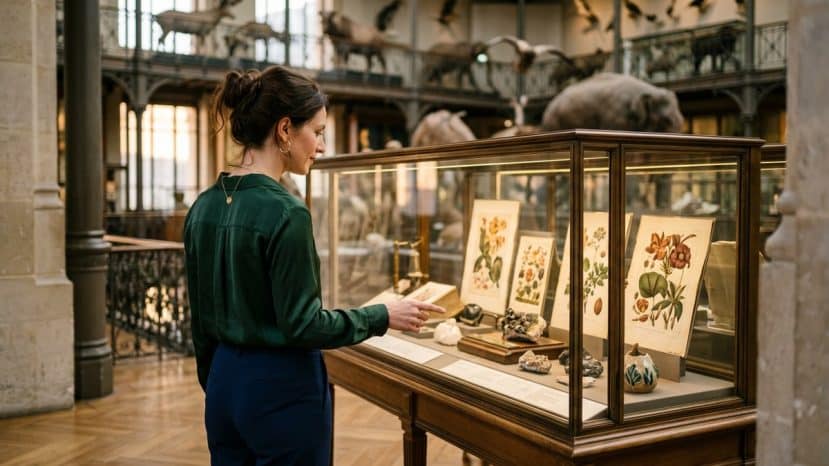
We rarely associate a science museum with artistic creation. And yet, the Muséum national d’Histoire naturelle has maintained a deep connection with artists since its very beginnings. Some of them worked directly alongside researchers, joining expeditions to the far corners of the world in order to bring back precise visual records. Their drawings and illustrated plates were, at the time, the only means of circulating knowledge, long before modern technologies existed.
Other artists produced rigorous scientific imagery: botanical plates, zoological drawings, anthropological representations and landscapes. These works did not simply illustrate the findings of scientists; they provided a shareable visual medium capable of spreading knowledge on a grand scale. In this way, art played a concrete role in the construction of natural knowledge.
Unexpected big names in the allées of the Jardin des Plantes
The Muséum national d’Histoire naturelle also served as a source of inspiration for painters who would go on to become household names. Le Douanier Rousseau, Eugène Delacroix and Gustave Moreau all walked its paths to study animal anatomy and observe the colours of plants. This surprising detail shows just how deeply this scientific institution nourished some of the most significant works in the history of French art.
Later, artists such as Robert Doisneau, Alberto Giacometti and François Pompon chose the museum and its collections as a subject in their own right. They immortalised taxidermied animals, visitors, researchers and the Jardin des Plantes itself. Contemporary artists round out this panorama, demonstrating that the Paris museum still holds a place in the art world today.
More than 300 works to tell 400 years of history
The anniversary exhibition brings together more than 300 works and objects drawn from a wide variety of disciplines. Paintings, photographs, drawings, sculptures, films and taxidermy pieces make up a journey that is both chronological and thematic. This diversity of formats reflects the richness of artistic contributions across the centuries.
- Paintings and drawings produced during scientific expeditions
- Botanical and zoological plates created for illustrative purposes
- Photographs by Robert Doisneau
- Sculptures, including works by François Pompon and Alberto Giacometti
- Films and taxidermy pieces
- Contemporary creations focused on environmental issues
The exhibition also shines a light on portraits of key contributors to the museum, allowing visitors to put faces to this long collective history. For the Muséum national d’Histoire naturelle is not merely a place of collections: it is also a human community built across many generations.
Who is this exhibition for?
The exhibition is aimed primarily at an informed audience. Science enthusiasts will find significant historical pieces, while those who love the museum will have the chance to rediscover an institution they thought they knew well. The themes shift as the journey unfolds: older works address very different subjects from the contemporary creations, which focus more squarely on the preservation of the planet and environmental change.
That said, the exhibition is better suited to slightly older visitors. Young children, even if they always enjoy the animals, may miss much of the historical narrative. For curious adults, however, this is a rare opportunity to understand the ties between art and science, and to grasp the many roles the Muséum national d’Histoire naturelle has played in French intellectual and cultural life.
The Muséum national d’Histoire naturelle, an institution born in 1626
To appreciate the full scope of this exhibition, it helps to recall the origins of the place. It was in 1626 that the medicinal plant garden, the direct ancestor of today’s museum, was established. A decree of 1793 officially created the Muséum, with a threefold mission: public scientific education, research and the conservation of collections. Since then, this Parisian site has never stopped drawing curious minds, families and scientists from around the world.
This autumn 2026 exhibition offers far more than a simple anniversary stocktake. It is an invitation to reread four centuries of shared history between artists and scientists, and to measure what the Muséum national d’Histoire naturelle owes, in part, to those who chose the paintbrush over the microscope.