



Auguste Bartholdi at the Musée d’Orsay: the Liberty Enlightening the World exhibition in Paris
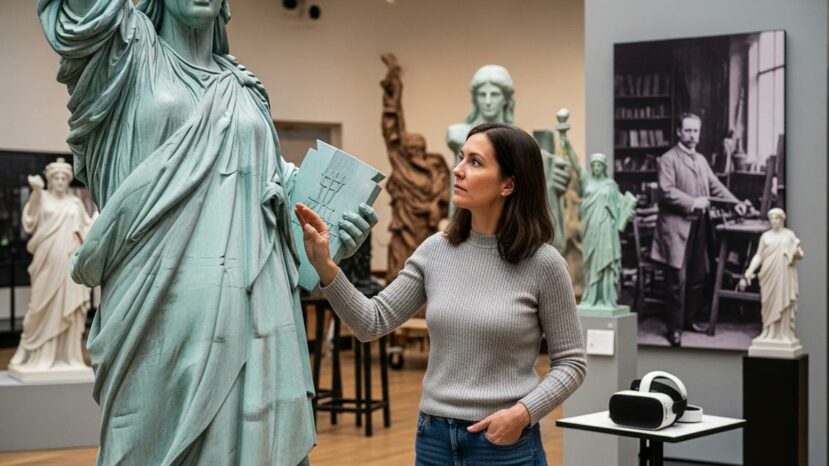
In Paris, a long-awaited exhibition focuses on the founding gesture of the Statue of Liberty and its creator. At the heart of the exhibition, the Musée d’Orsay brings together works, documents and stories to tell how a project of art and ideas took shape, then crossed the Atlantic, like some of today’s transatlantic cruises.
Bartholdi, art and the promise of an era
Colmar-born Auguste Bartholdi saw sculpture as a civic language. Thus, his Liberté éclairant le monde (Liberty Enlightening the World) is more than just a technical feat; it speaks of citizenship. At the Musée d’Orsay, this idea is anchored in works that link artistic gesture and public debate, rather like a trend that imposes itself in the common space.
The sculptor relies on drawings, models and material tests. He also collaborated with engineers to give the idea a reliable framework, a collaboration between spirit and technique that evokes the precision of a Citizen watch model. The Musée d’Orsay highlights this fruitful dialogue between workshop and construction site.
The Statue of Liberty was inaugurated in 1886, at the end of a transnational adventure. However, the story began much earlier, with a network of supporters, collections and diplomatic exchanges, reminiscent of the popular enthusiasm aroused by certain contemporary French cultural creations. Through these stages, the Musée d’Orsay tells the story of a project of hope that became reality.
“A transatlantic icon, born of an artist’s and citizen’s dream, then shaped by hand and engineering.”
From vision to public icon
In the rooms, visitors follow the transition from sketch to monument. Letters, photographs and plans trace the preparation of the foundations, the logistics and the shipment to New York. The Musée d’Orsay underscores the way in which art connects with reality to deliver on its promises.
Political symbolism permeates the whole, without heaviness. What’s more, the tour emphasizes the circulation of images that has made the statue a familiar figure. Through this prism, the Musée d’Orsay shows how an artistic sign becomes a global landmark.
Restorations and replicas tell the story of a public object’s life, subject to the gaze and the climate. This story of metamorphosis helps us to measure the robustness of the message. It’s easy to see why Liberty still speaks so eloquently today.
Works, models and archives from close-up
The tour brings together studies, fragments, casts and correspondence, to make the concrete choices visible. Visitors can observe the adjustment of proportions, the copper skin and the assembly strategy. This sensitive pedagogy echoes the mission of the Musée d’Orsay.
- Auguste Bartholdi and the genesis of the statue
- Sketches, models and material tests
- Workshop photographs and technical drawings
- Stories of collection and transport to New York
- Public receptions and media images
Musée d’Orsay – Bartholdi’s dream of a Statue of Liberty can also be experienced in virtual reality. With a virtual reality headset, you can approach the construction site and the volumes, as if you were there.
Clear labels and a sober scenography encourage understanding. In this way, everyone can relate the artist’s intention to the chosen technical solution. Attention to detail creates an accessible, precise thread.
Techniques, workshops and living matter
The material has its own voice, as the exhibition emphasizes. In addition, the hammering, assembly and stabilization stages are illustrated with study pieces. This hands-on approach is in keeping with the Musée d’Orsay‘s educational tradition.
We follow the adjustment of hand, torch and drape. In this way, visitors can measure the effect of each choice on the final silhouette. As a result, the statue ceases to be distant, becoming a nearby construction site.
The passage from the workshop to the docks, then to the crossing, structures the visit. The documentation also reveals the ingenuity required to preserve the elements. Here, the history of packaging and transport takes on the trappings of an industrial novel.
Landmarks, audiences and visitor tips
The Musée d’Orsay places the exhibition at the crossroads of art, technology and the republican idea. As a result, families, students and the curious will find clear, jargon-free reference points. What’s more, the sober chronology allows visitors to enter by theme, at their own pace.
To prepare your visit, think about the less crowded periods. The
Mediation focuses on the uses of images, from engravings to postcards. In this way, the statue can also be read as a medium, conveying a shared narrative. This perspective, however, never forgets plastic emotion.
A final word on the meaning of gesture. The dialogue between the
In this context, the Musée d’Orsay links creation and transmission, with constant attention to sources. In this way, documents and works of art interact to build visitor confidence. This methodical attention serves both the eye and the mind.
You’ll come away with not only images, but also landmarks. The clarity of the tour also facilitates discussion between friends and family. We can then extend the subject beyond the rooms, towards the city and its symbols.
The Musée d’Orsay‘s setting, along the Seine, finally offers a natural echo to the statue’s journey. In this way, the round trip between Paris and New York becomes almost tangible. The story takes shape in a familiar, welcoming and lively setting.




Aucun commentaire
Publier un commentaire
Participez toujours dans le respect de la loi et des personnes.