



Dolmen in Île-de-France: discover a megalithic burial chamber near Paris
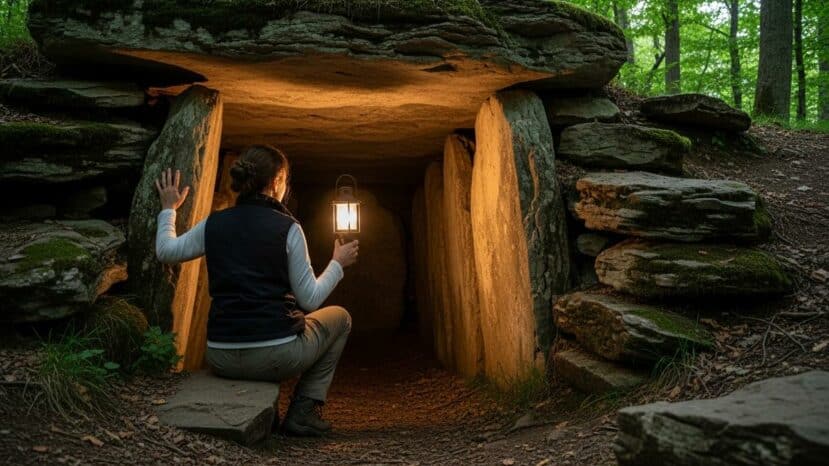
A stone’s throw from Paris, a Dolmen houses a burial chamber. This is how the Neolithic came to be in Île-de-France, in the heart of a peaceful forest. The site is intriguing because it tells the story of lives lived over 4,000 years ago.
A Neolithic landmark at the gateway to Paris
Located in the Île-de-France region, the site nestles in a wooded setting where you can walk in silence. What’s more, access is via passable paths that invite caution in wet weather.
This forest-side dolmen features upright slabs. A stone corridor leads to a burialchamber, designed for collective burial.
Archaeologists generally place these monuments in the Late Neolithic period. Consequently, the period is often placed between 3500 and 2500 BC, depending on the regional context.
“In the shelter of the flagstones, an ancestral memory remains, discreet and precise.
What we see on site
Around the Dolmen, the gallery forms a clear mineral perspective. Cut or rough blocks of sandstone or millstone create a simple, robust architecture.
The scenery changes with the light, especially under a clear sky. On the other hand, moss and roots remind us that stone lives in its own landscape, without artifice.
- Respect the structure, without climbing or moving stones.
- Keep to the marked paths to preserve the vegetation.
- Bring closed shoes, especially after rain.
- Come in small groups to limit soil erosion.
- Read any information signs on site.
Archaeological context and local memory
In the Paris Basin, covered walkways bear witness to a shared megalithic culture. These monuments served not only as tombs, but also as symbolic landmarks for communities.
Dolmen de la Pierre Plate – Dolmen de la Pierre Plate (Monument ; 95590 Presles). Located at 95590 Presles, this dolmen is part of this tradition, with a sepulchral chamber accessible on foot.
Excavations of comparable sites sometimes yield fragments of pottery, flint or bones. These traces help us to understand gestures, rituals and the circulation of objects on a regional scale.
Access, season and equipment
To see the Dolmen in the best conditions, aim for quiet mornings. In this way, the light illuminates the slabs and reliefs, without crowds or noise.
Taking water, a windbreaker and a simple map is still very useful. What’s more, a headlamp sometimes helps to read the shadows in the room, without touching the walls.
Preserving without freezing
Visitor traffic can wear down the surroundings, especially in winter. So it’s up to each and every one of us to take care of the site by adopting clear, sober gestures.
Local authorities and associations carry out maintenance work. So reporting damage or illegal dumping helps to keep the site healthy.
This Dolmen links research, education and nature walks in an unfiltered way. It also feeds the curiosity of families and school classes, who read about the long term.
What the stone says today
The slabs reveal the mastery of heavy materials, with few tools. In this way, the burial chamber is proof of a patient and precise collective organization.
Today’s place names, stories and uses continue this presence. In short, stone remains a discreet landmark in local life.
Practical tips for an enlightened visit
Checking the weather forecast before you set off avoids many surprises. What’s more, letting someone close to you know where you’re going is reassuring when the network is scarce.
Photographing the structure without flash respects the patina of time. On the other hand, it’s best to frame wide to show the structure’s anchorage in the landscape.
A notebook helps you keep track of your impressions in the field. In this way, everyone leaves with reliable reference points, useful for understanding other nearby sites.




Aucun commentaire
Publier un commentaire
Participez toujours dans le respect de la loi et des personnes.