



Grand Palais becomes a military hospital in Paris during the First World War, treating thousands of soldiers
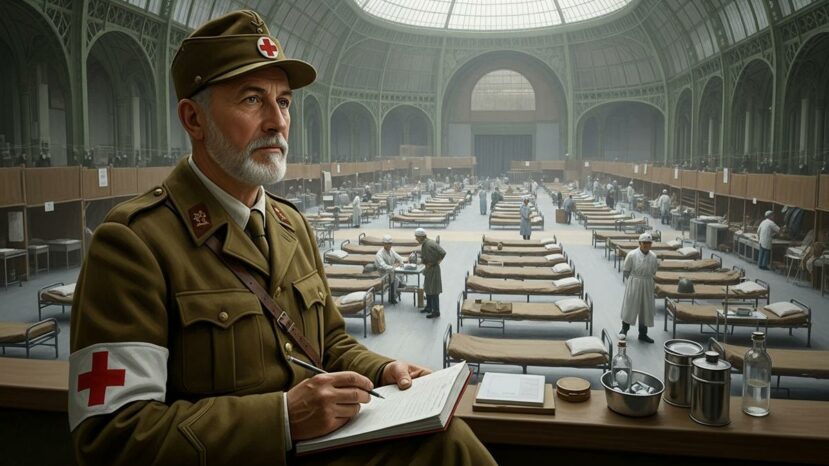
In Paris, the Grand Palais has already changed face more than once. During the First World War, the glass and steel monument became a refuge for the wounded. In this way, its cultural history intersected with the health emergency, as close to the population as possible.
From art to dressings: a turning point under the glass roof
In the autumn of 1914, Red Cross teams moved into the monumental nave. From then on, the Grand Palais was transformed into a temporary hospital in the heart of the Champs-Élysées. Exhibition aisles became corridors where beds and stretchers were set up.
Wooden partitions design care and rest rooms. Operating theatres and dressing rooms appear, designed for emergencies and asepsis. In addition, flows are organized to limit promiscuity and facilitate surveillance.
Ambulances arrived quickly, close to the main roads, so sorting was straightforward. Volunteers, nurses and doctors take turns until the Armistice of 1918. Then, the immense glass roof protects a precise ballet of admissions, care and convalescence.
“Under the glass roof, art gave way to care.
Care, rehabilitation, reassurance
Wounds were treated, but so were bodies shattered by war. As in other Paris hospitals, X-rays, physiotherapy and rehabilitation workshops are organized at the Grand Palais. As a result, patients relearn simple gestures before returning home.
The experiences of the wounded structure daily life, yet the pain remains in the memory. What’s more, convalescence is accompanied by letters, modest gestures and hot meals. The presence of attentive teams keeps morale up, day after day.
- 1914-1918: the time frame of the military hospital on site
- Healthcare operator: French Red Cross and aid networks
- Key functions: hospitalization, surgery, dressings, radiography, rehabilitation
- Site advantages: proximity to the Champs-Élysées and rapid access
- Heritage: memory preserved in archives and testimonies
A sanitary worksite in the heart of the capital
Buildings pose material challenges, so hygiene is closely monitored. Heating and ventilation are adapted to the large volumes and flows. Finally, the housekeeping department ensures clean linen, water, disinfection and essential repairs.
The authorities coordinated the effort with the Red Cross and the Assistance Publique. The Grand Palais became a key link in the Paris health network. As a result, the capital distributed care according to the specialties and capacities of each site.
Works of art and trade fairs give way to the calendar, yet the memory of the place persists. Consequently, the archives preserve photos, plans and activity reports to document these months. In this way, researchers can cross-reference sources and gauge the scale of the organization.
Players and professions involved
Trained nurses, military and civilian doctors cross paths on a daily basis. Stretcher-bearers, drivers and stewards support the entire care chain. What’s more, young carers learn quickly, in contact with seasoned teams.
This network also relies on volunteers, donations and rare skills. On the other hand, medical requirements remain strict at the Grand Palais, from reception to follow-up. The supply of dressings, tools and food also determines the quality of care.
What this past means for the way we look at things today
This narrative feeds another use of heritage, and so it calls for respect and precision. From now on, guiding a visitor also means recounting a mission of exemplary care. As a result, the public monument is seen as an agent of solidarity in times of crisis.
Memory markers exist in the capital, so memory circulates in the city. On the scale of the Grand Palais, this historical thread helps to understand the contemporary site. As a result, cultural programs sometimes include this chapter, to enlighten the experience of the public.
Facing the glass roof, we imagine the stretchers, the silences and the murmurs. What’s more, this sensitive look is based on dated, precise and verifiable facts. In this way, passing on this history means linking past care with present practices.



Aucun commentaire
Publier un commentaire
Participez toujours dans le respect de la loi et des personnes.