



Michelangelo and Rodin confront each other at the Louvre: new exhibition
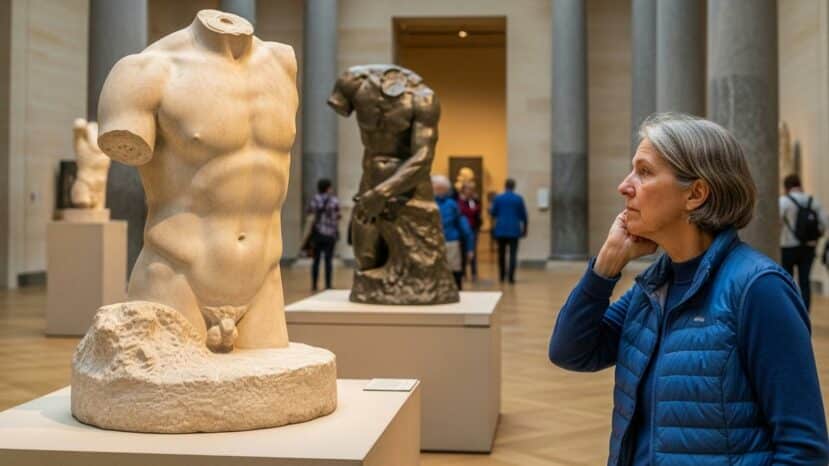
In Paris, the Musée du Louvre brings Michelangelo and Auguste Rodin together in a rare and striking face-to-face encounter. The sculptors converse in marble, clay and plaster, under the watchful eye of a curious public. Each advances at his own pace, without losing the thread of the attentive and patient gaze on site.
The tour brings together study drawings, fragments and finished marbles, with no heavy-handed pedagogical effect. In addition, discreet comparisons illuminate choices of form, light and material. In this way, each room constructs a lively dialogue, then relaunches the visit with sensitive counterpoints.
Michelangelo and Rodin at the Louvre: a lively dialogue
The subject matter revolves around the body, the fragment and the famously unfinished, among other things. As a result, the sculptors appear close in their impetus, but remain distinct in their final intention. The comparison doesn’t impose anything; rather, it reveals differences in rhythm, density and breath.
In Michelangelo, the figure struggles with the block, as if the material were still resisting. Rodin, on the other hand, captures the moment, then lets the sketch vibrate until it verges on a sensitive abstraction. In this way, the eye follows a concrete path, from the weight of the marble to the ribbing of a model.
“Seeing Michelangelo and Rodin face to face changes the perception of each work.”
Gestures, materials and crossed views
The scenography multiplies oblique points of view to open up clear, often useful, correspondences. In this way, a hand detail responds to a torso, and the light guides the eye, without heaviness. In addition, low plinths allow us to approach the volumes without losing the safe distance from the public.
We observe working sets that evoke the studio, time and, sometimes, happy fatigue. What’s more, the casts reveal the often invisible stages in the process, from sketch to enlarged museum piece. In this way, the sculptor’s gesture can be better read by the visitor, without fetishizing the tool or the trace.
- Michelangelo and Rodin face off on common and divergent themes
- Highlighted materials: marble, plaster, terracotta, with light and shadow effects
- Visual dialogues between fragments, torsos and hands, to capture momentum and pause
- Lighting designed to follow gestures and shapes, without dazzling the eye
- Contextual markers to situate works and workshops, from initial drawing to enlargement
Tour and points of interest
The tour opens with drawings, to put thought before force. In this way, visitors understand the construction of a body, from line to volume, very early on. This is followed by freer-format sheets, showing a quest for movement that is still very much alive here.
The marbles and plaster casts are then grouped thematically rather than chronologically within the rooms. As a result, the sculptors respond to each other on the heroic body, dynamism, and the fragment, here. This approach gives clear keys, then withdraws to let the eye act, gently.
The layout encourages circulation, allowing time for observation and reflection. Simple signage provides clear, easy-to-read cues. Occasional seating invites visitors to return to a particular piece, and then set off again.
Historical background and contemporary resonance
Michelangelo worked during the Renaissance, in contact with religious orders and civic authorities alike. As a result, his vision of the body reflects humanist thinking, while serving powerful images. He seeks tension, then shapes the hero with an almost architectural energy, in time.
Rodin works in a modern context, with photography, the press and the enlarged studio. In short, sculptors converse across the centuries, without imposed hierarchies or hasty simplifications. What’s more, the notion of series is taking hold, changing the relationship with the original, which is enduring.
Practical tips for preparing your visit
This reunion at the Musée du Louvre confirms the constant attention paid to sculpture and its links. The museum offers a comparative view, without erasing the authority of each work here. Visitors move between periods and styles, then experience the continuity of a plastic research today.
Before coming, be sure to check the practical details announced by the institution, to avoid waiting. Also, extended opening hours can make it easier for enthusiasts and amateur sculptors to visit during the week. Be sure to allow plenty of time, as the eye sometimes needs breaks to mature too.
For a group, alternate comments and silences, to let everyone really breathe in the works. The result is a lively dialogue between students, amateurs, professionals and budding sculptors. The outing can easily be extended with readings, sketches, or a visit to neighboring rooms.

Aucun commentaire
Publier un commentaire
Participez toujours dans le respect de la loi et des personnes.