



Les Maîtres du Feu at the Musée d’Archéologie nationale: the historical exhibition continues in Saint-Germain-en-Laye
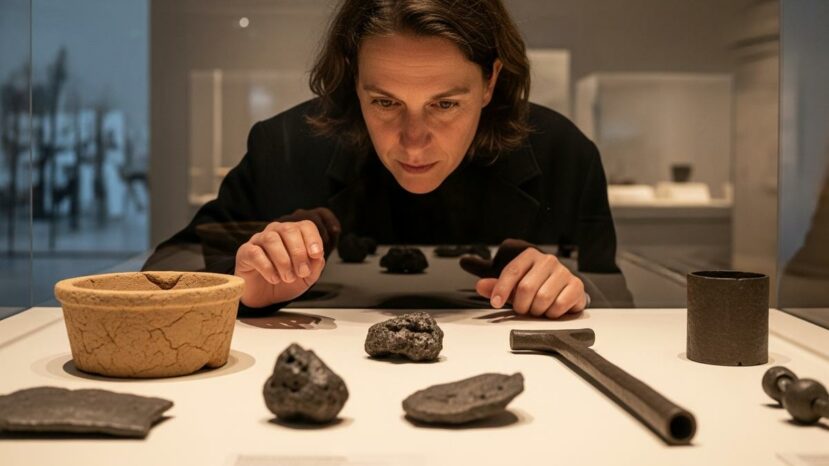
The Musée d’Archéologie Nationale continues “Les Maîtres du Feu”, in Saint-Germain-en-Laye. This historical exhibition methodically highlights the mastery of fire and its social impact. The public benefits from an extended, unhurried calendar.
At the museum, fire is a common thread
At the Château de Saint-Germain-en-Laye, the setting makes sense. The tour links objects, gestures and traces of old workshops in a coherent way. The historical exhibition places each piece in a precise, contextualized narrative.
The rooms feature well-preserved crucibles, molds, nozzles and hammers. What’s more, clear diagrams illustrate successive heating, pouring and annealing processes, without getting technical. You can follow the process step by step, without unnecessary jargon or shortcuts.
From the Neolithic to the Age of Metals, fire changed everything, everywhere. And the transformation of minerals structured exchanges, knowledge and long-lasting community hierarchies. The mediation remains simple, and the comparisons really help to understand.
“Fire shapes matter and societies, from the first crucible to the forge.”
Gestures, tools, knowledge
At the heart of the exhibition, human expertise remains the key, with no miracle machine. Thus, the historical exhibition emphasizes apprenticeship, observation and intergenerational transmission. Craftsmen adjust temperatures, alloys and times, gesture after gesture, with precision.
Tests show the effect of a stronger or longer blast at the hearth. On the other hand, heating too briefly weakens the final piece, sometimes irreparably. Every detail counts, and determines the success or failure of the work.
- Venue: Musée d’Archéologie nationale, Château de Saint-Germain-en-Laye.
- Access: RER A terminus, journey time approx. 30 minutes.
- Periods: Neolithic, Bronze Age 2200-800 BC, Iron Age 800-50 BC.
- Topics: metallurgy, combustion, craftsmanship and workshop organization.
- Public: families, the curious, students and archaeology enthusiasts.
The museum is based on decades of research carried out in conjunction with laboratories. As a result, the historical exhibition is rooted in verifiable, fully sourced and dated data. Physico-chemical analyses clarify the origins, processes and degrees of mastery observed.
Scientific background and chronology
The layout of the exhibition situates the major periods with clear, legible markers. The Bronze Age covers around 2200-800 BC, depending on the region studied. The Iron Age extends to around 800-50 BC in Gaul, depending on the context.
The showcases display ornaments, tools, weapons and structural hearth waste. We also understand the importance of slag in tracing a complete forge. These clues tell the story of the duration of the workshops and their more distant exchanges.
These processes can be seen in the objects themselves, including cracks and traces of wear. A stone mold, for example, reveals a cautious, discontinuous flow, without breakage. An ingot, on the other hand, bears the memory of repeated, then controlled, heating.
These readings cross complex habitat, sanctuary and tomb contexts. What’s more, they shed light on supply networks that are sometimes vast, including maritime ones. Routes for tin and iron create precise, dynamic maps.
Prepare for a stress-free visit
The site is just a stone’s throw from the RER A terminus on the forest side. From Paris, it takes around 30 minutes to reach Place du Château. The building is visible from the exit, making it easy for groups to arrive.
Plan on a gentle pace, as the route requires attention and a few breaks. Regular breaks also help to memorize the more demanding technical stages. The historical exhibition dialogues with MAN’s permanent collections, without redundancy.
Founded in 1862, the MAN brings together major long-term ensembles. A visit to the museum therefore benefits from a combination of temporary exhibits and complementary reference rooms. You’ll draw useful links between objects, territories and lifestyles.
Why this is a landmark exhibition
Why an extension now, and for whom, in concrete terms? Firstly, the demand for the exhibition exceeds the initial timetable set by the museum. Secondly, the theme brings together researchers, teachers and curious weekend strollers.
Fire talks about engineering, risks, then shared and tested solutions. In this way, everyone projects their own experience into these very concrete, patient gestures. This resonance naturally feeds curiosity and discussion on the spot.
For technical enthusiasts, the example of stoves immediately hits the spot. This historical exhibition also shows the ingenuity of the workshops, with no pretense or folklore. We can better understand the collective effort behind each finished, essential object.
Are you still reluctant to schedule a visit this season, despite the extension? Yet access by direct train really does simplify family organization, including the return journey. You leave with a reliable reference point and a different, useful image of fire.

No comments
Post a comment
Always participate in accordance with the law and with respect for others.