



Chef Florian Barbarot reveals his trick for eliminating garlic burns in the pan
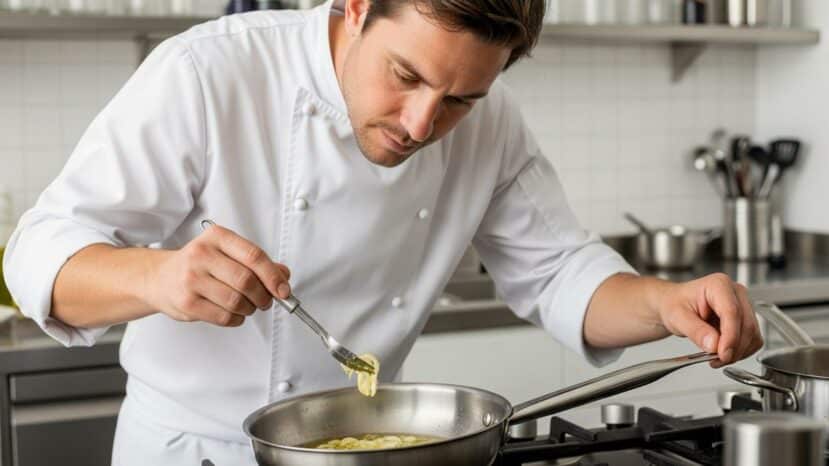
Who hasn’t seen a garlic slice turn black in seconds, leaving a bitter taste? Good news: there’s a simple method for safe cooking, based on a chef’s tip. Inspired by professional practices, it puts heat control at the heart of the gesture, without the need for complicated equipment.
Why garlic burns so quickly in the pan
Garlic contains little water and many sugars, so it colors very quickly. As a result, a pan that’s too hot causes the oil temperature to rise above 140-150°C, and the surface of the pieces browns even before the core perfumes the dish.
The size of the cut also counts, as a minutely chopped clove overheats in an instant. What’s more, garlic reacts differently depending on the fat, the pan material and the order of the ingredients, hence the importance of a chef’s tip that prioritizes these parameters.
What Florian Barbarot recommends
In a tip relayed by the culinary press, Florian Barbarot insists on fire management and good timing. He favors a gentle start to perfume the oil, then adding the garlic at just the right moment: brief contact, pearly color, and immediate removal, a chef’s trick that reassures even those in a hurry.
“Garlic should be intensely fragrant, but never charred. Look for blond, avoid brown.”
It may seem a simple reflex, but it changes everything on the plate. What’s more, removing the garlic as soon as it turns golden allows you to continue cooking the other ingredients without bitterness, then returning the garlic to the heat for a clean flavor.
Step-by-step instructions for a pan without burnt garlic
Start by preparing the garlic according to the desired effect: crushed for a quick release, finely minced for a delicate note, or jacketed for a candied sweetness. Then turn up the heat gradually, and work over low heat: this is the heart of the chef’s tip.
- Heat the pan with a drizzle of oil over moderate, steady heat.
- Add the garlic when the oil ripples, not when it smokes.
- Stir to distribute the heat, without leaving it motionless.
- Remove as soon as it becomes blond and fragrant.
- Reintegrate the garlic at the end of cooking, off the heat if necessary.
Tilt the pan slightly to gather the fat and control the heating zone. In this way, you keep the garlic in a pool of oil at a stable temperature, and remove it after 30 seconds to 1 minute depending on the cut, a chef’s trick that makes the maneuver safer.
Then add your vegetables, pasta or protein, and reintroduce the garlic at the end of cooking. On the other hand, if the pan gets hot, pour in a spoonful of water or stock: the thermal shock lowers the temperature and preserves a clean taste.
Common mistakes and how to correct them
The first mistake is to turn the heat up too high, as this is often done by reflex. So turn it down a notch and watch the smoke point of your fat: oil that’s too hot burns the garlic, whereas a moderate temperature sublimates it.
Another pitfall: chopping the garlic into a purée and then forgetting about it at the bottom of the pan. What’s more, a puree has a large contact surface, so it blackens very quickly; correct this by adding it later, or by choosing thin strips that are easy to control.
Ideas for everyday use
For spaghetti aglio e olio worthy of a trattoria, first brown the garlic over a moderate heat, remove it, then flavor the oil with a chili pepper. Then coat the pasta, add the garlic again off the heat, and serve immediately: this chef’s tip guarantees a clean flavor, with no bitterness.
In a pan-fried vegetable dish, start with the oil, then remove the garlic before adding the vegetables that require more heat. In short, you avoid browning too quickly, and save the garlic for the final touch that wakes up the whole dish.
For pan-fried meats, slip the crushed garlic into the foaming butter at the end of cooking, then baste. As a result, the meat stays juicy and the garlic note remains clear, while the garlic, removed at the right moment, doesn’t go over the edge. So, if you make a garlic-flavored oil, keep it cool and use it quickly, ideally within 3 days, to combine pleasure and safety, in the spirit of a chef’s tip designed to last.




No comments
Post a comment
Always participate in accordance with the law and with respect for others.