Buying to let in ski resorts: an investigation into the profitability of a very French investment.
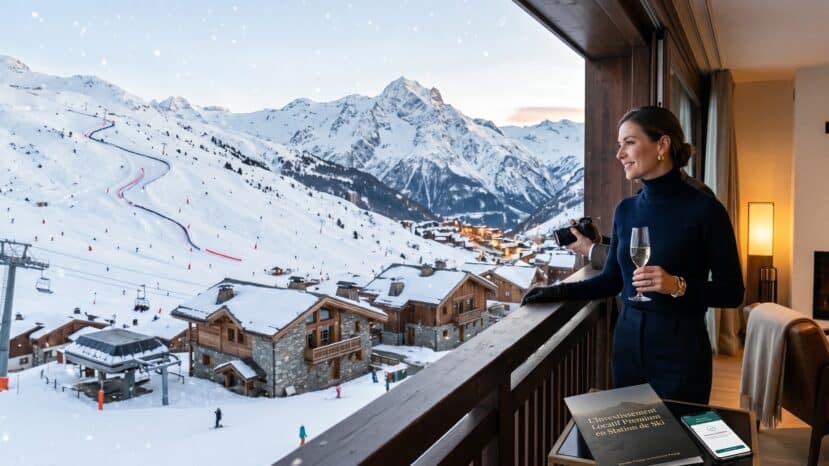


The 2025-2026 season has just drawn to a close in the Alps and Pyrenees, and the results announced at the end of April at the Mountain Planet trade show in Grenoble are enough to give any investor pause for thought. According to Domaines Skiables de France, the average occupancy rate reached 73% in mountain accommodation (+2.5 points in one year), with +1% skier-days on the ski areas and +6% in sales for sports stores. The industry confirms its solidity after an already historic 2024-2025 season with 54.8 million skier-days, placing France2nd worldwide behind the United States. All the more reason to rekindle savers’ appetite for a classic investment: buying an apartment at altitude and renting it out for the coming winters.
But behind the flattering figures, this market remains demanding. Before signing at the notary’s, it’s best to understand where profitability really lies, and above all, what can make it falter. That’s why it’s become a reflex for savvy investors to take out online apartment insurance: between weather damage, rental deterioration and intense holidaymaker turnover, the property needs to be covered from the moment the keys are handed over. Here’s an overview of an investment that’s more subtle than it seems.
A 2025-2026 season that has reshuffled the cards
The past winter has provided some valuable signals for investors. First lesson: the window of profitability is widening. The Christmas vacations climbed to 86% occupancy, January reached 67% (+3 points), and above all March leapt to 57%, buoyed by an exceptional late snowfall and demand increasingly smoothed out over the season. For an owner-lessor, what this means in concrete terms is that we’re no longer just renting “the two weeks of February”: we’re now renting from mid-December to mid-April, with real demand in the inter-holiday periods.
Second lesson: the geography of returns is changing. The Southern Alps and Pyrenees are doing well, with resorts such as Saint-Lary and Font-Romeu 2000 openly talking about record figures. Meanwhile, the mid-mountain massifs (Jura, Vosges, Massif Central) are in decline. The message for investors is clear: altitude is no longer an option, it’s an insurance policy against snowfall volatility.
Third lesson: international customers are back in force. The British, Belgians and Dutch still account for the bulk of foreigners (between 25% and 35% of skiers in France, depending on the resort), and 50% of professionals forecast an increase in this clientele by 2025-2026. This is good news for yields, provided you target internationally-renowned resorts.
Mythical slopes, a real driver of real estate value
The value of a mountain property depends on the reputation of its area. Legendary slopes act as magnets for rental demand, and some of them are enough to attract an entire resort.
La Sarenne, at Alpe d’Huez, remains one of Europe’s longest black runs, with 16 kilometers of downhill. La Face de Bellevarde in Val d’Isère, scene of the 1992 Albertville Games, attracts a premium clientele ready to pay top dollar for ski-in/ski-out accommodation. And above all, the Trois Vallées ski area, the world’s largest linked ski area with 600 km of pistes between Courchevel, Méribel, Val Thorens, Les Menuires and Saint-Martin-de-Belleville, accounts for more than half of the 5-star offer in the French Alps.
Targeting these internationally renowned resorts automatically maximizes ROI. Square meters are expensive (over €25,000/m² in Val d’Isère at the top end of the market, even more in Courchevel 1850), but gross profitability remains solid thanks to a wealthy and loyal clientele. Less iconic estates offer lower entry prices, but require much harder sales work to fill the weeks.
The halo effect of luxury hotels on private property
A point often underestimated by investors: the presence of palaces and 5-star hotels in a resort mechanically boosts the rental value of surrounding private properties. As in Paris, where twelve hotels now bear the Palace label, the luxury ecosystem drives up the value of the entire area. When a visitor looks for a chalet or apartment in Courchevel 1850, he or she is in an environment where Les Airelles, Le Cheval Blanc (owned by LVMH), Le K2 Palace, L’Apogée and Hôtel Barrière Les Neiges are all classified as palaces. Today, the resort boasts more than 20 5-star hotels. In Megève, the Rothschilds’ village spirit continues with addresses such as the Four Seasons, Les Fermes de Marie, l’Alpaga and the Chalet du Mont d’Arbois, supported by a gastronomic scene with Emmanuel Renaut’s three-starred Flocons de Sel. In Val d’Isère, Les Airelles, Les Barmes de l’Ours, Le Blizzard and K2 Chogori set the standard. Val Thorens (Koh-I Nor, Altapura) and Méribel (Le Coucou, Le Kaïla) are following the same trajectory.
For an owner-lessor, this environment changes everything. It sets end-customer expectations (bedding, equipment, finishings), it justifies higher rental rates, and it reassures an international clientele that first looks for well-known brands before booking a private property.
Extreme statistics: a high-risk sport
While these descents add value to local real estate, they also serve as a reminder that downhill skiing is far from harmless. As a landlord, you welcome a public exposed to speed, changeable weather and over-frequentation of popular areas.
Out of 51.8 million skier-days in the 2023-2024 season, some 136,700 injuries were recorded, representing a stable average of 2.6 injuries per 1,000 skier-days. Mountain rescuers intervened more than 53,500 times in marked areas alone. The 2025-2026 season, marked by an unstable snowpack, also saw a particularly heavy avalanche toll in the Alps, with some thirty fatalities by mid-season. Above 70% slope capacity, collisions increase sharply due to insufficient safety distances.
For an owner, these figures are not anecdotal. They determine the profile of the tenant who returns in the evening: wet equipment, fatigue, sometimes injury. Providing dedicated technical storage areas (skis, boots, helmets) is not a luxury, it’s what prevents falls in the home and preserves the furniture.
Protecting your heritage from the constraints of altitude
High altitude imposes climatic constraints that the plains ignore. Frozen pipes, the weight of snow on roofs, water damage during the spring thaw: these are just some of the disasters that, if poorly anticipated, can wipe out an entire year’s profitability. In fact, the 2025-2026 season was marked by the partial closure of ski areas in Savoie, Haute-Savoie and Isère due to heavy snow cover, a sign that extreme events are becoming the norm.
The intense rotation of holidaymakers does the rest. Edge damage in narrow corridors, ski boots carried into the living room, wet equipment on the parquet floor: property damage quickly accumulates and is expensive. Appropriate home insurance, designed for the mountains and short-term rentals, is now essential to absorb this damage and preserve the net yield.
Finally, there’s the question of service. Successful investors are those who understand that the competition is no longer based on location alone, but on the experience offered. Just as we consult a book of high-end Parisian addresses to unearth the best experiences in the capital, the layout of a chalet or apartment in a resort must be inspired by the codes of the hotel industry: premium bedding, meticulous welcome, local concierge service, recommendations for tables and instructors. It’s this level of service that wins the loyalty of a demanding clientele, and justifies nights at €800 rather than €300.
What investors take away from the season
The winter of 2025-2026 confirms that mountain real estate remains a real asset class, as long as the right target is set: altitude, linked ski area, internationally recognizable resort, hotel environment that pulls the resort upwards. Profitability exists, and is built around iconic slopes such as La Sarenne and La Face de Bellevarde, in ecosystems where palaces and Michelin-starred restaurants stand side by side. But it has to be earned. More than 136,000 people are injured every season, ski areas are closed due to bad weather, and rental turnover wears out properties: protecting your assets is not an option, it’s what turns a fine purchase into a lasting investment.