
This dermatologist is adamant: if your nails burn under the UV lamp, it’s this signal you shouldn’t ignore
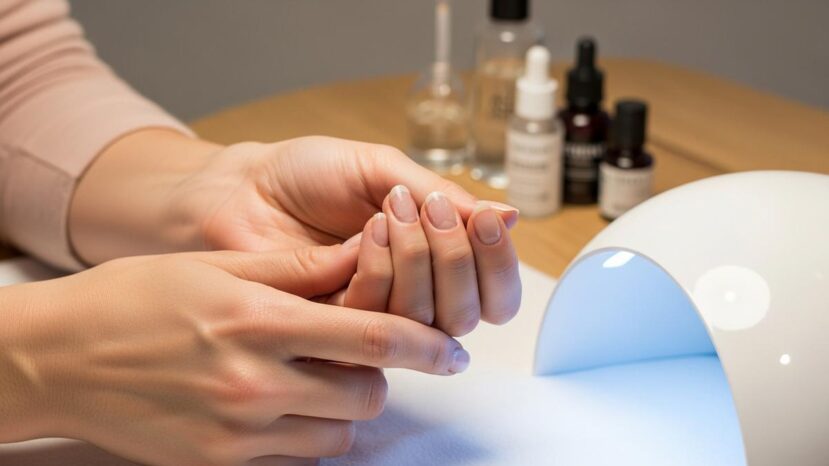


Semi-permanents have transformed manicure habits in just a few years. However, some professionals are now warning about a reflex that has become all too common: applying nail after nail without ever giving your nails a break.
Semi-permanent varnish: a questionable success story
Mirror shine, long-lasting hold, always-clear results… Semi-permanent nail polish has established itself as a practical, hard-wearing alternative to classic nail polish. No need to redo your manicure every three days: nails remain impeccable for several weeks.
But if this technique is so popular, some specialists are beginning to sound the alarm. Contrary to popular belief, the problem isn’t just semi-permanent hair itself. It’s the repeated repeated applicationsuccessive removal with acetone and regular filing can gradually weaken the natural nail.
Over time, some women notice that their nails are softer, thinner, sometimes split or more brittle than before. Dermatologist Dana Stern, who specializes in nail health, explains that repeated gel or semi-permanent applications can lead to “over-treated” nails.
“The acetone used during removal remains particularly aggressive for the nail plate.”
Nails weakened by frequent dissolving
Dana Stern, interviewed by Refinery29, points out that frequent dissolving and repeated mechanical aggression weaken the plaque. As a result, a sensitized nail does not immediately return to its original state.
Between the UV used under the lamp, repeated dissolving and frequent filing, the nail surface can gradually lose its resistance. As a result, certain sensations of heat under the UV lamp during application can sometimes be the sign of nails already sensitized by repeated manicures.
- Nails softer or thinner than before
- Dull appearance and visible streaks
- Sensation of “softened” nails
- Split or brittle nails
- Sensations of heat under UV lamp
Breaks that allow nails to recover
For a long time, many people thought that simply reapplying nail polish was enough to mask weakened nails. However, experts now recommend more moderation. The aim is not necessarily to abandon semi-permanent nails altogether, but rather to alternate periods of application with periods of recuperation.
This heat phenomenon is often downplayed, even though it can reveal a fragile nail plate. It’s usually during breaks that we really notice the state of our nails. Signs that are prompting more and more women to rethink their manicure habits.
As a result, many are now adopting a more balanced approach to semi-permanent. Some alternate between classic and semi-permanent varnish, while others prefer several weeks without application.
A new approach to manicure
This realization is prompting many nail enthusiasts to space out their salon appointments. What’s more, allowing nails to regenerate naturally is becoming a priority for those who have noticed signs of fragility.
By alternating between different techniques, you can enjoy the benefits of semi-permanent nails without the drawbacks. Consequently, moderation seems to be the key to maintaining healthy nails over the long term.
Warning signs to watch out for
Duller appearance, streaks, lack of suppleness or the sensation of a “softened” nail: these signs should alert semi-permanent nail enthusiasts. They often indicate that the nail plate needs a period of rest.
Dana Stern points out that these symptoms generally appear after several months of consecutive application. So, observing your nails during a break allows you to better assess their actual condition.
In 2026, this awareness is gaining ground among manicure enthusiasts. Henceforth, the trend is towards a more reasoned consumption of semi-permanents, with regular breaks to preserve the health of nails.
Professionals are encouraging this evolution in practices. Because a healthy nail remains the best basis for a successful manicure, whether classic or semi-permanent.