The 3-ingredient herbal tea that gastroenterologists recommend drinking after dinner to soothe the intestines


We often think about what we eat. Yet what we drink in the evening plays a key role in lightening our bowels. A simple three-ingredient herbal tea could well change all that, according to two experts: Dr Martine Cotinat, gastroenterologist and author of Guide de la santé du ventre (Ed. Terre vivante), and Lydie Palmieri, naturopath.
Why is the evening crucial for gut health?
The intestine doesn’t stop when night falls. It continues to work, to sort, to repair. What we do in the hour before bedtime directly influences the quality of this nocturnal work.
Lydie Palmieri’s answer is primarily neurological. According to her, repetition and the anchoring of a routine transmit indications to our brain. The brain loves stability and constancy.
Associated with the end of the day, a ritual drink becomes a signal. It’s the signal to switch to rest. In this way, ritualizing the after-dinner ritual helps to switch into parasympathetic mode, and thus to promote sleep.
“Ritualizing after dinner helps to shift into parasympathetic mode, and therefore promote sleep.”
The nervous system and digestion: a direct link
This parasympathetic nervous system is the opposite of the stress mode. It also governs digestion. So, calming it simultaneously relaxes the intestine andlightens the bowel overnight.
There’s nothing to prevent a morning ritual in parallel. However, both experts agree: in the evening, the body is more available to receive the benefits of plants.
- In the evening, the intestine continues its repair work
- A vesper routine sends a rest signal to the brain
- Parasympathetic mode promotes soothed digestion
- A lukewarm drink helps lighten the bowel without rushing it
- The ideal time is after dinner, not just before going to bed.
When and how to drink this herbal tea to lighten your bowels?
Dr Martine Cotinat adds an important medical nuance. A drink taken at the same time as a late meal can increase stomach volume. As a result, the specialist describes nocturnal gastro-oesophageal reflux as “the most aggressive”.
Hydration too late can also cause night-time awakenings. These interruptions fragment deep sleep and, in cascade, promote constipation. That’s why timing is crucial if you really want to lighten your bowels.
The right thing to do is to take this drink after dinner, not just before going to bed. It should be consumed in small quantities at lukewarm temperatures. According to the gastroenterologist, both cold and hot temperatures slow down digestion.
This precaution allows you to enjoy the digestive benefits without disturbing your sleep. What’s more, a moderate quantity will avoid overloading the stomach at the end of the day.
Mistakes to avoid in the evening
Drinking too close to bedtime remains the main pitfall. The resulting night-time awakenings impair the quality of restful sleep. In addition, drinking too hot or too cold slows down the digestive process.
Combining this herbal tea with a late meal is not recommended either. The extra volume in the stomach increases the risk of reflux. On the other hand, waiting an hour after dinner optimizes the effects to lighten the bowel.
The trio of ingredients recommended by experts
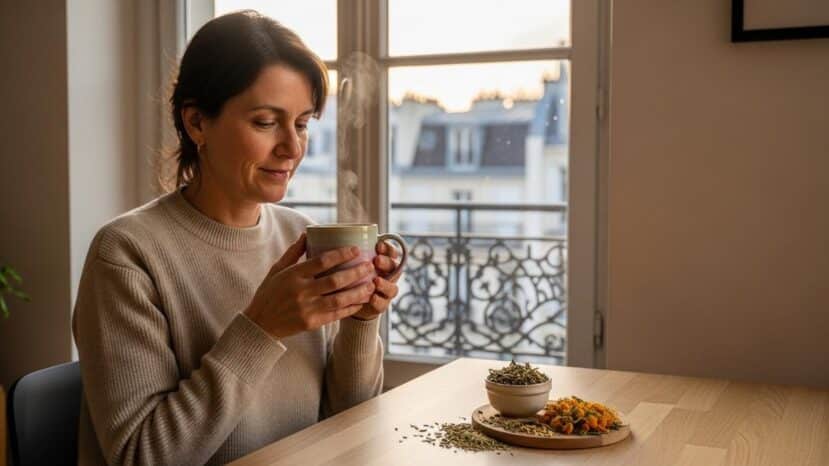
Lydie Palmieri has her trio of choice for acting on the intestines and nervous system. She describes it as her “best evening trio for a soothed mind and belly”.
Lemon verbena comes first for its dual action. It is soothing, reducing stress and improving sleep quality. It is also digestive, relieving bloating and stomach cramps.
Orange blossom has similar virtues. Calming and antispasmodic, it acts against nausea. What’s more, it promotes slow, soothed digestion, ideal for gently lightening the bowels.
Fennel completes the trio. A carminative plant par excellence, it relieves heaviness and persistent bloating. Its action on gas is recognized by both naturopathic and medical approaches.
Dr Cotinat confirms that several plants have documented efficacy on the intestinal mucosa and microbiota. She cites marshmallow root and its protective mucilage. Turmeric has anti-inflammatory and microbiota-modulating properties. Ginger stimulates gastric emptying.
Licorice has interesting anti-inflammatory and antimicrobial properties. Beware, however, of medical contraindications. Peppermint, with its scientifically-proven antispasmodic power, is best reserved for daytime use, so as not to disrupt sleep.