The 98% collapsed rose that Chanel, Dior and Louis Vuitton decided to save in Grasse
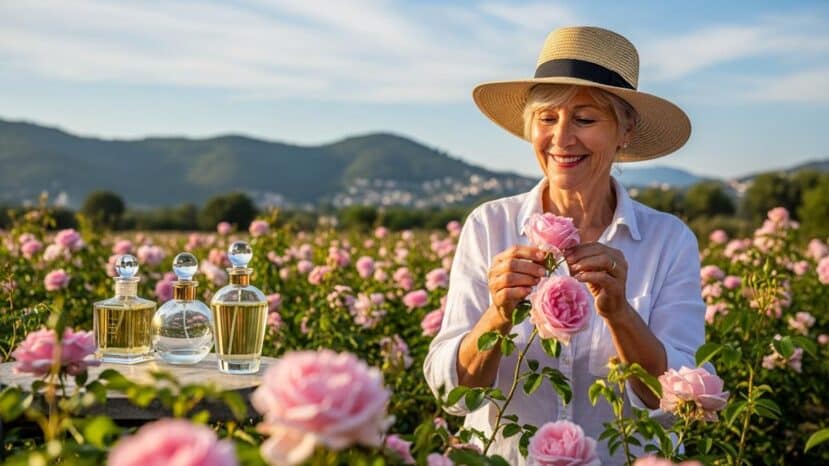


The Centifolia rose, treasure of the Grasse hills, has come close to extinction. Production fell from 3,000 tonnes at the beginning of the 20th century to just 59 tonnes in 2011, a 98% collapse. But thanks to the commitment of companies like Chanel, Dior and Louis Vuitton, the world’s perfume capital is coming back to life.
A vertiginous decline: when Grasse lost its roses
In 1939, the Alpes-Maritimes produced up to 1,600 tons of Centifolia rose and almost 2,000 tons of Grandiflorum jasmine. Perfumers from all over the world came to stock up in this town perched high above the Côte d’Azur. The decline then began, slowly but surely.
International competition struck first. Grasse jasmine costs 20-30% more than that grown in Egypt or India. Real-estate pressures did the rest: floral plots were suddenly worth much more in square meters of living space than in petals.
By 1971, volumes had dwindled to around 300 tonnes. The rise of synthetic ingredients completed the marginalization of local cultures. Grasse wasn’t dying, but it was being hollowed out.
“His ancestral know-how, the same that gave birth to Chanel N°5, risked becoming a mere line in the history books.
The unique profile of the May rose
Despite this decline, Grasse retained a major asset. No one else could reproduce the unique olfactory profile of the May rose. This uniqueness was to become the lever of its renaissance.
The great luxury houses understood this before anyone else. They capitalized on this irreplaceable specificity to anchor their creations in an authentic terroir. This strategic choice has changed the destiny of an entire region.
- Centifolia rose production in 2011: 59 tons
- 98% drop compared to the beginning of the 20th century
- Grass Jasmine 20% to 30% more expensive than the competition
- Volumes already reduced to 300 tonnes by 1971
- Unesco inscription of know-how in 2018
Chanel and luxury giants to Grasse’s rescue
If Grasse still breathes jasmine and rose, it’s thanks to the loyalty of a few houses. For decades, Chanel has had an exclusive partnership with the Mul family for the flowers used in its legendary N°5 fragrance. The house has even had its own extraction plant in the middle of the fields since 1987.
This model remains extremely rare in the industry. Dior has signed several exclusive agreements with local producers. In 2016, Louis Vuitton opened Les Fontaines Parfumées, a vast creation center dedicated to its fragrances.
Since 2023, Lancôme has been welcoming visitors and customers to Domaine de la Rose, a seven-hectare property acquired in 2020. It’s no longer just about sourcing: it’s now a showcase, a laboratory, a selling point. The real cost of making a perfume begins here, in the red earth of the Grasse hills.
In 2018, Grasse’s perfume-related know-how was inscribed on Unesco’s intangible cultural heritage list. This consecration also served as an electroshock for local decision-makers.
Chanel’s commitment to the Mul family
Chanel’s partnership with the Mul family illustrates a long-term approach. Chanel doesn’t just buy flowers: it invests in an entire ecosystem. This long-term relationship guarantees the quality of the raw materials for N°5.
Thanks to this loyalty, ancestral know-how endures. Growers pass on their techniques from generation to generation. This continuity also benefits other houses in the region.
928 hectares set aside for agricultural reclamation
In Grasse, the main issue is land. In 2018, the municipality took a radical decision: to reclassify nearly 100 hectares initially earmarked for urbanization as agricultural land. Among them, 70 hectares were set aside for perfume plants.
As a result, the communal agricultural area has increased from 178 to 928 hectares. This measure provides long-term protection for flower-growing in the face of real estate pressure. It also offers new prospects for young farmers.
At the same time, international giants have reinvested heavily. Switzerland’s dsm-firmenich has set up its natural ingredients development site. International Flavors & Fragrances has almost doubled its headquarters in Grasse. For its part, Givaudan is preparing a new innovation center.
The balance of power is also changing. Contracts now allow young farmers to set up in business, where the relationship between grower and manufacturer used to be “rather dominant-dominated”, according to Laetitia Lycke of the association Les Fleurs d’Exception du Pays de Grasse. In June 2025, Grasse will host Simppar, the international trade show for perfume raw materials, long reserved for Paris. This transfer symbolizes a brilliant reconquest for the world capital of perfume.