
Mycelium, seaweed, oyster shells: the 2026 decor trends that make every home unique
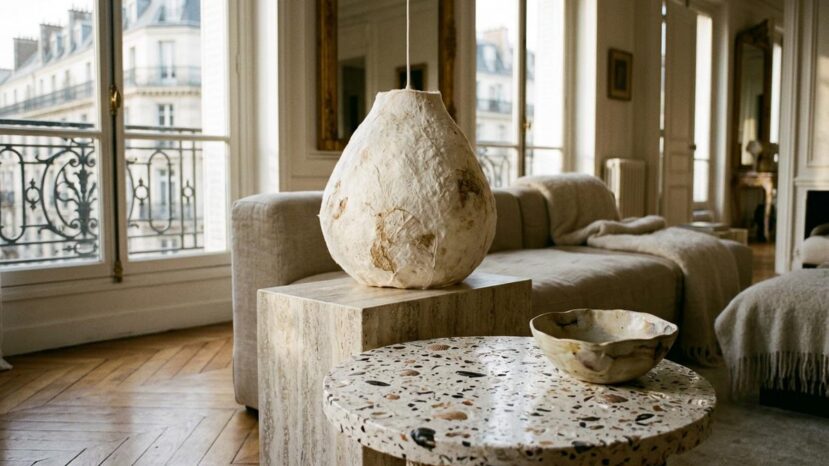


Living materials, unpredictable chemical reactions, resources from the sea or the forest floor: the interior design trends of 2026 push the boundaries of what’s possible and promise every interior a radically unique identity.
When the Sea and Nature Become Raw Materials
Among the most striking trends in interior design, the use of marine resources stands out for its diversity. The Nantes-based design studio Malàkio creates a marine-inspired terrazzo using oyster, mussel, and scallop shells, as seen in its “MA02” wall sconce. Each piece thus features a unique texture and color palette.
Even rarer is the Danish duo Jonas Edvard and Nikolaj Steenfatt, who mix seaweed with paper to create furniture. Meanwhile, the French women of the hors-studio collective have worked with byssus—the natural secretions produced by mollusks—to design lighting installations presented at the Prototype fair in Paris.
In addition, some unexpected plant-based fibers have joined this list: loofah, agave sisal, corn husks, and even weeds are now being used to make furniture. These niche materials reflect a fundamental shift toward entirely new sources.
Mycelium: The New Leather of the Design World
Mycelium, produced from fungal filaments, is combined with plant fibers to create strong composites. This process gives rise to stools, coffee tables, lamps, and wall panels with properties that traditional plastic or wood cannot offer. The New York-based company Ecovative pioneered this field as early as 2007 with its first mycelium-based material.
However, it was Dutch designer Eric Klarenbeek who, in 2012, created the first finished product: a chair molded from mycelium. Since then, the process has expanded. In 2025, the Aifunghi brand presented ten original pieces at the 3daysofdesign festival.
That same year, Studio Tooj, a Japanese-Swedish design firm, unveiled the Duk collection: draped furniture made from wood and mycelium “leather.” In December 2024, the Indian design duo Anomalia presented the MycoMuseum in Mumbai, which also featured furniture made from mycelium “leather.” These initiatives show that the trend toward living decor is here to stay.
The Unpredictable as a Tool for Personalization
Some designers have turned randomness into a true creative act. Today, the boldest interior design trends rely on processes in which the material plays just as much of a role as the artisan. Roche Bobois illustrates this in its 2026 outdoor collection with stoneware side tables on which multiple layers of pigments are applied in several stages and fired multiple times, resulting in consistently unique finishes.
Similarly, designer Dan Yeffet, in collaboration with the Veronese brand, adds glass patches to mold-blown vessels and then fuses them together through firing. The final shape when the pieces come out of the kiln remains completely unpredictable. And that is precisely the challenge: to produce on a large scale while ensuring that each piece is unique.
At the same time, naturally variable materials— marble, wood, lava stone, alabaster —are attracting more and more designers. Their veins, imperfections, and irregularities are no longer seen as limitations. On the contrary, they have become the distinctive features that make each piece of furniture unique.
- Marble and wood: veining varies depending on the section or block
- Lava stone and alabaster: natural irregularities turned into assets
- Fired stoneware with pigments: different results with each firing (Roche Bobois, 2026)
- Blown glass and fused patches: an unpredictable shape upon emerging from the kiln (Dan Yeffet for Veronese)
- Draped mycelium: a unique organic texture in every piece (Studio Tooj, Duk collection)
The human hand is regaining its place over the machine
Other designers place the act of craftsmanship at the heart of their creative process. Serax, for example, collaborated with the Belgian-Peruvian painter Shurleey—whose real name is Shirley Villavicencio Pizango—on the “Santiago de Borja” vases: a sketch created during production is then redrawn by hand. Each vase thus bears an indelible human touch.
The ceramics company Moca Tableware, for its part, has developed a machine that pours liquid porcelain into plaster molds while precisely controlling the speed, movements, and mixing of pigments. The result, once again, is always unique. Thus, even mechanization can serve to enhance uniqueness rather than erase it.
Toward a home that reflects who you are
These new interior design trends all share a common thread: making it impossible to create an exact replica. Whether it involves cooking, living materials, or artisanal techniques applied to mass production, each approach guarantees a unique result. Today’s interior design trends, therefore, don’t simply aim to be beautiful—they aim to be irreplaceable.
This trend responds to a genuine need. More and more people refuse to have a living room that looks just like their neighbor’s. As a result, brands and design studios are competing to come up with creative ways to combine mass production with customization, and craftsmanship with technology.
The trend toward mass-customized interior design is no longer limited to major luxury brands. From studios in Nantes to workshops in Denmark, from labs in New York to designers in India, a shared ambition is taking hold: to turn every everyday object into a unique piece in its own right. Piece by piece, these interior design trends are shaping the interiors of tomorrow—vibrant, organic, and resolutely personal.