Chanel acquires Charvet, the exclusive blouse maker on Place Vendôme founded in 1838 and frequented by Napoleon I
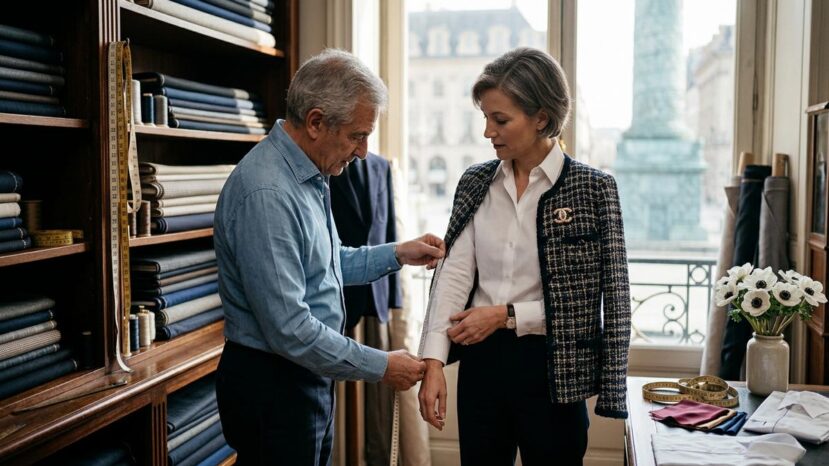


Imagine a fashion house founded during the Napoleonic era, nestled at No . 28 Place Vendôme, joining forces with one of the most famous addresses on Rue Cambon. This partnership between two French luxury institutions has just become a reality, and it says a lot about how Chanel envisions its future.
Charvet: Nearly 200 Years of History Dedicated to Parisian Craftsmanship
Charvet is unlike any other. Founded in 1838 by Joseph-Christophe Charvet, son of Napoleon I’s wardrobe curator, it single-handedly embodies the concept of rare and exclusive luxury. It can be found at only one location in the world: 28 Place Vendôme, in Paris.
This family-owned business has always catered to a very specific clientele. It primarily attracts men seeking carefully tailored shirts, but also many women of refined taste who shop there for well-cut men’s clothing. As a result, Charvet brings together two types of customers that few other brands are able to retain at the same time.
The building on Rue Cambon is now home to a vibrant, solid, and profitable legacy. Bruno Pavlovsky, president of Chanel’s fashion division, confirmed this to *Le Figaro*: “Charvet is a very well-managed company that isn’t losing money.”
Why Chanel Took the Plunge in 2026
The decision to acquire Charvet did not spring from a strategic plan devised in advance. It arose from a personal connection—a meeting of two visions of fashion. Bruno Pavlovsky puts it bluntly: without Matthieu Blazy, Chanel’s creative director who was appointed to lead the collections a little over a year ago, this merger likely would not have taken place.
“This acquisition didn’t stem from a corporate strategy, but from a human story—a connection forged around a project centered on expertise. If Matthieu hadn’t been there, I don’t know if this partnership would have happened.”
Furthermore, Bruno Pavlovsky points out that it was Charvet’s representatives who took the initiative. “To be honest, I think it was actually them who chose us after putting us to the test,” he says. This detail changes everything: this isn’t a takeover, but a mutual decision.
October 2025: The Fashion Show That Started It All
In early October 2025, Matthieu Blazy presented his very first runway show for Chanel. The event surprised the fashion world in more ways than one. The fashion house, which rarely collaborates with other designers, unveiled an unprecedented partnership with Charvet that evening for a line of women’s shirts.
The presentation was very well received. Since then, the two fashion houses have continued to work together, and their complementary nature has become evident. Chanel primarily targets a female clientele, but its designs are increasingly appealing to men. Charvet, for its part, caters mainly to men, while also being appreciated by women who enjoy wearing its clothing.
In this sense, this merger reflects a concrete reality in the luxury market: the lines between men’s and women’s fashion are blurring, and each brand had the customer base that the other was seeking to reach.
Preserving a unique place rather than pursuing growth
What stands out in Bruno Pavlovsky’s remarks is the very nature of the stated goal. It is not about conquering new markets on a large scale, but about preserving a unique place. According to him, Charvet offers an experience that many foreign customers specifically seek out during their visits to Paris.
This philosophy aligns with the one Chanel has championed for several years: offering experiences that are increasingly unique and increasingly rare. For in true luxury, rarity takes precedence over volume, and the experience matters just as much as the product itself.
Bruno Pavlovsky sums up this shared goal in simple terms: “The important thing is to offer the best product and ensure that everyone finds what they’re looking for.” This statement says a lot about the direction Chanel hopes to take with this new partnership, a far cry from the mass acquisitions that sometimes rock the luxury world.
Two companies, a shared vision of the customer experience
Ultimately, what unites Chanel and Charvet goes beyond textiles. The two houses share a conviction: the customer who walks through their doors is not just looking for a garment. They are seeking a moment, a ritual, and a connection to craftsmanship passed down from generation to generation.
Furthermore, both brands uphold a strong form of geographic exclusivity. Chanel operates out of Rue Cambon, and Charvet out of Place Vendôme. These two Parisian locations are, each in their own way, destinations in their own right for high-end fashion enthusiasts from around the world.
For in this agreement, formalized on July 2, 2026, there is something greater than the simple sum of two houses. It reinforces a certain vision of Paris: that of a capital where artisanal craftsmanship does not disappear, but rather finds allies capable of carrying it forward into the coming decades.
Now backed by the strength of Chanel, Charvet can look to the future with confidence, without compromising the essence that has defined it for nearly two centuries.