Seven exceptional manors and palaces with breathtaking frescoes and mouldings
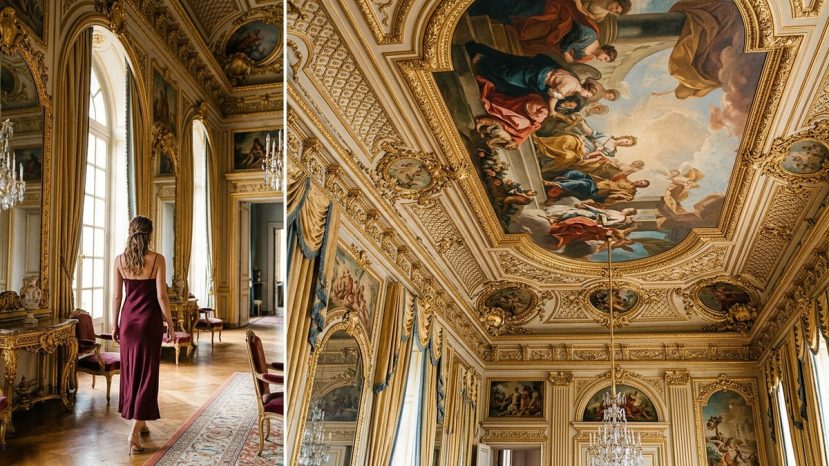


Adorned with frescoes, elevated by plasterwork mouldings and enriched by details that bear witness to a bygone era, these exceptional manors and palaces stand with quiet elegance across the world. From London to Bundi, each tells a singular story, etched into stone, stucco or natural pigment. In 2026, these architecturally remarkable addresses continue to captivate heritage enthusiasts.
Pitzhanger Manor and Syon House: two London gems
Considered one of the last true London country houses, Pitzhanger Manor sits in Ealing, within Walpole Park. This stone building dates back to the 16th century and served as the country retreat of Sir John Soane. Built in the neoclassical style by George Dance, it reflects the British architect’s deep passion for antiquity.
Now reimagined as a museum dedicated to contemporary art exhibitions, this west London landmark retains all of its interior richness. The Breakfast Room, for instance, is dressed in Greco-Roman marbles, paintings and architectural fragments faithful to the whimsical interiors of a former age.
On the other side of London, Syon House overlooks the Thames from the borough of Hounslow. Home to the Duke of Northumberland, this former medieval abbey has undergone many transformations since its construction in the 16th century. Its Elizabethan architecture, restored in the neoclassical style by Robert Adam, makes it one of the most distinctive palaces in the British capital.
The anteroom of Syon House, an exceptional space
Balancing classical interiors with rare collections, Syon House is dotted with details that reference its medieval past. Each room enters into dialogue between two distinct eras, creating a rare visual tension.
The twelve stucco columns and bronze statues amplify the grandeur of the anteroom. This exceptional space remains one of the most photographed rooms among London’s historic residences.
« The twelve stucco columns and bronze statues amplify the grandeur of the anteroom, a truly exceptional space. »
From Munich to Hungary: extraordinary baroque palaces
In Munich, the Pagodenburg at Nymphenburg Palace stands as one of Europe’s finest royal residences. Built between 1716 and 1719 by Joseph Effner, this summer retreat of Bavaria’s former sovereigns takes the form of a Chinese pagoda, adorned with Arabic and Indian motifs that reflect a confident cosmopolitanism.
The small palace, tucked behind lush vegetation, also features figurative Dutch tiles throughout its interior. Furnished by Johann Anton Gumpp and Johann Adam Pichler, this European Régence-style building remains a living testament to the chinoiserie craze of the 18th century. It ranks among the most cosmopolitan exceptional manors and palaces on the continent.
In Hungary, Esterházy Palace has earned the nickname the “Hungarian Versailles”. Built in the baroque-rococo style during the 18th century by the aristocratic Esterházy family, it was once home to composer Joseph Haydn and his orchestra, and is adorned with details reminiscent of opera houses decorated with cherubs.
The Sala Terrena, inspired by a grotto, features coloured stucco, painted walls and porcelain animals. It connects the main courtyard to the sweeping French-style gardens, serving as a graceful transition between the reception hall and the grounds beyond.
- Pitzhanger Manor, London: Georgian neoclassical style, contemporary art museum
- Syon House, London: Elizabethan architecture restored by Robert Adam, anteroom with twelve stucco columns
- Nymphenburg Palace Pagodenburg, Munich: built between 1716 and 1719, 18th-century chinoiserie
- Esterházy Palace, Hungary: baroque-rococo, nicknamed the “Hungarian Versailles”
- Chitrashala, Bundi Palace, India: miniature frescoes in natural pigments, walls and ceilings entirely painted
Palazzo Milzetti, a total work of Italian neoclassicism
In Italy, Palazzo Milzetti represents a complete Gesamtkunstwerk of neoclassicism, blending the architecture of Giuseppe Pistocchi and Giovanni Antolini with the decorative genius of Felice Giani. In the anteroom, mythological scenes and themes drawn from antiquity weave a powerful symbolic narrative.
The Salone Ottagonale, also known as the Temple of Apollo, immerses visitors in a monochrome decorative scheme of deep walls and gilded ceilings. The bas-reliefs by Antonio Trentanove and Ballanti Graziani enter into conversation with Giani’s frescoes. The vaulted ceilings echo those of Raphael, making this space a near-sacred setting where chimeric motifs and classical woodwork resonate with one another.
Sicily and India: residences with breathtaking frescoes
In Sicily, Palazzo Nicolaci di Villadorata presides over Noto, the baroque capital. The historic residence of the Nicolaci family, the building was designed by Rosario Gagliardi in the early 18th century. Its facade, flanked by imposing Ionic columns and grotesque figures, lions, sphinxes and hippogriffs, contrasts sharply with a 19th-century neoclassical interior.
Inside, frescoes, gilding and vibrant ornamentation unfold in the manner typical of Italian palazzos. These exceptional manors and palaces of Sicily embody the full richness of the island’s architectural heritage. Every detail recounts a vanished era with rare precision.
In India, the Chitrashala of Garh Palace in Bundi is an 18th-century painted gallery of extraordinary intensity. This elevated pavilion features walls and ceilings entirely covered in miniature frescoes of breathtaking detail. Rendered in natural pigments, deities, human figures and lyrical movements flood the walls in vivid, luminous hues.
Among the exceptional manors and palaces documented across the world, the Chitrashala holds a place apart. Its bold tones and dense compositions make it a pictorial space without equal. These historic residences, whether London, Italian, Hungarian or Indian, share a single ambition: to freeze time in matter and colour.