Tubing mascara is winning over French women this summer, with Google searches up 424%


In 2026, tubing mascara has established itself as one of the most talked-about beauty innovations. In France, Google searches have surged by 424% in a single year, and nearly 347,000 queries were recorded worldwide in June alone, according to a Glimpse study for Fresha. Yet behind this renewed interest lies a technology that is far older than it might seem.
A tubing mascara that holds up against heat and water
It arrived on shelves so quietly that many people may have already used it without realising. Several pioneering brands, including Glossier, Hourglass, Clinique and Tarte Cosmetics, adopted it years ago. They were later joined by younger clean beauty labels such as Aime Skincare and Merit Beauty, before the term went viral on social media.
Unlike traditional mascaras, which are formulated with waxes, balms and pigments, tubing mascara is built primarily around polymers. These molecules bond together to form a mesh that wraps around each individual lash. The polymers, most often synthetic, dissolve in water rather than in oil. This is why the product washes off easily with warm water, no makeup remover required.
This formula addresses some very familiar summer frustrations: smudging caused by heat and sebum, pigment transfer after a swim, and the laborious removal process of waterproof mascaras. It also holds up, in theory, against tears and a dip in the sea or an unheated pool.
“Once you’ve made the switch, many women never go back, largely because removing it is so much simpler.” Carole Colombani, studio makeup artist
Tubing vs waterproof: what’s the real difference?
Tubing mascara should not be confused with waterproof. The latter relies on different film-forming agents that deliver an even stronger hold, but are also harder to remove and require more rubbing around the eyes. Carole Colombani, studio makeup artist and founder of Colombani Beauty, does not necessarily recommend waterproof for everyday use, unlike tubing, which can be worn daily.
That said, it is best to avoid very hot and humid environments, such as a jacuzzi, a hammam or a heated pool above 28°C. In those situations, a water-resistant mascara will be a better fit. Tubing therefore positions itself as a solid middle ground between staying power and gentleness for everyday wear.
Defined lashes, no clumping, no transfer
Another major strength of tubing mascara is its ability to visually build up lashes, even when they are fine, short or sparse. The polymers form a small sheath around each lash, which Sophie Strobel, a biologist and cosmetic science engineer, likens to “a little bespoke black dress.” Each lash is coated individually, which prevents clumping.
By contrast, mascaras richer in waxes or balms tend to group lashes together. In that case, the quality of the brush becomes essential to restore definition. With tubing, the formula already does most of the work. This makes it a real advantage for those with oily eyelids or prone to smudging by the end of the day.
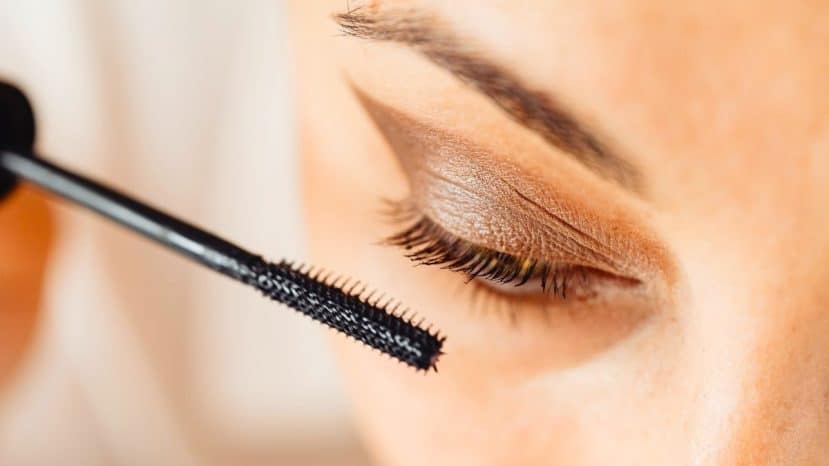
To apply it well, you need to work quickly: tubing mascaras dry faster than classic formulas. Carole Colombani recommends starting with a first coat using the concave side of the brush, then switching to the convex side to add length and volume. Two to three coats are enough, as long as you leave it alone afterwards.
- All-day hold without touch-ups, even in intense heat
- Removes with warm water, no dedicated makeup remover needed
- Separated, defined lashes thanks to individual polymer coating
- Ideal for active women, sports enthusiasts or those with oily eyelids
- Best avoided in very hot and humid environments (jacuzzi, hammam, heated pool above 28°C)
How to remove tubing mascara without damaging your lashes
Removal is arguably the most compelling argument for tubing mascara. Where waterproof mascaras call for a biphasic remover, an oil or a cleansing balm, tubing simply washes off with warm water. Carole Colombani notes that this removes “a real mental load,” especially when travelling or on holiday.
That said, removal is simpler, but not necessarily faster. The makeup artist recommends finishing with a microfibre cloth, a damp cotton bud or a little micellar water. She also advises against removing it in the shower, as this can leave more residue on the skin.
Tubing mascara: a lasting staple in our makeup bags
Does that mean you should ditch your traditional mascara? Not necessarily. Both technologies will continue to coexist, according to Carole Colombani. Tubing mascaras are gradually claiming more shelf space, but what matters most is finding the formula that suits your lashes and your routine. Not every woman has the same expectations.
Sophie Strobel shares this measured view. For her, tubing mascara has become a genuine staple, not a passing trend, but a real formulation innovation that has proven its worth. She is quick to point out, however, that no mascara is universal: a newer formula is not automatically better for everyone.
More than a replacement for classic mascara, tubing reflects a broader shift in what consumers are looking for: products that combine performance, comfort and simplicity. This innovation has every chance of becoming a permanent fixture in our makeup bags.