
Red beet in the vegetable garden: grow successfully and harvest almost all year round
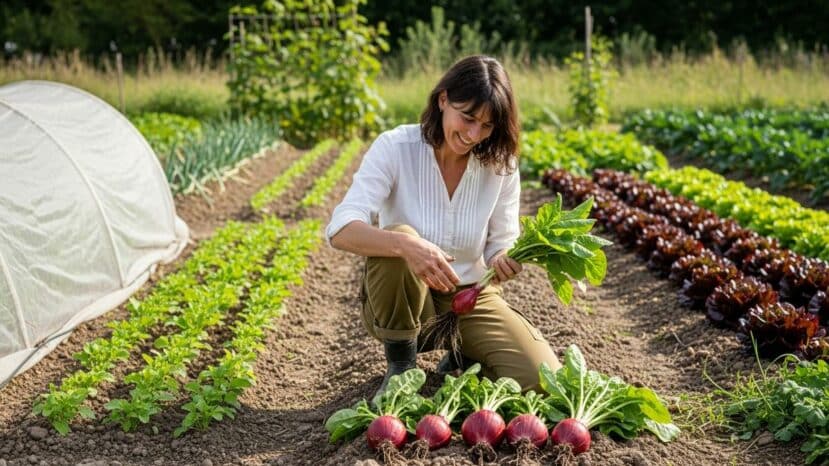


In the vegetable garden, growing beet almost all year round becomes realistic with a few simple guidelines. In this way, you gain in autonomy, while controlling your harvests according to the season.
The local climate counts, of course. What’s more, good soil preparation and regular maintenance ensure healthy, tasty roots.
Sow almost all year round, with the right gestures
At the end of winter, seedlings can be sown under sails or trays to kick-start the season. In open ground, aim for spring to early autumn, depending on the region. For continuous beets, stagger sowing every 2 to 3 weeks.
Deep, loose, pebble-free soil promotes regular root growth. Avoid fresh manure, which is too stimulating for the leaves. Ripe compost, on the other hand, improves structure and retainsmoisture.
“Sowing in stages means long, smooth harvests.”
Each seed is actually a glomerule containing several seedlings. Soak them 12 hours before sowing, to even out emergence. Space rows 25-30 cm apart, leaving 8-10 cm on the row after thinning.
Watering, mulching and heat: winning consistency
Watering should be regular, especially in summer. Aim for 2 to 3 moderate doses per week, preferably in the evening. Mulching limits evaporation and prevents water shock.
- Sow under cover in late winter, then in the open field in spring.
- Thin early to allow each root to breathe.
- Water regularly, without excess or sudden bursts.
- Protect with a net against leaf flies.
- Alternate growing beds over 3-4 years.
Watch for leaves that fade or curl, a sign of stress. Also, constant humidity produces homogeneous, sweeter roots. Beet heckled by drought becomes fibrous more quickly.
Protection and prevention: diseases, pests, rotation
The leafminer bores galleries into the foliage, then weakens it. An anti-insect net installed early on greatly reduces pressure. Remove damaged leaves and discard them, to avoid feeding the cycle.
Algoflash – Vegetable Garden Fertilizer Algoflash Naturasol provides gentle, regular and clear organic nutrition. As a result, the plant grows smoothly and builds fleshy, colorful roots.
Brown spots can signal leaf disease in wet weather. Therefore, space out plants, aerate, and rotate the bed over 3-4 years. Associations with lettuces, onions or cabbage go well, and beets appreciate these neighbors.
From earth to plate: harvesting and preservation
Count on average 8-12 weeks after sowing for a medium-sized root. Pull gently, then twist the leaves by hand to avoid bleeding the flesh. Leaves can be cooked like chard, so nothing goes to waste.
To preserve freshness, cut the tops 2 cm from the collar. Store in cool crates in slightly damp sand. In this way, you can preserve firm roots, including small early beets, for 3 to 5 months.
Variety, nutrition and sensible cooking ideas
The red varieties ‘Detroit 2’ and ‘Crapaudine’ remain sure values. Chioggia’ offers graphic pinkish rings, while ‘Golden’ adds a softer, less earthy note. Choose faster or slower cycles according to your growing window.
In terms of nutrition, the root provides fiber, folate and pigments with studied effects. For example, natural nitrates are of interest to some athletes during exercise. The tops provide vitamins and iron, so a pan-fried dish is a welcome addition to any weekday meal.
To spread out harvests, sow in waves and protect between seasons with a tunnel. From now on, a simple layer of straw will limit early cold and evaporation. You’ll enjoy your beets for longer, from the garden to the table.