
Hôtel de Ville de Paris: in 1871, a fire ravaged the building. Here’s what it looked like before the fire.
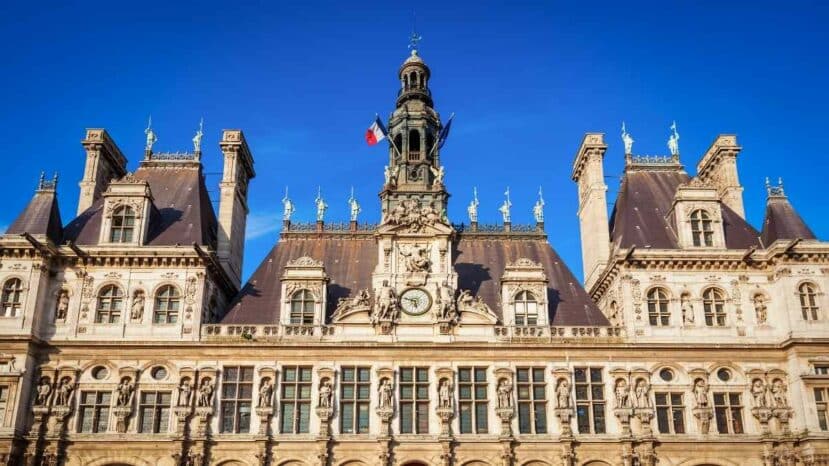


At the heart of the capital, the Hôtel de Ville de Paris bears scars that are both old and visible. However, a major fire struck the building in 1871, permanently altering its use and image. Here, we trace its past forms, then its rebirth in republican and urban France.
Before the flames: a Renaissance civic palace
Initially, the town hall was located on the Place de Grève, close to the merchant quays. In the 16th century, François I commissioned Boccador, anItalian-inspired architect, to build a palace. It was here that the city established taxes, debates, public posters and a nascent municipal power.
Construction began around 1533 and was completed around 1628, following the rhythm of the reigns. The facade is a blend of gables, dormers, broken roofs and tall chimneys, crowned with slate. The carved stone also tells the story of the town, with coats of arms, mottos and civic scenes.
May 1871: the rupture
In May 1871, the Commune set fire to several strategic buildings, including ministries and town halls. The Hôtel de Ville de Paris partially collapsed, and the archives went up in smoke. Despite rescue efforts, the blaze soon ravaged roofs, frameworks and decorations.
“The fire changed the city’s memory, without extinguishing its life.”
As a result, thousands of registers disappeared, including invaluable records of family and urban history. As a result, town halls had to start from scratch, in a hurry, with few points of reference. As a result, families lose civil status records, which are essential for the administrative process.
The Third Republic launched a competition to rebuild the symbolic Hôtel de Ville de Paris. The public authorities then set an ambitious timetable and a budget to secure. Work began in 1873 and was completed in 1882, after a major collective effort.
- Before 1871: a Renaissance palace, enlarged in the 19th century, a major administrative center.
- May 1871: fire, destruction of roofs and massive loss of public archives.
- 1873-1882: inspired reconstruction, modernized structure, new services and enhanced security.
- Facades faithful to the original; interiors redesigned for republican functions.
- Today: guided tours available during heritage events and open days.
Rebuilding without betraying: the Republican challenge
Théodore Ballu and Édouard Deperthes won the project from several other teams. They recreated the Renaissance volumes of the Hôtel de Ville de Paris, then modernized the interior. In this way, they combined memory, security, comfort of use and clarity of sustainable circulation.
What’s more, the structure adopts discreet iron, useful for fire safety and spans. On the other hand, the lounges gain in light, comfort and acoustic quality for all. Technical networks are concealed behind wood panelling, painted ceilings and moulded plasterwork.
As a result, the facade once again features statues, niches and bell towers, like a living stone book. Henceforth, the address once again becomes the civic, ceremonial and administrative heart of everyday life. As a result, the silhouette is once again familiar to passers-by, despite the interior modernization.
What’s changed, what’s stayed the same
Yet the Hôtel de Ville de Paris respects the original scale and urban landmarks. As a result, meeting rooms and departments are less functional and easier for staff to understand on a day-to-day basis. On the other hand, internal circulation is made more fluid by clear pathways.
The grand salon pays tribute to Parisian arts, crafts and civic know-how. The decor also tells the story of work, science, urban solidarity and collective ambitions. In this way, protocol finds a clear, warm and appropriate setting for receptions.
Visit, understand, pass on
First, look at the Place de Grève and its vast perspective over the quays. Secondly, the esplanade has hosted parties, announcements, strikes and public punishments for centuries. Also, observe the cobblestones, the alignments and the views over the Seine.
During the Journées du Patrimoine, the Hôtel de Ville de Paris opens certain areas to the public. You can admire the Salle des Fêtes and the Great Staircase, richly decorated and restored. As a result, the visit reveals a discreet, precise and effective teaching of history.
Keep in mind the trauma of 1871, which left its mark on the Hôtel de Ville de Paris. In short, today’s architecture responds to a fragile past, without denying its collective memory. In this way, everyone can link past and present, with an attentive eye.