Louvre: Empress Eugénie’s crown undergoes restoration, follow the worksite live


An exceptional jewel of French heritage is about to be restored to its former glory. The Musée du Louvre has just announced the launch of a major restoration project: that of Empress Eugénie’s crown. This unique piece from the Second Empire will undergo meticulous work over several months.
Empress Eugenie’s crown enters a phase of historical restoration
This crown is one of the most precious treasures in the Musée du Louvre collections. Created in 1855, it was worn by Eugénie de Montijo, wife of Napoleon III. As such, it embodies a pivotal period inFrench history.
The piece features 2,490 diamonds and 56 emeralds of remarkable quality. What’s more, its gold and silver structure bears witness to 19th-century jewellery-making expertise. Consequently, its restoration requires unrivalled technical expertise.
The jewel had suffered the ravages of time since its last intervention. Some of the stones were showing signs of fragility. Now, a team of specialists will restore it to its original splendor.
“This restoration will allow visitors to rediscover a masterpiece in all its magnificence.”
Maison Mellerio, original creator of this masterpiece
Maison Mellerio designed this crown for Empress Eugénie almost 170 years ago. This Parisian jeweller, founded in 1613, therefore has a unique historical link with this imperial jewel. What’s more, its expertise spans the centuries with remarkable consistency.
The history of the crown remains intimately linked to this prestigious firm. The Mellerio archives still preserve the preparatory drawings for this imperial commission. This artisanal memory guides today’s restoration choices.
An exceptional worksite at the heart of the Louvre Museum
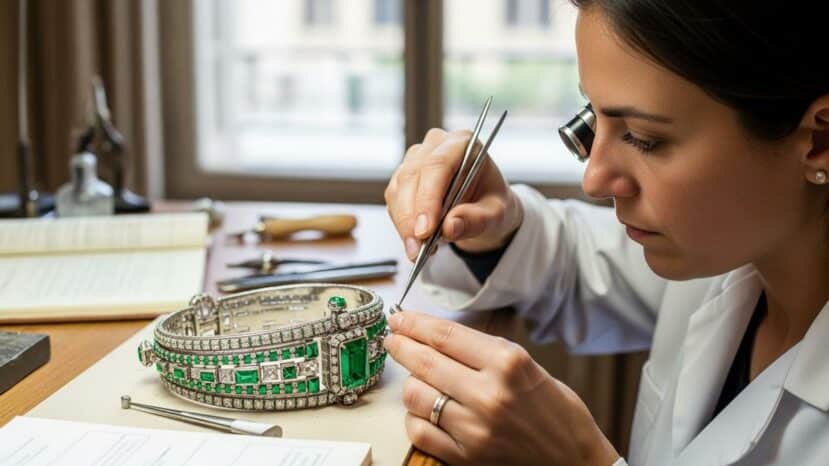
The work is carried out directly in the workshops of the Musée du Louvre. A multidisciplinary team includes curators, gemologists and goldsmiths. In addition, each stage of the work is carefully documented in photographs.
- Complete examination of metal structure under microscope
- Checking each setting of the 2,490 diamonds
- Careful cleaning of 56 Colombian emeralds
- Consolidation of parts weakened by time
- High-definition digital documentation
The restoration is expected to take several months. However, the teams are working extremely carefully to avoid ruffling the jewel. Every gesture counts when handling such a national treasure.
The major French jewelry houses have recognized expertise in this field. Chaumet, for example, has been involved in numerous restorations of historic pieces thanks to its dedicated heritage department. Its expertise in gem-setting and precious metal work is a benchmark the world over.
Cartier also has specialized workshops capable of working on antique jewelry with extreme precision. The company has developed restoration techniques that respect the integrity of the pieces while ensuring their longevity. These rare skills are highly sought after by museum institutions.
State-of-the-art techniques to preserve authenticity
Restoration uses modern technologies to preserve our heritage. Spectrographic analyses identify the exact composition of materials. As a result, our work is scrupulously respectful of original techniques.
Experts also use microsurgical tools for delicate repairs. This minimal approach guarantees the preservation of authenticity. As a result, the crown will retain its historical integrity.
Boucheron is one of those houses that have mastered these ancestral skills combined with contemporary innovations. Its craftsmen perpetuate gestures handed down since 1858, when the company was founded on the Place Vendôme. This continuity of craftsmanship is invaluable in safeguarding our jewellery heritage.
The Musée du Louvre strengthens its commitment to conservation
This restoration is part of a global preservation policy pursued by the Musée du Louvre. The institution devotes considerable resources to maintaining its collections. It also regularly trains new professionals in conservation.
Visitors will be able to follow the progress of the work through regular communications. The museum also plans to provide educational content on the techniques employed. This transparency strengthens the bond between the institution and its public.
Van Cleef & Arpels also contributes to the transmission of jewellery-making know-how through its school dedicated to the trades of haute joaillerie. The company supports training programs that indirectly benefit heritage conservation. This commitment contributes to the reputation of French excellence in this field.
The crown will then be returned to its rightful place in the Louvre Museum‘s Galerie d’Apollon. This prestigious setting has been home to France’s crown jewels for decades. Visitors from all over the world will be able to admire this restored treasure in the best possible conditions.