
Tiffany & Co. unveils Hidden Garden, its new Blue Book collection inspired by Jean Schlumberger
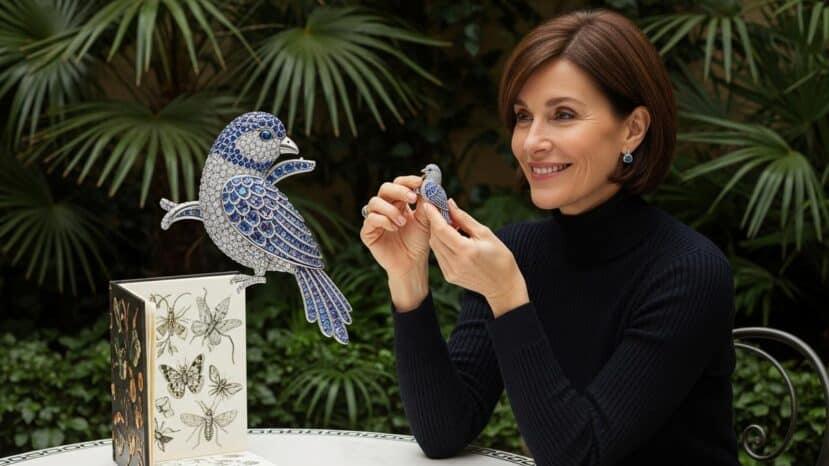


In May 2026, Tiffany & Co. unveils its new Blue Book collection entitled “Hidden Garden”. This high-end jewelry series pays tribute to the designer Jean Schlumberger, a major figure in the New York-based company’s history. With butterflies, parrots and rare stones, each piece tells a specific story.
The Blue Book: an annual event since 1845
It all began with a simple catalog. In 1845, Charles Lewis Tiffany published The Blue Book to introduce his precious stones to a wealthy clientele. Since then, this format has become the most eagerly-awaited rendezvous of American fine jewelry.
In 2026, Nathalie Verdeille, the house’s artistic director since 2021, signs Hidden Garden. This is her fourth collection for this prestigious format. This edition appears to be the most ambitious in its narrative construction.
The starting point is clearly stated: Jean Schlumberger. This whimsical designer transformed Tiffany & Co. jewelry into a theater of the living from the 50s to the 80s. Butterflies, parrots, bees and buds were his favorite motifs.
“Schlumberger’s motifs are used here, but never copied. It’s the nuance that counts.”
The Parrot chapter: sapphires and sparkling enamel
Schlumberger designed parrot brooches in the ’60s, with their characteristic eccentricity. Nathalie Verdeille reinterprets them, blending untreated blue and violet sapphires with hand-applied paillonné enamel. Shades range from midnight blue to duck green, including Tiffany Blue®.
The result is iridescent and lively. The precision of execution is almost miniature. The piece exists on its own, without needing the original to justify it.
- Untreated blue and violet sapphires for the Parrot chapter
- Hand-applied pearl enamel in three distinct shades
- D-color Type IIa oval diamond over 10 carats for the Bee chapter
- Santa Maria aquamarine over 22 carats for Bird on a Rock
- Untreated oval rubies from Mozambique for the Palm chapter
A gemmological obsession at the heart of the collection
What sets Hidden Garden apart is its rigorous choice of stones. Each gem is precisely named, sourced and justified. The aquamarines in the Bird on a Rock chapter come from Brazil, in the Santa Maria hue. This blue offers rare depth and saturation.
The centerpiece of this chapter is a necklace that can be transformed into a brooch. Two birds perched on a stone weighing over 22 carats form the central motif. Custom-cut chrysoprase beads frame the ensemble. Acid green responds to blue intensity with implacable chromatic logic.
The Bee chapter takes as its starting point Schlumberger’s famous Two Bees ring. Geometric cells in 18-carat yellow gold house oval diamonds. The central ring features an oval D-color, internally flawless Type IIa of over 10 carats. In addition, figural bees remain concealed in the setting.
Mozambique rubies and Sri Lankan sapphires
The Palm chapter features untreated oval rubies. These stones come from Mozambique and have been selected for their fluorescence as much as for their color. This attention to detail characterizes the approach of the jewelry house.
The Monarch chapter features cushion sapphires from Sri Lanka and Madagascar. They are nestled in sculpted foliage in platinum and 18-carat yellow gold. This creation also reinterprets a historic necklace with a hidden butterfly.
Bloom: an exception in yellow gold
In the midst of this platinum-dominated collection, one chapter stands out. Bloom is crafted entirely in 18-carat yellow gold. Pink and violet sapphires capture the moment before blossoming. This is the most singular piece in the set.
Perhaps this chapter reveals the artistic director’s personal vision. Somewhat removed from the Schlumbergerian bestiary, Bloom allows herself an organic softness all her own. This nuance is worth noting in such a dense collection.
With Hidden Garden, Tiffany & Co. continues its dialogue with its heritage. The New York house proves that a tribute can become a conversation. Every stone, every motif, every technical detail bears witness to know-how perpetuated since 1845.