This 5-step beauty routine really transforms oily skin


A glistening complexion from the moment you wake up in the morning, visible pores, imperfections that return without warning… Oily skin is not inevitable, but it does require a tailor-made approach. Yet many make the mistake of over-treating it with stripping products, or conversely, neglecting to moisturize it. Adopting a consistent beauty routine is a real game-changer, provided we first understand what’s going on beneath the surface.
What oily skin does and why it happens
Hyperseborrhea refers to excessive sebum production by the sebaceous glands. This oily substance forms part of the hydrolipidic film, the natural shield that protects the epidermis from drying out. When the glands go into overdrive, the results are immediately visible: oily appearance, dilated pores, blackheads, pimples and uneven skin texture.
The causes are multifactorial. On the endogenous side, genetic predisposition and hormonal imbalances play a central role. Androgens, hormones present in both sexes, directly stimulate the sebaceous glands. This imbalance between androgens and estrogens explains acne flare-ups at puberty, but also in adulthood, particularly during menstrual cycles, pregnancy and menopause.
External factors also amplify the situation. Stress, pollution, smoking, heat and humidity disrupt sebum production. Strong emotions and alcohol raise body temperature, directly stimulating sebaceous secretion. An unsuitable skincare routine, with overly aggressive products, also encourages the skin to defend itself by producing even more sebum.
An overly aggressive routine convinces the skin to produce even more sebum, aggravating precisely the problem it was trying to correct.
A little-known advantage: oily skin ages better
Contrary to popular belief, oily skin has a major long-term advantage. The natural lipids it produces preserve elasticity and delay the appearance of wrinkles. On the downside, however, oily skin can become flaccid with age, which is why anti-aging skin care is recommended from the age of 30.
Five steps to a beauty routine adapted to oily skin
Cleansing is the basis of everything. Morning and night, a gentle cleanser is all you need. The trick is to start with warm water to dissolve excess sebum, then rinse with cold water to tighten pores. An overly stripping product has the opposite effect: the skin compensates by secreting even more sebum.
In the evening, make-up removal remains essential. Against all odds, organic jojoba oil is perfectly suited to oily skin: regulating and protecting, it rebalances the pH and calms inflammation. Organic sunflower oil, non-comedogenic and healing, is also very similar to natural sebum. The T-zone – forehead, nose and chin – deserves special attention when cleansing.
After cleansing, a purifying toner completes the job. Gently patting onto clean skin, it removes any remaining residue and tightens pores. An astringent hydrolat such as organic sweet mint floral water effectively cleanses the epidermis, without aggressing it.
- Cleanse morning and night with a mild cleanser and warm, then cold water.
- Apply a purifying toner or astringent hydrosol after each cleansing.
- Use a hyaluronic acid serum to moisturize without weighing down the skin
- Choose a light, mattifying cream with a non-comedogenic formula.
- Apply SPF 50 sun protection every morning, all year round
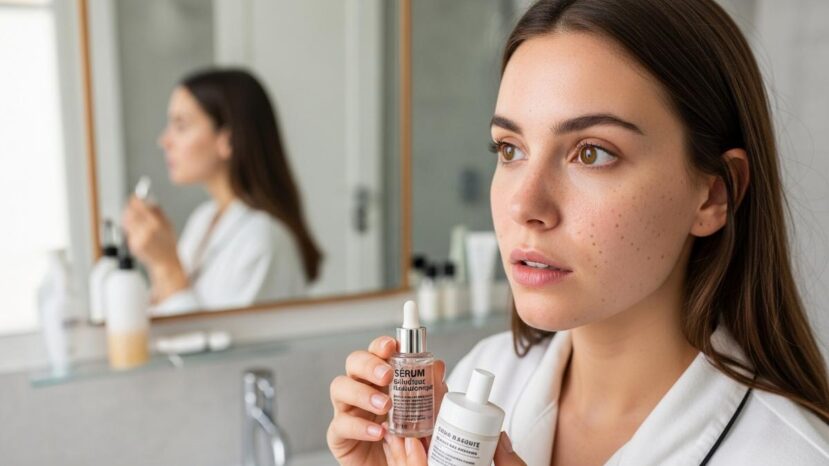
The serum comes next. A serum concentrated in active ingredients acts in depth where a cream alone is not enough. Hyaluronic acid adds water without adding oil, helping the skin to retain its own moisture. Layering serums with light, non-comedogenic textures remains an option for those who wish to combine several active ingredients.
Moisturizing oily skin is not a contradiction: it’s a necessity. Without the right moisturizing cream, the epidermis becomes dehydrated and compensates by producing more sebum. Opt for a light, mattifying texture. Silica, present in certain moisturizers, prevents untimely shine. Sun protection factor 50 concludes the morning routine. The sun temporarily dries out the skin, but triggers a more severe delayed acne flare-up and accelerates premature aging.
Complementary care, common mistakes and targeted active ingredients
Exfoliating once or twice a week removes dead cells that clog pores and promotes cell renewal. Choose acid exfoliants enriched with AHAs – such as glycolic or lactic acid – or BHAs such as salicylic acid, which are more effective at deeply unclogging pores. Enzymatic scrubs without grains are suitable for more reactive skin. On the other hand, an excessively scouring product may inflame the skin or cause overproduction of sebum.
A green clay mask, applied once or twice a week, absorbs excess sebum, eliminates impurities and tightens pores. Be careful: ten minutes or so is enough, and you should never let it dry completely to avoid irritating the epidermis. Vegetal charcoal complements clay with its detoxifying properties. After the mask, moisturizing immediately with a light cream or a few drops of jojoba oil remains essential.
Classic mistakes include: popping pimples can lead to long-lasting scarring, as bacteria on the fingers contaminate the skin directly. Stopping using moisturizers for fear of oiliness worsens dehydration and boosts sebum production. Excessive make-up coverage amplifies imperfections; a tinted mattifying cream is a much gentler alternative.
In terms of targeted active ingredients, niacinamide directly reduces sebaceous gland secretion and prevents pore dilation. Zinc, with its anti-inflammatory and antibacterial properties, inhibits the activity of reductase, the enzyme that stimulates sebum production.
Retinoids, derived from vitamin A, accelerate cell renewal. Azelaic acid regulates keratinization and inhibits the bacterium Propionibacterium acnes, often implicated in acne-prone epidermis.
Sarcosine and gluconolactone complete the picture, rebalancing excess sebum and tightening pores. Finally, organic burdock root detoxifies and regulates shiny areas thanks to its sebum-regulating and purifying properties.
Remember to adapt your routine according to the season: nourishing in winter, purifying in spring, protective in summer, revitalizing in autumn. A Tencel pillowcase, which absorbs excess sebum during the night, is a simple and often underestimated way to care for oily skin on a daily basis.