
Pierpaolo Piccioli revives Balenciaga’s City bag—first seen on Kate Moss 20 years ago—in emerald green and powder pink
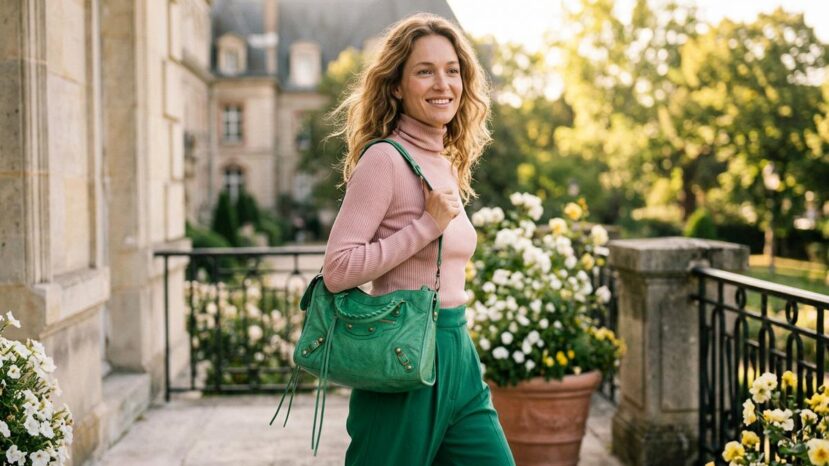


The City Bag has endured for more than twenty years without losing its iconic status. Yet it was in July 2026, on the runways of Paris Fashion Week, that Balenciaga gave it a new lease on life—and a stunning twist that no one really expected.
Two looks, a powerful statement at Paris Fashion Week
On July 8, 2026, Pierpaolo Piccioli presented his very first Fall/Winter 2026–2027 haute couture fashion show at the Cité internationale universitaire in Paris. Among the looks on the runway, two stand out beyond the dresses and luxurious fabrics.
In the first scene, the City bag appears in a vibrant green, paired with a silk turtleneck. In the second, Piccioli chooses a silvery metal shade, which he pairs with a delicate powder pink. Only two models carry this bag, as this limited number makes the gesture even more precise—almost surgical.
The Italian designer isn’t introducing the City bag for the first time with this collection. Variations of it had already been featured on the runway during the Spring/Summer 2026 show. Thus, the Fall/Winter 2026–2027 haute couture collection marks another milestone in the relationship between Piccioli and the house’s most historic accessory.
What These Two Versions Reveal About Piccioli’s Project
Choosing the City Bag for a haute couture fashion show is no small matter. Piccioli is sending a clear message: this accessory now belongs to Balenciaga’s most prestigious collection. After all, slipping it in between a silk piece and a powder-hued silhouette is a way of asserting that it has transcended its image as a 2000s city bag.
Furthermore, the combination of green-silk and silver-powder-pink represents a color palette that deliberately departs from the rock-inspired hues that had made the model famous. Piccioli reinterprets the design without betraying its essence—he keeps the studs and leather—but softens the overall look.
Nicolas Ghesquière, Kate Moss, and the Birth of an Unintended Phenomenon
To understand why this comeback is stirring up so much excitement, we need to go back to the origins of the City bag. Nicolas Ghesquière designed it, but he wasn’t the one who turned it into an icon. Originally, the design wasn’t meant to become a bestseller. It was supposed to remain in the brand’s archives.
It’s Kate Moss who’s changing everything. The most-photographed model of the 2000s has fallen under the spell of this leather bag, with its glossy finish and decorative studs. Her enthusiasm is such that the City bag has become an accessory that everyone is scrambling to get their hands on, far beyond the circles of Parisian haute couture.
Yet the brand hadn’t planned for this success. This kind of story—an item that takes on a life of its own and becomes a cult classic—is rare in the luxury industry. As a general rule, major brands methodically craft their iconic pieces. The City Bag, on the other hand, emerged from one woman’s sincere desire.
A legacy built on successive reinterpretations
After Nicolas Ghesquière’s departure, every creative director who succeeded him at the helm of Balenciaga has put their own spin on the City bag. Each has brought their own vision to it, because it is precisely this ability to reinvent itself that explains its longevity.
The model is therefore not merely a nostalgic object that is brought out from time to time. It serves as a creative playground, a fixed point around which each creative director develops their own signature style. Pierpaolo Piccioli thus follows in this tradition, offering his own interpretation.
- An original design by Nicolas Ghesquière, intended for the archives
- Made popular by Kate Moss in the 2000s
- Leather, glossy finishes, and studs as distinctive features
- Successive reinterpretations by the following artistic directors
- Designs by Pierpaolo Piccioli from the Spring/Summer 2026 fashion show
- Debut in haute couture at the Fall/Winter 2026–2027 fashion show
Why This Comeback Resonates So Strongly in 2026
2000s fashion has been making a strong comeback for several seasons now. As a result, the City bag is arriving at just the right time: it embodies both nostalgia for a romanticized decade and the demands of the present. For women who carried it back then, this comeback is quite moving.
For younger generations, however, it represents a collection steeped in history that they discover through the lens of a designer who is making his mark. Since his appointment at Balenciaga, Piccioli has been building a cohesive vision in which the house’s past enriches the present without freezing it in time.
Moreover, the choice of the Cité internationale universitaire de Paris as the venue for the fashion show is not without symbolism. After all, presenting haute couture in a space dedicated to students from around the world is also a statement of openness. In this context, the City bag takes on a new dimension: that of a Balenciaga accessory that transcends both time and purpose.
This iconic bag, born of a happy accident in the archives of a Parisian fashion house, proves that a fashion piece can stand the test of time without becoming outdated. Guided by Pierpaolo Piccioli’s vision, the brand reaffirms in 2026 that its finest days are still ahead.