
Fête de la Science 2026: IPGP opens its doors for free on 10 October in Paris
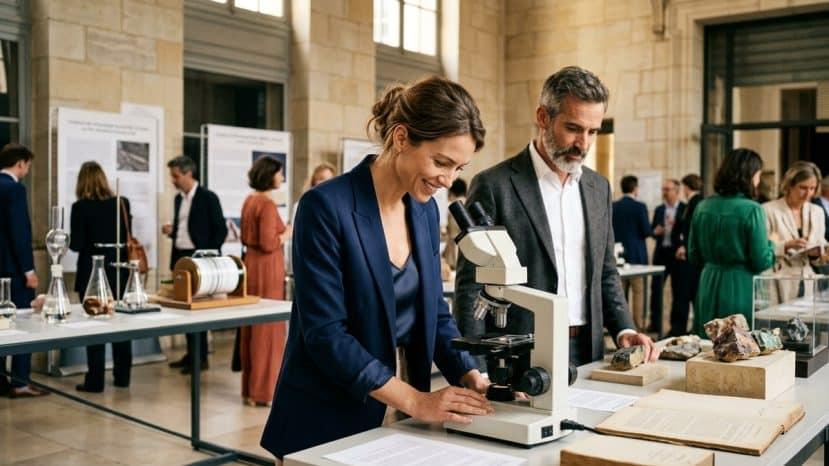


The Fête de la Science 2026 comes to Paris from 8 to 10 October, with a programme led by the Institut de physique du globe de Paris (IPGP). Université Paris Cité is throwing open the doors of one of France’s leading geoscience research centres, located at 1 rue Jussieu, in the 5th arrondissement. All activities are free of charge.
A science event open to everyone
Thursday 8 and Friday 9 October are reserved for school groups, by prior booking. On Saturday 10 October, from 10am to 6pm, the site welcomes the general public with no reservation required. Families, children, students and adults alike can engage directly with IPGP’s research teams.
This edition puts geosciences front and centre. The programme spans the Earth, other planets, the environment and natural phenomena. Visitors can take part in interactive workshops, attend talks, watch live demonstrations and meet researchers, with activities tailored to different age groups.
The goal is to make science genuinely accessible to everyone, so that anyone can better understand how scientists study earthquakes, volcanoes, oceans, climate change and even the origins of the solar system.
“IPGP brings together more than 500 researchers, engineers, teachers and technical staff, and its work focuses on the interior of the Earth and other planets, natural hazards, the functioning of the Earth system and the origins of our planet.”
IPGP: a world-class research institute
Founded in 1921, the Institut de physique du globe de Paris is affiliated with the CNRS and is a constituent institution of Université Paris Cité. Its research is organised around four major themes: Earth and Planetary Interiors, Natural Hazards, the Earth System, and Origins.
The institute also monitors the four active French overseas volcanoes, in Guadeloupe, Martinique, Réunion and Mayotte, and takes part in numerous international scientific missions.
- Earthquakes and major fault lines: simulation and global data
- Meteorites and the origins of planets more than 4.5 billion years ago
- Levitating magma oceans recreated in the laboratory
- Nanoparticles in tap water, explored through the nanoTAP project (CNRS Innovation)
- Virtual reality flights over Mars and Titan
The full workshop programme for 10 October
The workshop series titled “On the Trail of the Mystery Bone: a playful scientific investigation” unfolds in three consecutive acts. The first, “Comparative Anatomy”, invites visitors to identify a mystery bone through the lens of Georges Cuvier and 18th-century naturalist methods. The second, “Dating”, puts participants in Marie Curie’s shoes to explore isotopic dating and characterisation techniques. The third, “Palaeomagnetism and Palaeoenvironments”, is led by Frédéric Fluteau and grounds the investigation in contemporary geology.
The workshop “Oceans of Levitating Magma” invites visitors to recreate a miniature magma ocean in the lab. A specially designed device keeps a molten sphere suspended in mid-air using laser heating. This workshop runs from 10am to 5pm and is open to visitors aged 6 to 25.
Meanwhile, the workshop “Tracing the Origins of Planets through Meteorites” lets visitors aged 6 to 15 hold in their hands some of the oldest rocks in the solar system, including fragments of the Moon. And “Mountains: they really get to you!” uses boxes and sand to show how mountain ranges form, booking is recommended for this one.
Citizen science and virtual reality on the agenda
The interactive stand built around the nanoTAP project (CNRS Innovation) invites visitors to discover the nanoparticles lurking in their tap water. A true/false quiz, hands-on filter experiments and a wheel of elements (Fe, Cu, Pb…) make the experience tangible. Participants can also sign up as volunteers for the sampling campaign.
The workshop “Exploring the Solar System in Virtual Reality” is open to visitors aged 11 and over. It lets you fly over Titan’s hydrocarbon lakes, roam the dunes of Mars or listen to the Red Planet tremble, thanks to the SEIS seismometer from the InSight mission. This workshop runs from 10am to 6pm.
Everything you need to plan your visit to the Fête de la Science 2026
The event takes place at IPGP, at 1 rue Jussieu, 75005 Paris. The public open day is Saturday 10 October, with free entry from 10am to 6pm. Around 1,000 visitors are expected throughout the day, with between 10 and 15 workshops on offer.
The Fête de la Science 2026 at IPGP is designed for all ages, from 6 upwards. Some workshops, such as the mystery bone series, require participants to complete all three sequences in order. Booking is recommended for the mountain-building workshop.
The Fête de la Science 2026 is a rare chance to access the laboratories and researchers of one of France’s most respected geoscience institutes, completely free of charge. Talks on primordial oceans and the earliest traces of life on Earth round out a programme crafted to pass on a love of Earth sciences to every generation.