
Nivea cream and honey after 50: what this DIY face mask actually does for your skin
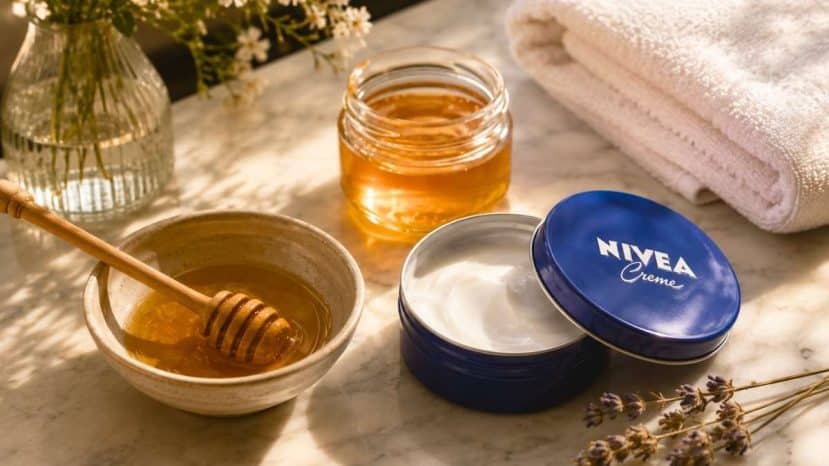


Mixing two everyday products to care for your skin after 50 sounds almost too simple to be true. Yet the combination of Nivea cream and honey has long circulated as an accessible home remedy. But what can you realistically expect from it, and just as importantly, what can you not?
What skin goes through after 50
With age, skin undergoes very specific changes. It tends to become drier and to lose its suppleness. This has a direct, visible consequence: dehydration lines become more pronounced, because skin that lacks moisture reflects light less effectively and looks more marked.
This is precisely the context in which a nourishing, hydrating treatment makes sense. Skin that is properly moisturised looks smoother, not because its deep structure has changed, but because hydration temporarily plumps it up. Understanding this distinction is essential before evaluating any beauty tip.
Why mixing Nivea and honey works on dryness
The Nivea cream, instantly recognisable in its blue tin, is first and foremost a rich moisturiser. Its formula helps limit water loss and keep skin supple. It is not an anti-ageing active in the clinical sense, but rather a shield against skin dehydration.
Honey, for its part, is well known in cosmetics for its humectant properties. In practical terms, it draws and retains water in the superficial layers of the skin. Combined with the blue cream, it therefore boosts the hydrating effect of the mixture. For dry skin, this duo can deliver a genuine boost of comfort.
Applied as a mask, this blend leaves skin softer and more supple. Some fine lines may then appear less noticeable, not because they have disappeared, but because the skin is better hydrated.
What this tip cannot do
It is important not to confuse a hydrating effect with an anti-wrinkle action. Neither classic Nivea cream nor honey is capable of making established wrinkles disappear. Equally, neither can reverse the mechanisms of skin ageing on its own.
The result rests on a simple principle: skin plumped with moisture temporarily looks smoother. But its deep structure remains unchanged. This is a fundamental distinction, and one that prevents unrealistic expectations from forming around this kind of home treatment.
- Nivea cream limits water loss and maintains skin suppleness.
- Honey draws and retains water in the superficial layers of the epidermis.
- Together, they form a nourishing mask suited to dry skin.
- The smoothing effect is temporary and linked to hydration, not anti-ageing action.
- This mixture does not alter the deep structure of the skin.
Where it fits in a skincare routine after 50
This DIY mask has a place in a beauty routine, provided it is seen for what it is: a nourishing treatment, not an anti-ageing one. For dry skin in search of a moment of comfort, it is a simple and accessible option.
That said, to act more directly on the signs of ageing, the evidence is clear: a well-adapted routine should include daily sun protection as well as actives whose efficacy on wrinkles is better documented. The Nivea-and-honey blend does not replace these steps; at best, it complements them.
The blue tin, launched over a century ago and passed down from generation to generation, therefore retains a very specific appeal in this context: offering dry skin a genuine comfort boost whenever the need arises. Nothing more, but nothing less either.