
Sun-bleaching your hair: the technique that lightens strands without chemicals
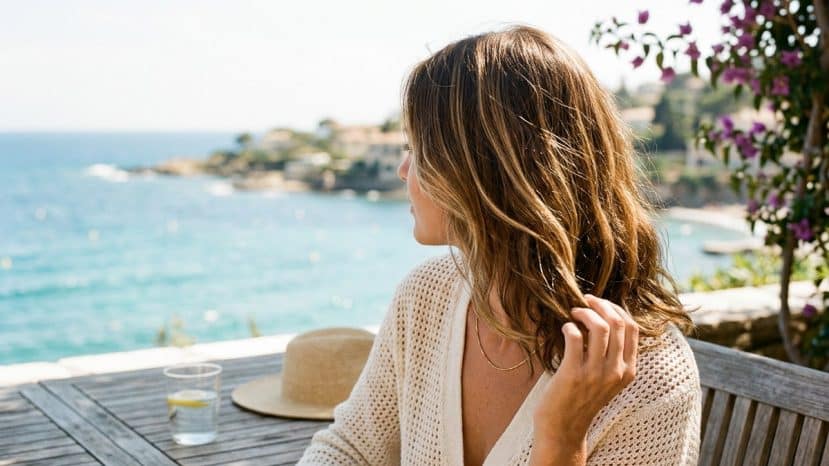


Every summer, many people notice their hair coming out lighter after a few weeks in the sun. Far from being a trivial observation, this phenomenon is rooted in a precise chemical mechanism that some have turned into a full-blown hair lightening technique. Before diving in, it’s worth understanding what is actually happening inside the hair fibre.
What the sun actually does to your hair
Behind that golden, sun-kissed look lies an oxidation reaction. Ultraviolet rays, and UVA rays in particular, break down the melanin present in the hair shaft. This pigment, responsible for hair colour, also acts as a natural sunscreen that shields hair proteins from light damage. By degrading it, the sun alters the hair’s ability to absorb light, producing the visible lightening effect.
At the same time, UVB rays attack keratin, the hair’s main structural protein. Keratin is what gives hair its strength and shine. As it gradually breaks down, the fibre is weakened from within, even if the visual result can seem appealing.
One essential point to keep in mind: this type of hair lightening is not reversible. Melanin destroyed by the sun does not regenerate, because the chemical reaction is permanent. Unlike a standard colour that grows out, sun-induced lightening stays until the hair has fully grown back.
Why lighter hair is more prone to sun-induced lightening
Not all hair types react the same way to sun exposure. Fair hair contains less black melanin and more orange-red melanin. This composition makes it more sensitive to UV-induced oxidation, and therefore more likely to lighten visibly.
Dark hair, on the other hand, benefits from a higher concentration of black melanin, which gives it greater resistance to photo-lightening. The effect is therefore far less dramatic on brown or black hair than on blonde or light brown hair.
The real risks of sun-induced hair lightening
The main appeal of this method lies in its natural quality: no chemicals are added, and the result blends seamlessly into the hair. Yet the consequences for hair health are real and should not be underestimated.
- The hair’s outer protective layer weakens under UV exposure.
- Hair becomes more vulnerable to the heat of styling tools.
- Swimming in salt water or chlorinated water worsens dryness.
- The fibre dries out, becomes brittle, and splits more easily.
- The scalp, left unprotected, risks sunburn, dehydration, and heatstroke.
In the most serious cases, repeated, unprotected exposure of the scalp to ultraviolet rays can encourage the development of skin cancers in this particularly vulnerable area. This risk directly concerns people who deliberately expose themselves without taking precautions.
How to protect your hair and scalp from the sun
If you want to prevent hair lightening, or simply preserve the vibrancy of an existing colour, practical solutions are available. The American Academy of Dermatology Association recommends using products specially formulated for hair, the parting, and the scalp, incorporating a UV protection factor. These products often come in the form of powders or mists, making them easy to apply without weighing the hair down.
A facial sunscreen can also be applied to the scalp, according to the same source. But the simplest protection remains wearing a hat, ideally UV-protective, or a scarf whenever you are outdoors. This basic step prevents rays from reaching the hair fibre directly and protects the scalp from sun damage.
For those who colour their hair, this precaution makes particular sense: UV rays accelerate the lightening of artificial tones and dull the result far more quickly than indoor conditions would. Protecting your hair from the sun is therefore also a way to extend the life of a colour crafted at the salon.