Solo-maxxing: the trend that’s romanticising single life and taking over social media
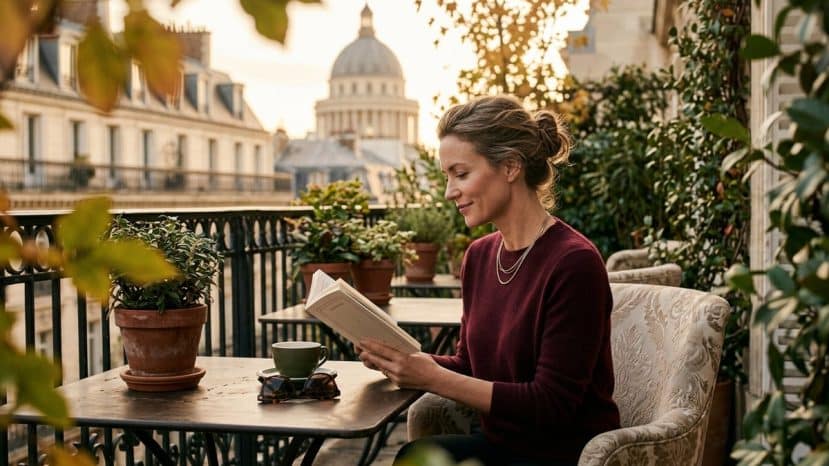


Have you ever spent a Saturday evening alone, running errands, coming home, slipping into your pyjamas and settling onto the sofa, without feeling the slightest sense of lack? What you were experiencing might just be called solo-maxxing, and you are far from the only one proudly owning it.
Choosing to live alone: what solo-maxxing really changes
The phenomenon describes a deliberate decision to stay single in order to devote your time and financial resources to yourself, rather than to a romantic relationship. It has nothing to do with a lack of love or a disinterest in life. It is more of an intentional recentring of your desires, away from the constraints that come with being in a couple.
Solo-maxxing sits within a broader vocabulary that attempts to name new romantic behaviours. Before it came along, ghosting described cutting off all contact without explanation, love bombing meant flooding someone with messages before vanishing, catfishing referred to deception through a fake profile, and orbiting described an ex who keeps creeping back into your daily life. Each of these words served the same purpose: giving a name to what you are going through, so you feel less alone in experiencing it.
Because that is precisely where the real stakes lie. Beatrice Di Lazzaro, psychologist and relationship counsellor, points out that Generation Z, having grown up with social media, has had few opportunities to develop an emotional culture around boredom and solitude. Finding a word is reassuring, it signals that this experience is not unique to you.
TikTok, the backstage of private life, and solo-maxxing as performance
What makes this phenomenon particularly striking is where it thrives. TikTok has become the natural home of this trend, and the numbers speak for themselves. Lana Isa, 24, a remote-working sales manager in Toronto, posted a video showing her evening routine: groceries, shower, pyjamas, sofa. The video racked up nearly 213,000 likes and 1.2 million views. She never anticipated such an impact.
Beatrice Di Lazzaro offers a valuable perspective on this paradox. She draws on the distinction sociologist Erving Goffman made between the front stage, the space of social performance, and the backstage, the private space. Today, that boundary has blurred: the stage has moved into the backstage. We show our bedrooms, our routines, our most intimate moments, to anyone who wants to watch. The question this raises is a concrete one: if even alone in your room you are still playing a role, is there any moment left where you are truly just with yourself?
On one hand, this staging responds to a need to aestheticise every experience. On the other, it betrays a need to verify that others are living the same thing, that they too are, just a little, sad.
When solitude becomes a product
Solo-maxxing is not simply a state of mind. It has given rise to an entire concrete lifestyle that the market has been quick to capitalise on. Eating alone, travelling alone, working from home, buying single-serving portions of food, single-serving portions of everything: these are all practices that sketch out a life organised around one person.
- Eating alone, without experiencing it as something to be ashamed of
- Travelling solo, turning the experience into a deliberate choice
- Working from home, away from imposed social interactions
- Buying single-serving portions, a reflection of a life calibrated for one
- Romanticising solitude, by giving it an aesthetic and a narrative
Beatrice Di Lazzaro sees the hand of capitalism at work here, having seized on affectivity itself. In her view, we are going through a reactive phase after decades of rigid models around coupledom, to the point where solitude itself has become a product to be consumed.
Dating apps and the paradox of infinite choice
This context also sheds light on our current relationship with dating apps. Beatrice Di Lazzaro compares them to supermarkets: faced with hundreds of available profiles, we convince ourselves there will always be a better one out there. The result is paradoxical. Rather than choosing, we prefer to remain without.
In 2025, the World Health Organization declared loneliness a public health priority, describing it as a genuine epidemic. Yet faced with this reality, part of society has chosen to rewrite the story of solitude, to romanticise it rather than endure it. Solo-maxxing is, in that sense, as much a cultural response as it is a symptom. And if, according to the psychologist, the one thing we truly need is a little lightness, this trend is a reminder that the question of whether we choose solitude out of necessity or out of genuine desire is one worth asking honestly.