Ferrari, Rolls-Royce, Porsche: These 7 electric cars are redefining automotive luxury in 2026


The luxury automotive sector is undergoing an unprecedented transformation. By 2026, luxury electric cars will no longer merely promise a green future—they will redefine what it means to drive an exceptional vehicle.
When Luxury Redefines Its Standards in the Electric Age
Long viewed as a constraint, electrification has now become a strategic priority for major automakers. The new generations of models aim to fully embody each brand’s DNA, going far beyond a mere display of technology.
As a result, driving experience, customization, and sustainability are emerging as new indicators of desirability. The prestige associated with the internal combustion engine is no longer the only factor that matters to buyers.
Furthermore, this trend affects both established players and new entrants alike. Brands such as Rolls-Royce and Ferrari now stand alongside challengers like Lucid and Lotus, each with its own unique vision of zero-emission luxury.
Rolls-Royce Spectre Series II and Ferrari Luce: Two Visions of Prestige Without an Internal Combustion Engine
With the Spectre Series II, Rolls-Royce is refining the first all-electric model in its history. The British brand is enhancing the range and performance of its grand tourer coupe, while staying true to its founding promise: the ultimate in driving fluidity.
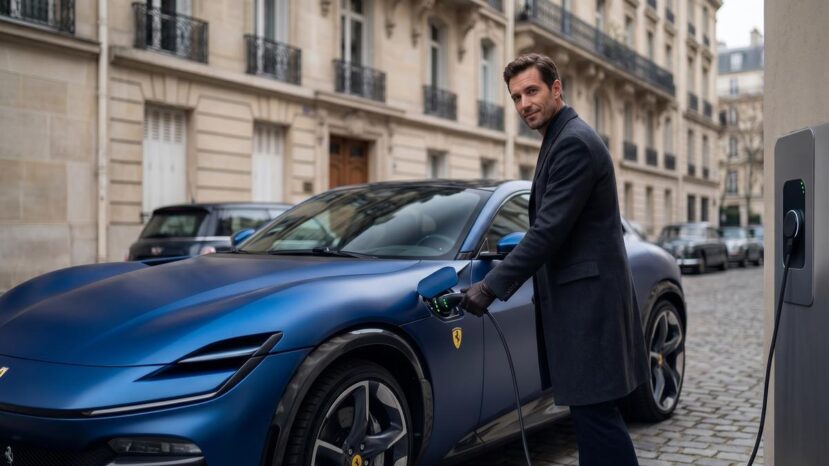
Ferrari, on the other hand, made the most symbolic move of the year. The Ferrari Luce, unveiled in May 2026, marks the Italian automaker’s official entry into the all-electric era. It produces 1,050 chevaux, features four independent electric motors, has a range of 531 km, and reaches a top speed of over 310 km/h.
“Luxury in the automotive industry is no longer defined solely by mechanical power or the prestige of the internal combustion engine.”
Models that push the boundaries of electric performance
The Porsche Taycan Turbo GT is the most powerful Taycan ever produced, with 1,108 chevaux. It has set several track records, including the fastest lap time at the Nürburgring for a production electric car.
Porsche thus demonstrates that electrification can support a brand’s sporting ambitions. Performance remains at the heart of the narrative, with no compromises whatsoever.
For its part, the Lotus Emeya, unveiled in 2023, marks a historic milestone for the British automaker: it is the company’s first sedan. Its engine can produce up to 918 chevaux, and it accelerates from 0 to 100 km/h in less than three seconds.
- Ferrari Luce: 1,050 ch, 4 electric motors, 531 km range, over 310 km/h
- Porsche Taycan Turbo GT: 1,108 ch, Nürburgring record for a production electric car
- Lotus Emeya: 918 ch, 0 to 100 km/h in under 3 seconds, the first Lotus sedan
- Lucid Air Sapphire: over 1,200 ch, estimated range of approximately 687 km
- Bentley Electric SUV: Bentley’s first 100% electric vehicle, set to be unveiled in late 2026
Lucid Air Sapphire and Jaguar Type 00: The Ambitions of the Underdogs
Although still relatively unknown to the general European public, the American automaker Lucid is establishing itself as one of the most ambitious players in the segment. The Lucid Air Sapphire, which has been on the market since 2021, boasts more than 1,200 chevaux and an estimated range of about 687 km—among the highest in its class.
For its part, the Jaguar Type 00 is more of a statement than a mere concept car. With its spectacular proportions and a design that is radically different from the brand’s historic models, it foreshadows the British automaker’s next generation of electric cars.
Bentley, Lamborghini: Two Opposing Strategies on Electrification
Bentley’s upcoming electric SUV plays a central role in the automaker’s transformation strategy. Its launch has been postponed several times, but the brand now expects to unveil it by the end of 2026. A prototype was also spotted at the Nürburgring racetrack.
Lamborghini, on the other hand, has decided to slow down its shift toward electric vehicles. The Italian automaker has shelved its plans for its first all-electric car —originally expected by 2028—and prefers to continue pursuing its hybrid strategy. It believes that demand for zero-emission supercars remains limited among its customer base.
This decision highlights the ongoing tensions in the industry. Not all luxury automakers are moving at the same pace or share the same conviction regarding the transition to electric vehicles.
The luxury automotive landscape is thus taking shape along two distinct paths: on one side, brands that are using electric vehicles as a means to express their identity; on the other, players who are cautiously choosing to wait. One thing is certain: with each new model, luxury electric cars are redefining what “luxury” means behind the wheel.