Matthieu Blazy reinvents the Chanel two-tone pump for his very first collection
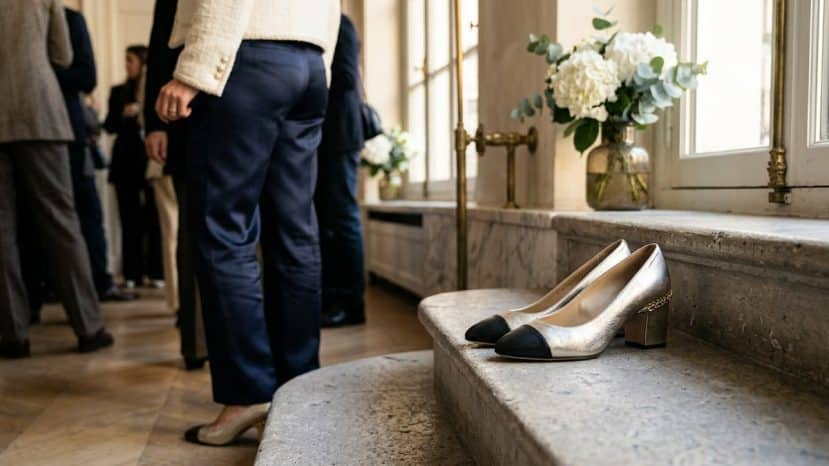


The Chanel two-tone pump is one of the most recognisable shoes in the world. Timeless, it has crossed decades without ever losing its allure. For his very first spring-summer 2026 ready-to-wear collection, Matthieu Blazy revisits it with a freedom that recalls the spirit of Gabrielle Chanel herself.
A passion for two-tone long before 1957
Gabrielle Chanel had a taste for two-tone shoes for many years before making them a signature of her house. In the 1920s and 1930s, she would appear in Paris or Biarritz wearing very British two-tone heeled shoes, combining delicate ankle straps with floral toe caps.
Later, it was beige wedge espadrilles with a black toe that she wore on the beach at the Lido in Venice. By her side was her close friend, the star dancer of the Ballets Russes, Serge Lifar. This was in 1937, twenty years before the official launch of her iconic shoe.
The two-tone, then, was not born of a sudden flash of inspiration. It was the result of a long reflection on comfort, elegance, and the practicalities of everyday life.
1957: the foundations of an icon
Gabrielle Chanel only laid the foundations of her two-tone pump in 1957. At the time, women’s shoes were monochrome and matched to the colours of their outfits. The designer changed everything.
Inspired, according to legend, by the two-tone shoes worn by the crew of her friend the Duke of Westminster’s yacht, she conceived a style with a small 5-centimetre square heel, held in place by a slingback strap. This shoe was designed to take a woman elegantly from morning through to an evening cocktail. Its contrasting black toe cap was also conceived to withstand the unpredictability of the weather and the wear of city walking.
It was the cobbler Massaro, already a creator of two-tone shoes for men, who crafted the first prototype of what would become a cult shoe.
“It is the most modern shoe and it makes legs look beautiful.” Karl Lagerfeld
Karl Lagerfeld and the passing of a legacy
Karl Lagerfeld, Gabrielle Chanel’s successor at the creative helm of the house, saw in this shoe an absolute modernity. His quote on the subject remains one of the most celebrated.
He also brought the two-tone back to the fore at the autumn-winter 2015-2016 show. This gesture confirmed the central place of the shoe within the house’s identity, well beyond the era in which it was created.
Every creative director who has followed Gabrielle Chanel has therefore been faced with this very precise legacy. The two-tone is not simply a shoe: it is a statement of style.
- Created in 1957 by Gabrielle Chanel with cobbler Massaro
- 5-centimetre square heel, held in place by a slingback strap
- Contrasting black toe cap designed for city walking and unpredictable weather
- Brought back to the fore by Karl Lagerfeld at the autumn-winter 2015-2016 show
- Revisited by Matthieu Blazy for the spring-summer 2026 collection
The two-tone slingback according to Matthieu Blazy
For his first collection, Matthieu Blazy plays with the proportions of accessories. He revisits the two-tone slingback, known the world over as the two-tone pump. He raises the vamp higher over the instep for an almond-shaped throat, refines the heel, and narrows the contrasting toe cap, tapering it as though it had been delicately dipped in colour.
The silhouette of the shoe gains lightness without betraying its DNA. Other pumps and heeled mules with square toes, alongside loafers, punctuate the 77 looks of the collection in the same two-tone spirit.
An icon carried towards new horizons
Matthieu Blazy’s spring-summer 2026 collection inhabits a world where refinement and naturalness go hand in hand. The two-tone finds a new lease of life within it, without disowning the founding choices made by Gabrielle Chanel and Massaro in 1957.
Yet the new creative director’s hand is unmistakable in every reworked detail: the almond-shaped throat, the refined heel, the tapered toe cap. These subtle adjustments give the shoe a more contemporary feel while preserving its instantly recognisable character.
In doing so, the two-tone proves once again its ability to transcend the ages. Season after season, it remains one of the house’s most powerful signatures.